





For distributors, agents, and channel partners expanding across borders, technical barriers often appear long before products reach the shelf. From labeling and packaging rules to safety documentation and product testing, small compliance gaps can delay shipments, raise costs, and weaken trust. Fixing these issues early is essential to protecting margins, accelerating market entry, and building a stronger export strategy in increasingly regulated global markets.
Why a checklist approach works better for technical barriers in export markets
For most distributors and agents, technical barriers are not one single problem. They are a chain of small decisions across packaging, hardware, documentation, product claims, and market entry timing. In cross-border trade, one missing label file or one outdated test report can hold a shipment for 2 to 8 weeks, even when the product itself is commercially ready.
A checklist method helps because export compliance is usually fragmented across sourcing teams, factories, freight partners, and local importers. In industrial finishing, auxiliary hardware, and commercial essentials, this fragmentation becomes more serious when a product combines coated surfaces, mechanical parts, electrical elements, and retail packaging in the same shipment.
For channel partners, the practical goal is not to become regulatory experts in every country. The goal is to identify the 20% of compliance items that prevent 80% of avoidable delays. That is why early review of technical barriers should focus on a short list of decision points before sampling, before bulk production, and again 7 to 14 days before shipment booking.
What to confirm before you commit inventory
Before placing volume orders, distributors should confirm whether the target market treats the item as a general commercial product, a regulated consumer product, or a product with special material, energy, or safety requirements. This first classification often determines whether technical barriers stay manageable or become expensive later.
- Check whether the product category requires pre-market testing, importer registration, or only document retention.
- Confirm if packaging, coating materials, adhesives, or electromechanical parts trigger separate requirements from the main product body.
- Verify whether local language labeling is mandatory at customs stage, retail stage, or both.
- Review whether distributor branding changes legal responsibility for product claims or traceability.
This first-screen review can usually be completed in 3 to 5 working days if the supplier has basic specifications ready. If those files are missing, technical barriers are already forming, even before a formal compliance review begins.
Core checklist: the compliance gaps that should be fixed first
When distributors assess technical barriers, the fastest wins usually come from correcting repeat issues rather than solving rare legal edge cases. In export practice, the same compliance gaps appear across furniture fittings, packaging-related goods, coated accessories, and small electromechanical essentials. The table below can be used as a first-pass audit tool.
This checklist shows why technical barriers are often documentation barriers first. The product may function well, but if the packaging artwork, declarations, and reports do not align at SKU level, the channel absorbs the operational cost. In many projects, correcting these four areas early can reduce avoidable launch friction within one sales cycle.
Priority order for distributors and agents
Not every issue carries the same urgency. A practical method is to sort technical barriers by how quickly they block booking, customs clearance, shelf entry, or claims defense. This is especially useful when you are managing 10 to 50 active SKUs across multiple suppliers.
First priority: market-entry blockers
- Mandatory safety documents not available before shipment.
- Labeling that does not match the importer or target market language requirements.
- Product descriptions on invoice, packaging, and test report that do not match each other.
Second priority: cost and margin leakage
- Incorrect packaging claims that require relabeling after arrival.
- Material declarations missing from tier-2 suppliers, causing last-minute sampling and retesting.
- Manuals and insert sheets prepared too late, leading to split shipments or delayed cartons.
In channel operations, the first priority should be addressed at least 30 days before estimated shipment date. The second priority should be closed before packaging approval, because relabeling after production often costs more than correcting artwork during prepress review.
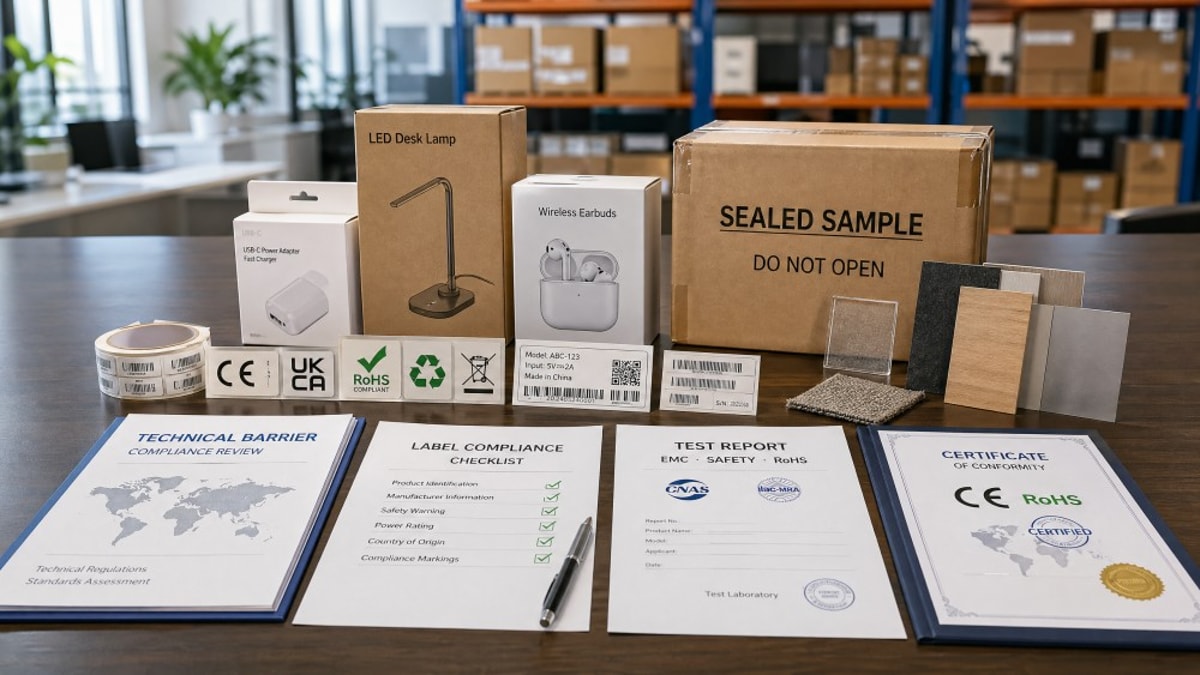
Scenario-based checks: where technical barriers differ by product type
Technical barriers do not affect all product groups in the same way. For industrial finishing and commercial essentials, distributors often handle mixed portfolios: decorative hardware, coated components, packaging-linked items, and compact electromechanical goods. Each group creates different risk patterns, so the checklist should be adjusted by scenario.
A coated handle, for example, may appear simple, but the finish chemistry, surface durability claims, and packaging disposal marks can all matter. A small motorized accessory may face more scrutiny on electrical safety and energy-related documentation. A premium packaged item may face stronger review on recyclability claims and language accuracy than on mechanical performance.
The objective is to identify which part of the product creates the highest compliance burden: the material, the function, the energy use, the consumer-facing claim, or the packaging system. This helps distributors allocate review time in the first 1 to 2 weeks of onboarding.
Quick comparison by export scenario
Use the following comparison to decide where to focus your early technical barriers review. This is not a legal classification table, but it is a practical planning tool for channel partners handling mixed inventories.
The key takeaway is that technical barriers should be managed according to the compliance driver, not only the product name. Two items in the same shipment can require very different preparation paths. Distributors that group reviews by risk driver usually make faster decisions on stocking, bundling, and rebranding.
Common blind spots that raise cost later
Many export teams think technical barriers are under control because a supplier says the product is “tested” or “for export.” In practice, the blind spots usually sit in version control, supplier change management, and claim consistency. These are not dramatic failures, but they create repeated leakage across customs, warehousing, and customer service.
One common issue is file mismatch. The test report may show one item code, the carton another, and the commercial invoice a shortened generic description. Another issue is silent material substitution. If a coating, resin, insert, or wire specification changes after the original report, the old file may no longer support the product now being shipped.
A third blind spot is overstated sustainability language. Terms such as recyclable, eco-friendly, reduced plastic, or low-energy should only be used when the claim can be reasonably supported in the target market context. This is increasingly important in sectors where packaging aesthetics and functional finishing are part of the product value story.
Blind-spot warning list for channel partners
- Do not rely on a report older than the current product configuration without checking bill of materials alignment.
- Do not assume one document covers all regional SKUs if warnings, language, or power specifications differ.
- Do not approve packaging text based only on design review; legal wording and disposal marks often need a separate check.
- Do not overlook spare labels, instruction leaflets, or master carton marks, because customs and retail compliance may assess all three levels.
- Do not wait until the booking stage to ask for declarations from sub-suppliers; 5 to 10 business days can disappear quickly.
A practical risk threshold
If more than 3 critical files are still pending within 14 days of shipment, the project is already in a high-risk zone. At that point, the chance of relabeling, split delivery, or customs clarification rises sharply. For distributors working on seasonal programs or promotional launches, that timing risk can matter more than the direct compliance cost itself.
Execution plan: how to fix technical barriers early and systematically
The most effective response to technical barriers is to build a repeatable pre-shipment review path. This does not need to be overly complex. For many channel businesses, a 4-stage process is enough: product classification, document collection, artwork verification, and final shipment consistency check. The value comes from timing and ownership, not bureaucracy.
In industrial finishing and commercial essentials, the earlier you connect technical and commercial reviews, the better the outcome. A buyer may focus on price and lead time, while a packaging manager focuses on branding, and the factory focuses on production release. Technical barriers appear when these teams work in sequence rather than in parallel.
A disciplined process can shorten response time by 1 to 3 weeks over a full program, especially when multiple SKUs share common materials or packaging formats. It also improves your ability to compare suppliers on real export readiness, not only on quoted cost.
Recommended early-action workflow
- Week 1: classify the product by material, function, end-use, and destination market.
- Week 1 to 2: collect core files, including specifications, declarations, test references, packaging artwork, and user instructions.
- Week 2 to 3: run a consistency review across SKU code, model name, voltage or material statements, origin marking, and importer details.
- Before production release: lock approved artwork and document versions, then record change-control responsibility.
- 7 to 14 days before shipment: verify that the packed goods still match the approved documents and labels.
What information to request from suppliers first
If you need to move quickly, start with six items: product specification sheet, bill of materials summary, packaging layout, draft labels, existing test references, and a declaration of any recent material or component change. These six files often reveal the majority of technical barriers before money is committed to full production.
For distributors handling private label or channel-exclusive versions, add one more step: confirm who owns compliance maintenance after branding changes. In many export projects, this is where responsibility becomes unclear, especially when the manufacturer provides a base report but the distributor changes packaging claims or importer identity.
Why choose us for export compliance intelligence and market-ready product planning
At GIFE, we focus on the practical junction where finishing quality, packaging expression, electromechanical function, and export readiness meet. That perspective matters for distributors and agents because technical barriers often emerge at the interface between product details and market documentation, not in one isolated file.
Our Strategic Intelligence Center tracks the operational signals that affect channel decisions, from environmental packaging expectations to evolving documentation needs in hardware and commercial essentials. This helps partners identify risk earlier, compare sourcing options more clearly, and prepare products for international circulation with fewer avoidable revisions.
If you are evaluating new suppliers, entering a new export market, or cleaning up recurring technical barriers in your portfolio, we can support the early-stage questions that matter most. You can contact us to discuss parameter confirmation, product selection, packaging and labeling review, delivery cycle planning, certification-related preparation, sample support, and quotation coordination for market-ready programs.
For channel partners, the best next step is to prepare a short file pack before the conversation: target market, product category, current specification sheet, packaging draft, and expected shipment window. With those inputs, it becomes much easier to identify which compliance gaps should be fixed first and where technical barriers are most likely to slow your launch.
Related News
- 00
0000-00
Electromechanical Engineers Consulting for Faster System Integration - 00
0000-00
Sustainable Packaging Solutions: What Works at Scale and What Fails - 00
0000-00
Global Value Chain Management Mistakes That Raise Export Risk - 00
0000-00
Industrial Finishing Technology Trends to Watch in 2026 - 00
0000-00
Industrial Production Efficiency Fixes That Do Not Require New Lines
Weekly Insights
Stay ahead with our curated technology reports delivered every Monday.