





Eco-materials are gaining attention in packaging, but real-world performance matters more than labels. For operators and end users, the key question is simple: which options resist moisture, pressure, transport stress, and daily handling without raising costs or slowing workflows? This article explores practical eco-materials choices that balance durability, usability, and sustainability in actual industrial and commercial use.
What do operators really mean when they ask whether eco-materials “hold up”?
In packaging, “holding up” rarely means one single property. For operators in warehousing, production, dispatch, retail backrooms, and light industrial use, it usually means a package can survive at least 3 to 5 handling stages without tearing, collapsing, leaking, or slowing packing speed. Eco-materials are often promoted for reduced plastic content or renewable feedstock, but practical performance depends on structure, coating, thickness, storage conditions, and the product inside.
That is why eco-materials should be judged by use conditions rather than by claims alone. A molded fiber insert may perform well for dry consumer goods but struggle in high-humidity export storage. A paper mailer may be enough for soft goods under 2 kg, yet fail for sharp-edged hardware. In real operations, users often compare eco-materials through four filters: compression strength, moisture resistance, machinability, and damage rate during transport.
For a platform such as GIFE, which observes industrial finishing, auxiliary hardware, and packaging essentials, the last stage of production is where material theory meets operational reality. Packaging is not only a sustainability decision; it is also a finishing decision that affects presentation, handling, shelf readiness, and claim rates. In many sectors, even a 1% to 3% increase in damage or repacking can erase the expected environmental or cost benefit.
Which practical checks matter most?
- Can the package keep shape during stacking for 24 to 72 hours in normal warehouse conditions?
- Does it maintain closure performance after repeated handling, typically 5 to 20 touchpoints from packing line to end use?
- Will humidity, oil, dust, or temperature swings reduce performance within the planned logistics cycle?
- Can operators assemble, seal, label, and open it without extra tools or slower line speed?
- Does the material fit existing carton erectors, sealers, or hand-packing workflows?
These checks turn eco-materials from a branding topic into a decision framework. For users and operators, a material is only “better” if it supports reliable use at the expected volume, whether that volume is 500 packs per week or 50,000 units per month.
Which eco-materials are most common in packaging, and where do they perform well?
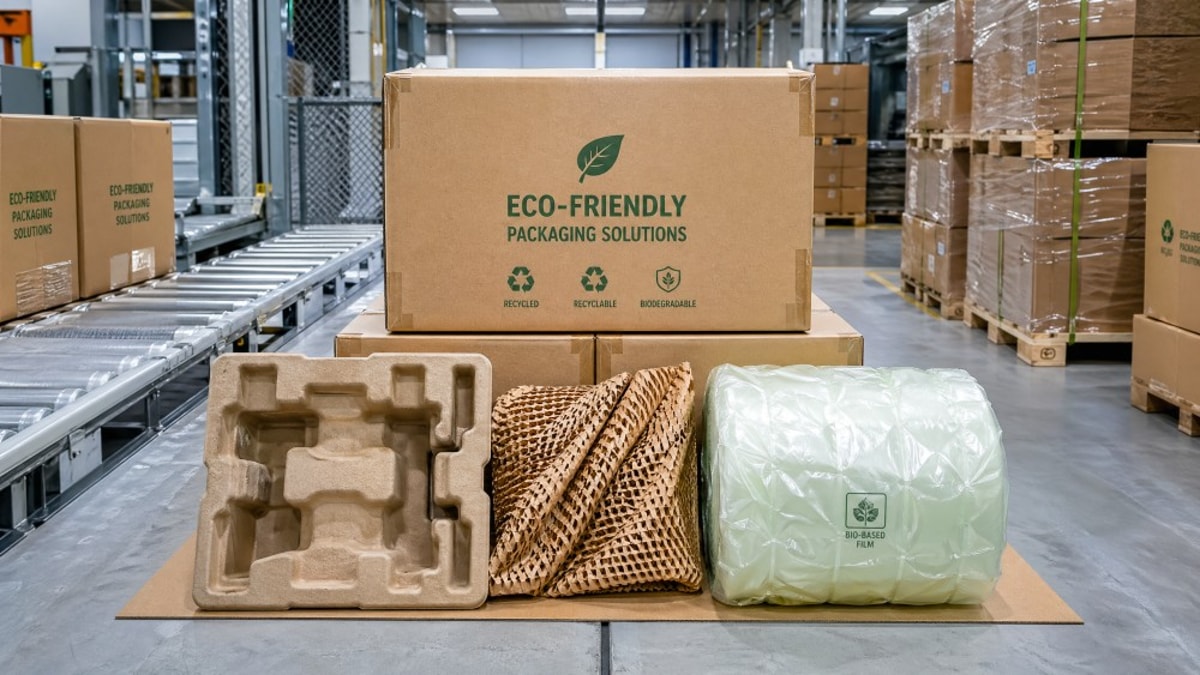
The most widely used eco-materials in practical packaging today include recycled corrugated board, molded fiber, kraft paper formats, paper-based cushioning, bio-based films, and reusable textile or rigid transit solutions. They do not solve the same problem. Some are best for visual presentation and low-weight transport, while others are chosen for cushioning, stack strength, or refill loops lasting 20 to 100 cycles.
A common mistake is to compare materials only by material family. In actual use, flute profile, basis weight, coating level, insert geometry, closure design, and fill ratio all influence performance. For example, recycled corrugated can be highly effective when board grade and box design are matched to the load, while a low-grade box with an attractive eco claim may fail under corner compression or long-distance pallet stacking.
The comparison below helps operators understand where common eco-materials typically fit. It is not a laboratory ranking; it is a field-oriented view based on normal industrial and commercial handling conditions.
For many users, recycled corrugated and molded fiber remain the most practical eco-materials for mainstream packaging because they integrate relatively well into current converting, labeling, and shipping systems. However, if the product faces humid storage, export transit of 2 to 6 weeks, or repeated impacts, then protective design matters more than sustainability messaging alone.
Are reusable formats part of the eco-materials discussion?
Yes, especially in B2B circulation. Reusable totes, textile sleeves, and rigid returnable containers can outperform one-way eco-materials when the return loop is stable and loss rates stay low. In many industrial environments, a reusable pack begins to make sense when the same item ships repeatedly on fixed routes and completes at least 20 cycles before replacement.
Still, returnable packaging is operationally demanding. It needs reverse logistics, cleaning standards, storage space, and tracking discipline. For that reason, it is often more suitable for internal plant transfers, regional supplier networks, or closed-loop component movement than for fragmented e-commerce distribution.
How can you compare eco-materials for moisture, pressure, and transport stress?
Operators often need a fast way to compare options before lab testing or pilot runs. The most useful approach is to separate three stresses: environmental exposure, structural load, and handling shock. Moisture affects paper-heavy eco-materials first. Compression affects stackability during storage and transport. Shock affects corners, closures, inserts, and surface finish during manual or automated movement.
A package moving only 50 km in a dry local network can tolerate different eco-materials than one moving across ports and warehouses over 30 to 45 days. Likewise, a premium finished component with scratch-sensitive surfaces will need different internal protection from a low-risk consumable. The answer is not simply “paper versus plastic,” but “which eco-materials system matches the risk profile?”
The matrix below offers a practical comparison for typical industrial and commercial use. It helps users identify where extra coatings, liners, or structural reinforcements may be necessary.
The key lesson is that eco-materials often need system design, not one-to-one substitution. If a plastic insert is removed, the outer box may need stronger board, a tighter fit, or a better divider design. If a film layer is reduced, closure integrity and moisture control must be checked again. A material change without structural redesign can create hidden failure points.
A quick stress-check sequence for operators
- Define product weight band, such as under 1 kg, 1 to 5 kg, or above 5 kg.
- Map the logistics cycle, including storage duration, climate exposure, and handling count.
- Identify the main failure mode: crushing, puncture, moisture, scuffing, or opening failure.
- Trial at least 2 to 3 eco-materials structures, not just different materials.
- Measure operator speed, pack-out consistency, and damage observations over a pilot batch.
This sequence is especially valuable in mixed industries where products vary from decorative goods to hardware, office components, and electromechanical accessories. It keeps the evaluation practical and reduces the risk of selecting eco-materials for appearance rather than performance.
What are the most common mistakes when switching to eco-materials?
The first mistake is assuming that “recyclable” means “fit for all uses.” Many eco-materials are effective within a defined range, but not across every climate, weight, or handling mode. A fiber solution that works for retail shelf packs may underperform in export pallets. A paper tape closure may be excellent on clean corrugated surfaces but less reliable when dust, low temperature, or high-speed application are involved.
The second mistake is evaluating only material cost per unit. In real operations, the more meaningful figure is total pack cost per delivered unit, including packing time, void-fill usage, line stoppages, dimensional weight, returns, and repacking. An eco-material with a unit price 8% lower can still raise total cost if it increases cube size or slows packing by 10 to 15 seconds per order.
The third mistake is ignoring finishing and presentation. In sectors where premium appearance matters, surface feel, print clarity, edge finish, and opening experience influence perceived quality. GIFE’s perspective on the “final stage” is relevant here: packaging is part protection, part operational tool, and part finishing layer. Eco-materials should support all three roles where possible.
Which warning signs should users watch during trial runs?
- Boxes bowing or softening after 24 hours in humid storage.
- Insert movement causing scratches on finished surfaces or plated parts.
- Higher tape use, extra manual reinforcement, or closure failures at dispatch.
- Operators needing retraining because fold sequence or pack-out logic is unclear.
- Visible increase in dimensional weight due to bulkier cushioning design.
When these signs appear, the solution is often redesign rather than abandonment. A stronger flute, a better die-cut fit, a moisture-tolerant outer wrap, or a revised pallet pattern can improve eco-materials performance without returning to conventional plastics.
How should buyers and operators evaluate cost, supply, and implementation time?
Cost decisions around eco-materials should be made across three layers: material cost, operational cost, and risk cost. Material cost covers board, fiber, film, or converted format. Operational cost includes line speed, labor, storage footprint, and compatibility with current equipment. Risk cost includes product damage, customer complaints, rejected shipments, and supply instability during peak demand periods.
Implementation time also varies more than many teams expect. A straightforward switch from one corrugated format to another may move in 2 to 4 weeks if tooling changes are minimal. A molded fiber insert project with fit checks, transport trials, and pack-line adjustments may take 4 to 10 weeks. If multiple SKUs, export routes, or compliance reviews are involved, timelines can extend further.
Supply continuity matters because some eco-materials categories have stronger regional availability than others. Recycled corrugated is broadly established in many markets, while niche bio-based films or custom molded formats can have longer lead times, especially for custom tooling, seasonal demand spikes, or imported feedstocks.
What should be confirmed before purchase approval?
Before approving eco-materials, teams should confirm at least six items: product weight range, fragility level, storage climate, transport duration, line compatibility, and disposal route at destination. If even one of these is unclear, the selected packaging may perform well in one node but fail in another. This is especially important for products with coated, polished, or precision-finished surfaces.
The table below summarizes a practical pre-purchase checklist for users and operators. It is useful for internal reviews, supplier discussions, and pilot planning.
This checklist shows why eco-materials selection is not only a sourcing task. It is a coordination task across packaging, production, logistics, and commercial teams. Decisions are stronger when users who actually pack, move, and open the products are involved early in the review.
Which eco-materials choices are usually the safest starting point for real-world use?
For many companies, the safest starting point is not a full packaging overhaul. It is usually a phased move: first optimize corrugated structure, then replace internal plastic components with molded fiber or paper cushioning where risk is manageable, and only then review specialty films or reusable systems. This staged approach reduces disruption and produces more reliable learning within one or two procurement cycles.
If the product is dry, moderately robust, and shipped in standard parcel or pallet networks, improved corrugated plus paper-based cushioning is often the most balanced eco-materials route. If the product has a shaped geometry and needs item-level retention, molded fiber is often worth testing. If moisture barrier is critical, teams should move carefully and compare hybrid solutions rather than forcing a paper-only design too early.
The best option is the one that protects the product, fits the workflow, and supports the sustainability target without hidden operational cost. In many cases, that means accepting a mixed-material transition period while performance data is gathered over 2 to 3 pilot batches.
Why choose us for guidance on eco-materials and packaging decisions?
GIFE focuses on the final stage where packaging aesthetics, hardware protection, industrial finishing, and commercial practicality meet. That perspective is useful when eco-materials must serve more than one purpose: they need to travel well, present well, and work within real operating limits. Our intelligence-led approach helps manufacturers and users compare options with attention to materials, workflows, and market expectations rather than trend language alone.
If you need support, we can help you clarify packaging parameters, shortlist eco-materials for specific load and climate conditions, review implementation timelines, compare protective structures, and discuss custom solutions for premium or industrial goods. We can also help frame questions around sample evaluation, delivery cycles, compatibility with existing packing processes, and practical quote discussions.
Contact us if you want to move from general interest in eco-materials to a workable packaging decision. A useful first conversation usually covers product dimensions, weight range, transport route, moisture exposure, target cost band, required finish level, and whether you need samples, structural recommendations, or a phased substitution plan.
Related News
- 00
0000-00
Electromechanical Engineers Consulting for Faster System Integration - 00
0000-00
Sustainable Packaging Solutions: What Works at Scale and What Fails - 00
0000-00
Global Value Chain Management Mistakes That Raise Export Risk - 00
0000-00
Industrial Finishing Technology Trends to Watch in 2026 - 00
0000-00
Industrial Production Efficiency Fixes That Do Not Require New Lines
Weekly Insights
Stay ahead with our curated technology reports delivered every Monday.