





As 2026 approaches, finance leaders can no longer assess eco-materials for sustainable packaging on purchase price alone. Cost gaps are shifting under the pressure of carbon rules, resin volatility, freight changes, and customer premium expectations. For budget approvers, the real question is not whether sustainable packaging costs more, but which material choices reduce long-term risk, protect margins, and create measurable commercial value.
Why scenario-based cost review matters more in 2026
For companies buying cartons, mailers, molded fiber inserts, compostable films, or recycled-content protective formats, the cost discussion around eco-materials for sustainable packaging is no longer universal. A food exporter, a luxury goods brand, an industrial parts supplier, and a high-volume e-commerce operator may all request “sustainable” packaging, yet their financial exposure is different across shelf life, damage rate, freight density, compliance burden, and customer tolerance for visible material variation.
In practical approval cycles, most finance teams review 3 to 5 variables first: unit material cost, transport impact, conversion efficiency, compliance risk, and expected sales effect. In 2026, these variables are likely to widen rather than narrow. Virgin resin prices can swing within a quarter, paper grades may shift with energy and pulp inputs, and some low-plastic formats may need secondary investment in equipment settings, sealing validation, or moisture control. That means a cheaper line item can still create a higher total cost over 12 to 24 months.
This is where a scenario-based approach helps financial approvers. Instead of asking whether eco-materials for sustainable packaging are expensive in general, the better question is where the cost gap creates strategic return and where it destroys value. Some materials generate margin protection by reducing tariff sensitivity or improving brand acceptance. Others add cost in applications where performance failure, pack-out inefficiency, or low recovery infrastructure offset the sustainability story.
Four cost lenses finance teams should apply
- Short-cycle purchase price: the visible gap per unit, case, or thousand pieces over the next 1 to 2 quarters.
- Operational conversion cost: sealing speed, reject rate, downtime, warehouse cube use, and labor handling differences.
- Risk-adjusted cost: exposure to regulation, retailer requirements, EPR-style fees, and customer claims tied to pack quality.
- Commercial value capture: premium positioning, contract retention, and buyer preference in tenders that increasingly score packaging sustainability.
For a broad industrial audience, this framework is especially useful because eco-materials for sustainable packaging sit at the intersection of finishing quality, essential component choice, and market intelligence. GIFE’s perspective is that packaging is not a cosmetic afterthought. It is part of the “final stage” value equation, where aesthetics, compliance, mechanical protection, and cost discipline all meet.
Three common application scenarios where cost gaps behave differently
The same sustainable material can be attractive in one business model and financially weak in another. Finance approvers should therefore map eco-materials for sustainable packaging by usage scenario before comparing quotations. The table below outlines three common situations seen across industries, from consumer goods and office products to industrial accessories and premium finished components.
The key lesson is that cost gaps are not static. In e-commerce, lighter or more dimensional-efficient formats may offset a 3% to 8% higher material spend. In premium retail, visual storytelling and perceived quality can justify a margin recovery path. In industrial shipping, however, CFOs usually need stronger proof because one damaged electromechanical component or finished hardware set can outweigh savings from a lower-cost eco substitution.
Scenario 1: High-volume e-commerce and direct-to-consumer fulfillment
This is the most volume-sensitive environment for eco-materials for sustainable packaging. Mailers, corrugated formats, recycled paper void fill, and plastic-reduced protective systems often look attractive because they align with customer expectations and can reduce packaging complexity. Yet the finance view must extend beyond the piece price. In fulfillment models shipping 50,000 to 500,000 units per month, a few grams of weight or small dimensional changes can materially alter parcel costs.
A common approval mistake is to accept a greener format that raises packing time by only a few seconds per order. At scale, an extra 3 to 6 seconds can translate into meaningful labor cost over a quarter. Another issue is machine compatibility. Some paper-based or fiber-based formats require line recalibration, slower run speed, or more frequent maintenance. Those effects belong in the total-cost model even if they are not shown in the supplier quotation.
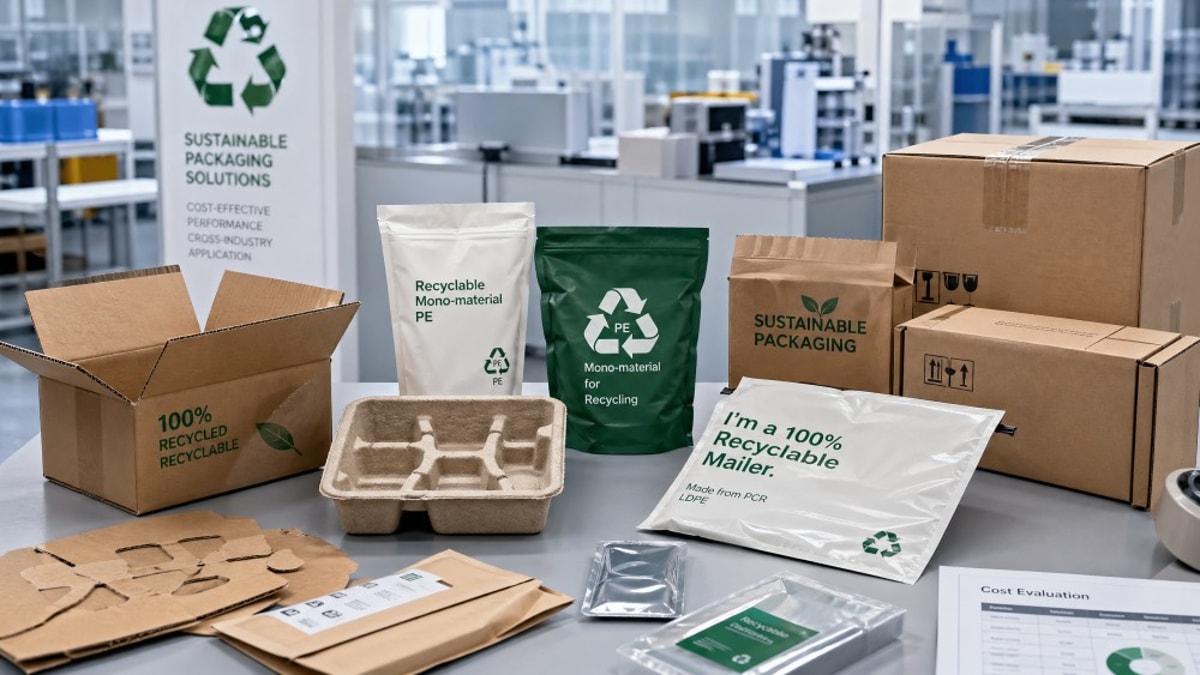
The better candidates in this scenario are materials that combine recyclability messaging with measurable logistics gains. Examples include right-sized corrugated mailers, recycled-content cushioning that reduces cube use, or mono-material designs that simplify disposal communication. The business case becomes stronger if the company also faces retailer sustainability scorecards or needs to reduce the number of packaging SKUs from, for example, 12 sizes down to 7 or 8.
Scenario 2: Premium consumer goods, furniture accessories, and office products
In premium categories, eco-materials for sustainable packaging should be evaluated as a brand and conversion asset, not only as a compliance line item. This includes decorative cartons, molded pulp inserts, rigid paper formats, and recycled-content wraps used for giftable office essentials, furniture hardware kits, branded accessories, and high-value finishing components. Here, the surface appearance and tactile quality can influence both shelf performance and online unboxing perception.
For financial approvers, the decision often turns on the recoverability of the premium. If sustainable packaging adds 6% to 15% to the packaging budget but supports a stronger product story, the question becomes whether that uplift can be recovered through price, lower markdown pressure, or improved tender win rates. In many premium segments, packaging is part of the commercial promise; therefore, visible sustainability may contribute to retention, especially in export channels where buyers increasingly ask for recycled-content or plastic-reduction narratives.
This scenario also carries a caution. Some eco-materials vary more in shade, fiber texture, or print outcome than conventional substrates. That may be acceptable, or even desirable, in artisanal positioning. It may be a problem for brands requiring highly uniform color blocks or metallic finishing. Finance should therefore ask commercial and design teams to define tolerance bands early, because late-stage artwork adjustments can erase expected savings.
What to confirm before approving a premium packaging shift
- Whether the new substrate supports the required print and finishing process within current lead times, often 4 to 8 weeks for repeat runs.
- Whether visual variation is acceptable across batches, especially when recycled fiber content is high.
- Whether the sales team has a realistic plan to convert the sustainability story into premium protection or account retention.
- Whether secondary packaging and transit protection must change to avoid scuffing, deformation, or humidity-related complaints.
Scenario 3: Industrial, technical, and export-oriented protective applications
For industrial goods, spare parts, auxiliary hardware, and electromechanical assemblies, the financial risk profile is stricter. Eco-materials for sustainable packaging in this scenario must first meet protection targets. If a molded fiber insert saves plastic content but increases breakage, moisture absorption, or stack deformation, the cost gap becomes unfavorable very quickly. This is particularly relevant for export shipments with longer transit windows of 20 to 45 days and multiple handling points.
The most suitable substitutions tend to be those with performance parity in compression, vibration protection, and pack-out efficiency. Recycled corrugated partitions, paper-based wraps, or engineered fiber inserts may work well for stable geometries and moderate humidity exposure. More caution is needed where products have sharp edges, precision finishes, or corrosion sensitivity. In those cases, finance teams should request test criteria tied to real shipping conditions rather than generic sustainability claims.
A strong approval model in this scenario includes expected claim rate, repack labor, line-side handling, and export documentation needs. If the company ships high-value components, a 0.5% increase in damage can outweigh a much larger saving on material input. Conversely, if the new eco format reduces void space and pallet count, there may be a meaningful logistics benefit over a 6- or 12-month cycle.
How the main material options compare by business need
Finance approvers usually need a practical way to compare eco-materials for sustainable packaging beyond broad claims. The table below is designed for all-industry use and highlights where common material families tend to fit. It does not replace product-specific testing, but it helps narrow where the 2026 cost gap is likely to be manageable and where deeper validation is needed.
This comparison shows why broad assumptions can mislead budget decisions. A molded fiber insert may look expensive on a first quote because of tooling, yet become economical when a stable SKU runs for 100,000 units or more. A compostable film may sound attractive for brand messaging but remain financially weak if local disposal systems are limited or machine speed falls. The right path depends on scenario fit, not ideology.
A practical threshold approach for finance reviewers
Many finance teams benefit from using threshold ranges instead of waiting for perfect certainty. For example, a packaging change may be easier to approve if the landed-cost increase stays within 2% to 4% and one of three value conditions is met: freight reduction, claim-rate stability, or measurable commercial uplift. If the increase exceeds 8% without a clear risk or revenue offset, the project typically needs stronger validation or narrower rollout.
This approach supports staged deployment. Rather than shifting the full portfolio at once, companies can pilot eco-materials for sustainable packaging in one channel, one export market, or one premium product family for 60 to 90 days. That creates usable data around line efficiency, customer response, and actual delivered cost.
Where financial teams often misjudge sustainable packaging projects
The largest errors in eco-materials for sustainable packaging decisions usually come from incomplete cost scope. A common example is focusing on the supplier’s price increase while ignoring hidden benefits such as lower dimensional weight, fewer packaging components, or better tender positioning. The opposite also happens: teams overestimate the market value of sustainability and under-budget for tooling, test runs, or failure risk.
Another misjudgment is using one approval standard for all product lines. A durable industrial component, a premium office accessory, and a low-cost replenishment item should not be held to the same payback logic. In one case, the decision may be risk avoidance. In another, it may be margin storytelling. In a third, the right answer may simply be to delay a switch until supply consistency improves over the next 2 to 3 sourcing cycles.
Finance also needs to watch cross-functional drift. Sustainability teams may prioritize material credentials, operations may prioritize line stability, and sales may prioritize customer messaging. Without a common business case, the approval process becomes fragmented. The most effective reviews align procurement, engineering, packaging development, and commercial leadership around the same three outputs: cost range, risk range, and value range.
Checklist for avoiding weak approvals
- Model landed cost over at least 2 quarters, not only the opening purchase order.
- Test one real logistics route, especially if humidity, stacking, or export handling is involved.
- Separate fixed conversion costs from variable material costs so payback is visible by volume band.
- Define the acceptable threshold for returns, damage, visual variation, and line-speed reduction before approval.
- Confirm whether the sustainability claim matches disposal reality in the target market.
These controls are especially relevant for companies operating across multiple industries or regions. A format that performs well in one country may create cost friction in another because of freight structure, retailer packaging rules, or recovery infrastructure. That is why scenario discipline matters more than broad market narratives.
How to build a 2026 approval roadmap by scenario
For finance leaders, the most practical roadmap is to rank packaging programs into three groups: ready now, validate next, and monitor only. “Ready now” typically includes recycled-content corrugated, paperboard optimization, or simplified mono-material structures with clear supply continuity. “Validate next” may include molded fiber conversions or premium presentation packs where tooling and finish need review. “Monitor only” often covers high-premium bio-based films or niche materials where cost and infrastructure remain uncertain.
A useful review cadence is every 6 months, because the cost gap in eco-materials for sustainable packaging may move with energy inputs, resin availability, freight conditions, and local compliance updates. Finance teams do not need to predict every market movement. They do need a disciplined update cycle so that material decisions remain commercially relevant in 2026.
For organizations with broad product portfolios, scenario clustering works well. Group SKUs by shipping intensity, premium sensitivity, and damage risk. Then approve material pathways by cluster instead of item by item. This can shorten decision time, improve supplier negotiations, and create a clearer capital plan for any tooling or line adjustment required.
Why work with GIFE on material and packaging intelligence
GIFE focuses on the final stage of industrial value creation, where packaging aesthetics, auxiliary hardware, technical compatibility, and commercial essentials directly affect market performance. For buyers and finance approvers, that means a more grounded view of eco-materials for sustainable packaging: not just what looks sustainable on paper, but what aligns with product protection, finish quality, sourcing reality, and margin logic.
Our Strategic Intelligence Center helps enterprises evaluate material choices through the lenses that matter in real approvals: application scenario, cost structure, supply risk, functional compatibility, and market-facing value. This is especially useful for manufacturers, exporters, and brand owners navigating packaging de-plasticization while still protecting delivery performance and product presentation.
If you are reviewing eco-materials for sustainable packaging for 2026 budgets, contact us to discuss parameter confirmation, material selection, lead-time expectations, customized packaging pathways, certification-related considerations, sample support, and quotation comparison. We can help you narrow which scenarios are ready for rollout, which need controlled testing, and which should remain under observation until the economics improve.
Related News
- 00
0000-00
Electromechanical Engineers Consulting for Faster System Integration - 00
0000-00
Sustainable Packaging Solutions: What Works at Scale and What Fails - 00
0000-00
Global Value Chain Management Mistakes That Raise Export Risk - 00
0000-00
Industrial Finishing Technology Trends to Watch in 2026 - 00
0000-00
Industrial Production Efficiency Fixes That Do Not Require New Lines
Weekly Insights
Stay ahead with our curated technology reports delivered every Monday.