





Technical barriers in industrial production rarely appear overnight—they usually begin as small, overlooked issues in specifications, materials, process alignment, or cross-team communication. For project managers and engineering leads, identifying where these delays first emerge is essential to protecting timelines, quality, and cost control. This article examines the most common starting points of disruption and how smarter technical coordination can prevent minor gaps from becoming major production setbacks.
Why project leaders should use a checklist to detect technical barriers in industrial production
For most industries, delays do not start when machines stop. They start earlier, often during drawing release, material approval, packaging definition, component matching, or interface clarification. A checklist approach helps project managers identify technical barriers in industrial production before they turn into missed milestones, rework, or supplier escalation.
In cross-functional manufacturing environments, a single project may involve 5 to 12 decision nodes before pilot production: design freeze, BOM confirmation, sample validation, tooling review, process capability review, packaging approval, compliance review, and shipping readiness. When one node is passed with assumptions instead of facts, the next node absorbs the risk. That is where technical barriers in industrial production usually begin to compound.
A checklist is useful because it forces teams to verify what is measurable: tolerance ranges, lead-time windows, coating compatibility, assembly interfaces, carton compression limits, power specifications, moisture sensitivity, and test thresholds. This is especially important in industrial finishing, hardware, electromechanical assemblies, and commercial essentials, where the final stage often determines whether the entire production cycle remains on schedule.
What should be checked first
- Whether all technical documents are released in the same revision, including drawings, BOMs, packaging specs, labels, and inspection criteria.
- Whether critical materials have been validated under the real process environment, such as heat, humidity, surface treatment, vibration, or electrical load.
- Whether supplier capability matches the required tolerance, finish consistency, assembly complexity, and delivery pace.
- Whether engineering, sourcing, quality, and production teams agree on what counts as acceptable output at pilot, ramp-up, and mass production stages.
When these items are checked early—ideally 2 to 6 weeks before pilot build—project leaders can reduce the chance that technical barriers in industrial production remain hidden until the line is already committed.
Core checklist: where delays usually begin
The most common technical barriers in industrial production can be grouped into a few repeatable categories. They are rarely dramatic at first. A missing tolerance note, an unverified coating thickness, or an incomplete connector map may look manageable, but each can trigger 3 to 10 days of cumulative delay once tooling, sampling, or assembly has started.
The table below can be used as a fast review tool during new product introduction, process transfer, supplier onboarding, or redesign projects. It is built for project managers who need a practical view of where to investigate first.
The table shows that technical barriers in industrial production usually start at handoff points rather than isolated departments. If the signal appears in one function, the impact often lands in another. That is why project reviews must follow the entire chain from design intent to shipment condition.
Priority checks before pilot build
- Confirm the top 10 critical-to-quality dimensions or parameters and link each one to an inspection method.
- Review whether alternative materials or substitute parts change thermal, mechanical, visual, or electrical behavior.
- Check whether packaging design reflects the real product weight, stacking height, transport route, and storage duration, often 30 to 90 days.
- Verify that process capability assumptions are based on line conditions, not only bench samples or supplier declarations.
A practical rule for escalation
If a technical uncertainty can affect fit, finish, function, compliance, or pack-out readiness, it should be escalated within 24 to 48 hours. Waiting until the weekly meeting often adds one extra production cycle of uncertainty, especially when tooling, finishing, or imported components are involved.
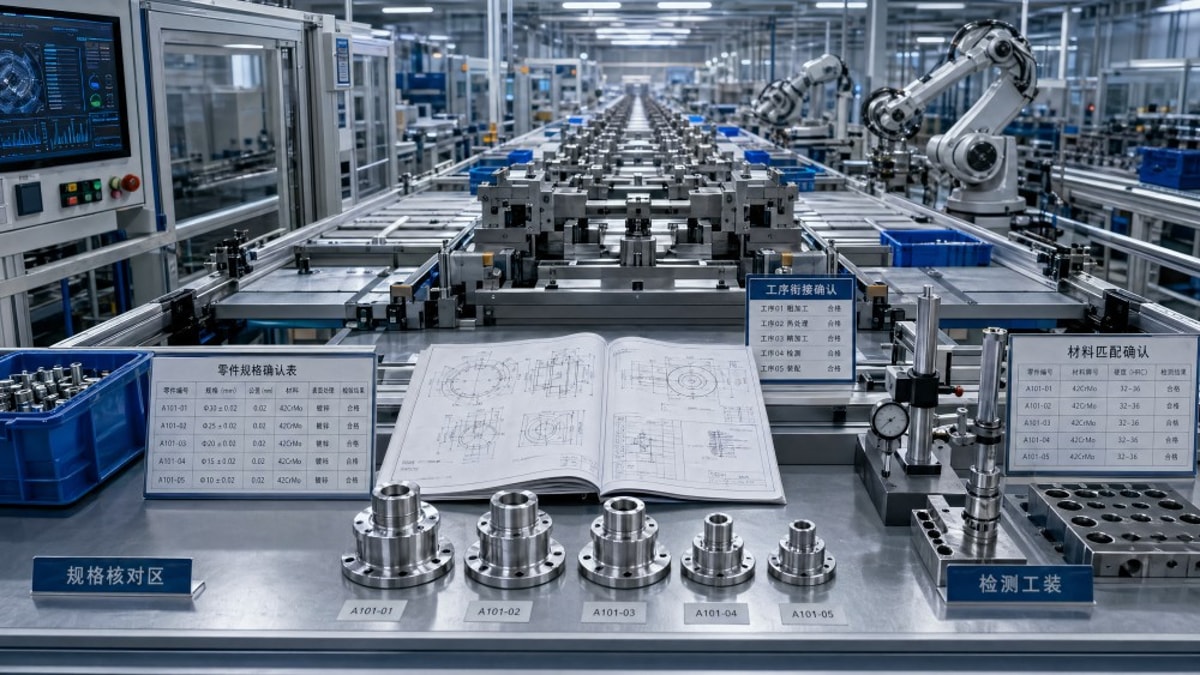
Checklist by technical area: specifications, materials, process, and interfaces
To manage technical barriers in industrial production effectively, project managers need a structured review across four areas: specifications, materials, process readiness, and cross-team interfaces. These are universal categories across industrial hardware, finishing systems, packaging, office products, appliance parts, and electromechanical assemblies.
Each category has its own warning signs. A drawing problem may look administrative, but it can create a machining issue. A packaging change may look commercial, but it can change product orientation, abrasion exposure, or drop resistance. In practice, the technical barrier often appears where one decision is assumed to be “minor.”
1) Specification review checklist
- Are tolerance ranges explicit, or do operators need to interpret intent from a visual sample?
- Are cosmetic standards defined by area, viewing distance, lighting condition, and defect size threshold?
- Are label content, barcode rules, orientation marks, and language versions aligned with the shipping destination?
Even a 0.2 mm tolerance ambiguity or an undefined surface acceptance zone can slow approval by several days because quality, engineering, and suppliers each apply a different judgment standard. This is one of the most common technical barriers in industrial production during final-stage execution.
2) Material and finish review checklist
- Has the material been validated under the intended coating, bonding, forming, or thermal cycle?
- Does the chosen finish affect conductivity, friction, corrosion resistance, odor, recyclability, or visual consistency?
- Are storage conditions defined, such as humidity below a practical threshold or shelf life within 6 to 12 months?
For industrial finishing and packaging aesthetics, appearance and functionality are often linked. A gloss target, plating thickness, adhesive choice, or eco-material substitution can influence both customer perception and production stability. When this interaction is not tested early, technical barriers in industrial production appear late and cost more to correct.
3) Process and assembly review checklist
- Is the process window defined for temperature, curing time, torque, pressure, cycle time, or line speed?
- Has the assembly sequence been tested for access, tool clearance, operator ergonomics, and fixture repeatability?
- Are pilot-run yields, such as 95% to 98% first-pass targets, realistic for the actual equipment mix?
A process that works on 20 units may fail at 2,000 units if heat load, takt balance, or handling variation changes. That is why process assumptions must be converted into measurable windows before mass production release.
4) Interface and communication review checklist
- Who owns each technical decision at every stage, from RFQ to pilot to shipment approval?
- Are engineering change notices communicated to sourcing, quality, logistics, and external suppliers on the same day?
- Do teams share one issue log with due dates, severity levels, and closure evidence?
Many technical barriers in industrial production are not purely technical. They are coordination failures around technical facts. A shared action tracker reviewed every 48 to 72 hours is often more effective than a larger but less frequent meeting cadence.
How risk patterns change by production scenario
Not every production environment produces the same technical risk. The delay pattern differs between new product launches, customization projects, capacity transfers, and cost-down redesigns. Project managers should adjust the checklist rather than using one static review template for all programs.
The table below compares common scenarios and the type of technical barriers in industrial production that typically emerge first. It helps teams assign attention where the earliest disruption is most likely to happen.
This comparison matters because the wrong review focus creates false confidence. For example, in a transfer project, teams often assume that existing drawings are enough, but finish behavior, tooling wear, and operator sequence can still shift output. In a customization project, packaging and labeling may become the earliest technical barrier even when the core product design remains unchanged.
Risk reminders by project phase
During concept and sourcing, the biggest risk is usually assumption drift. During pilot, the biggest risk is process instability. During ramp-up, the biggest risk is throughput imbalance. During shipment preparation, the biggest risk is packaging and documentation mismatch. These phase-specific risks should be reviewed at least once per gate, not only after failures appear.
For project leaders responsible for multiple suppliers or regions, a 4-phase review rhythm can be useful: weekly during concept validation, every 3 to 5 days during pilot, daily during ramp-up, and shipment-based review during launch week. This cadence helps surface technical barriers in industrial production while there is still time to respond.
Commonly overlooked issues that create hidden technical barriers
Some of the most damaging delays come from issues that are treated as secondary details. In final-stage industrial production, details are rarely secondary. Packaging structure affects damage rates. Finish selection affects assembly friction. Small hardware tolerances affect noise, alignment, and fit. Documentation timing affects whether materials are built to the correct revision.
For organizations managing global suppliers, the problem becomes larger because time zone differences and commercial pressure can push teams to approve “temporary” workarounds. Once a workaround enters production, it often becomes hard to reverse without cost, scrap, or field risk.
Frequently missed checks
- Packaging validation is skipped because the product itself passed function tests, even though transport vibration and compression were never reviewed.
- A finish is approved visually, but no one confirms its effect on grounding, conductivity, wear, or adhesive bonding.
- Mechanical and electrical teams approve separately, but connector access, harness routing, or fastening sequence is not checked in one assembly flow.
- Eco-material substitutions are accepted for sustainability goals, but moisture behavior, printability, or shelf stability over 60 to 180 days is not validated.
Why these issues stay hidden
They stay hidden because each one sits between departments. No single function sees the full risk unless someone owns the integration view. This is where project management discipline matters most. Technical barriers in industrial production are often integration failures disguised as isolated defects.
A simple prevention method is to require closure evidence for all medium- and high-severity technical issues: sample photos, measurement records, process settings, packaging test notes, or signed revision logs. If evidence is missing, the issue is not closed, regardless of verbal agreement.
Execution guide: how to prevent minor gaps from becoming major setbacks
Preventing technical barriers in industrial production does not always require complex systems. It requires disciplined technical coordination at the right moments. For project managers and engineering leads, the best results often come from early alignment, visible ownership, and measurable closure criteria.
A practical execution model is to divide action into three windows: pre-pilot, pilot, and ramp-up. In the pre-pilot window, the goal is to reduce ambiguity. In pilot, the goal is to prove repeatability. In ramp-up, the goal is to maintain output stability while controlling change.
Recommended action sequence
- Build one cross-functional issue list that covers specification, material, process, packaging, and compliance items in the same tracker.
- Mark the top 5 to 10 schedule-critical technical risks and assign one owner, one due date, and one closure proof for each.
- Use a fixed review cadence: 48-hour updates during pilot and daily updates during the first 1 to 2 weeks of ramp-up.
- Do not approve substitute solutions without reviewing total impact on tooling, appearance, assembly time, packaging, and serviceability.
When this discipline is applied consistently, technical barriers in industrial production can be addressed while they are still small enough to manage. The cost of early clarification is usually far lower than the cost of late-stage correction, especially when international logistics, finish-sensitive parts, or electromechanical modules are involved.
Why work with an intelligence-led industrial partner
GIFE focuses on the final stage of industrial value creation, where technical precision, finishing quality, packaging practicality, and commercial readiness meet. For project managers, this means support that goes beyond surface commentary. It means clearer parameter review, better understanding of material-process interaction, and more realistic visibility into where technical barriers in industrial production are likely to emerge.
Our perspective spans industrial finishing, auxiliary hardware, eco-material packaging, and electromechanical essentials—areas where small technical choices can influence brand perception, lead time, and operating cost at the same time. That integrated view is valuable when your project needs faster decisions without lower standards.
Contact us for parameter review, selection support, and delivery planning
If your team is dealing with technical barriers in industrial production, we can help you organize the right review points before delays spread. You can contact us to discuss specification confirmation, component or material selection, packaging-fit assessment, finishing compatibility, delivery lead-time planning, and sample support for validation programs.
We also welcome conversations around customization scope, certification-related preparation, cross-supplier coordination, and quotation planning when technical changes may influence cost or schedule. A focused early discussion can save one or more production cycles later.
For project managers and engineering leads who need sharper visibility into industrial execution risks, GIFE offers a practical starting point: identify the small technical gaps first, confirm the facts that matter, and move forward with fewer surprises across production, finishing, packaging, and delivery.
Related News
- 00
0000-00
Electromechanical Engineers Consulting for Faster System Integration - 00
0000-00
Sustainable Packaging Solutions: What Works at Scale and What Fails - 00
0000-00
Global Value Chain Management Mistakes That Raise Export Risk - 00
0000-00
Industrial Finishing Technology Trends to Watch in 2026 - 00
0000-00
Industrial Production Efficiency Fixes That Do Not Require New Lines
Weekly Insights
Stay ahead with our curated technology reports delivered every Monday.