





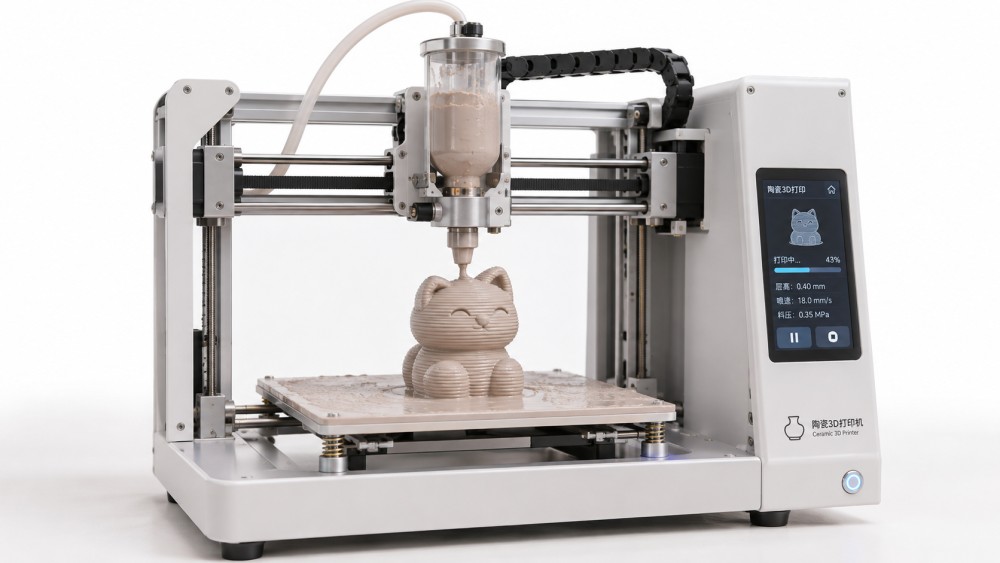
Jingdezhen’s ceramics industry is adopting digital tools in the production of designer toys, according to a report by Xinhua. At a local designer-toy space and a 3D ceramic printing business, designers use AI to generate concepts and combine them with ceramic 3D printing to make collectible figures.
The approach has substantially shortened the time from design to production, replacing the conventional mould-making and drying process described in the report. For ceramic toy makers, the immediate significance lies in how a design can move into production without passing through those traditional steps.
A shorter route from concept to object
AI-assisted design and 3D printing address different parts of the process. The first helps generate design concepts; the second provides a way to make a physical ceramic figure. Together, they offer a workflow in which digital design is connected more directly to production.
That connection may be especially relevant when a design needs to be revised. If a producer can adjust a digital design and print another version without making a conventional mould, the work involved in moving between an idea and a physical form may change. The reported reduction in production time points to the potential of that approach, although the report does not specify how much time is saved or how results vary between products.
For designers, the change raises a practical question: how well can an AI-generated concept be translated into a ceramic object that meets the intended design? For producers, the question extends to whether the resulting process can deliver the desired finish and consistency. These are considerations arising from the workflow, rather than outcomes established by the report.
What the change signals for ceramic production
The development shows how digital tools can take on work associated with both design and making in Jingdezhen’s ceramics sector. Its clearest reported application is in designer-toy figures; the same account does not establish how widely the approach has been adopted across other ceramic products.
The shorter production cycle could be most consequential where a maker places particular value on moving quickly from a concept to a finished object. Whether those gains carry over to other products or larger production runs will depend on the demands of the design and the production process. The report does not establish that 3D printing replaces every conventional step in ceramic manufacturing.
Further accounts of production times, finished quality and the range of products made with these tools would help clarify how far the approach extends beyond the examples described. For now, the reported shift is a concrete example of AI and ceramic 3D printing being combined to shorten the path from design to a physical figure.
Contact Us
Got questions about global market dynamics or seeking best practices for your expansion strategy? Drop us a line below, and let the experts at Global Market Feed help you out.
“We respect your privacy. Your information is strictly confidential.”
Related News
- 00
0000-00
Jingdezhen Ceramics Turn to AI and 3D Printing for Designer Toys - 00
0000-00
How to assess a packaging and printing manufacturer's print quality - 00
0000-00
International Paper Executive Sees Tough 2027 as US Containerboard Supply Stays Tight - 00
0000-00
How to assess an industrial finishing materials supplier’s consistency - 00
0000-00
AF&PA October Report: Packaging Paper Shipments Flat, Bleached Operating Rate Falls
Weekly Insights
Stay ahead with our curated technology reports delivered every Monday.