





Packaging machinery maintenance is not a single line-item expense. A basic semi-automatic sealer may require only periodic cleaning, lubrication, and a small stock of wear parts, while a high-speed filling, cartoning, labeling, or case-packing line can generate substantial annual spending on specialist labor, controls support, format-change components, sensors, belts, bearings, and planned shutdown work.
For budgeting purposes, annual maintenance can range from a few hundred or a few thousand US dollars for simple standalone equipment to tens of thousands of dollars for an automated line. Complex, high-output, hygienic, regulated, or heavily integrated systems can exceed that range, particularly when major components such as servo drives, gearboxes, sealing assemblies, pumps, PLC hardware, or conveyors require replacement.
The useful question is therefore not simply “How much does packaging machinery maintenance cost?” but: what level of maintenance cost is normal for this machine’s duty cycle, design complexity, local support conditions, and downtime exposure?
Indicative annual maintenance cost by equipment complexity
The figures below are practical planning ranges rather than fixed market prices. They assume normal operation, routine preventive work, and ordinary wear-part replacement. They do not include major upgrades, relocation, severe damage, prolonged production losses, or a complete machine rebuild.
These ranges should not be used as a purchasing quote. A lightly used automatic wrapper on one shift can cost less to maintain than a simple machine operated continuously under poor cleaning conditions. Conversely, a technically sophisticated machine may have manageable maintenance spending if it is correctly installed, operated within specification, and supported by readily available parts.
A more useful budgeting proxy is to begin with the machine’s replacement value and separate expected maintenance into three categories: scheduled labor, routine spare parts, and irregular corrective repairs. Treating all maintenance as one unpredictable expense often leads to underfunding the spares that prevent the most expensive stoppages.
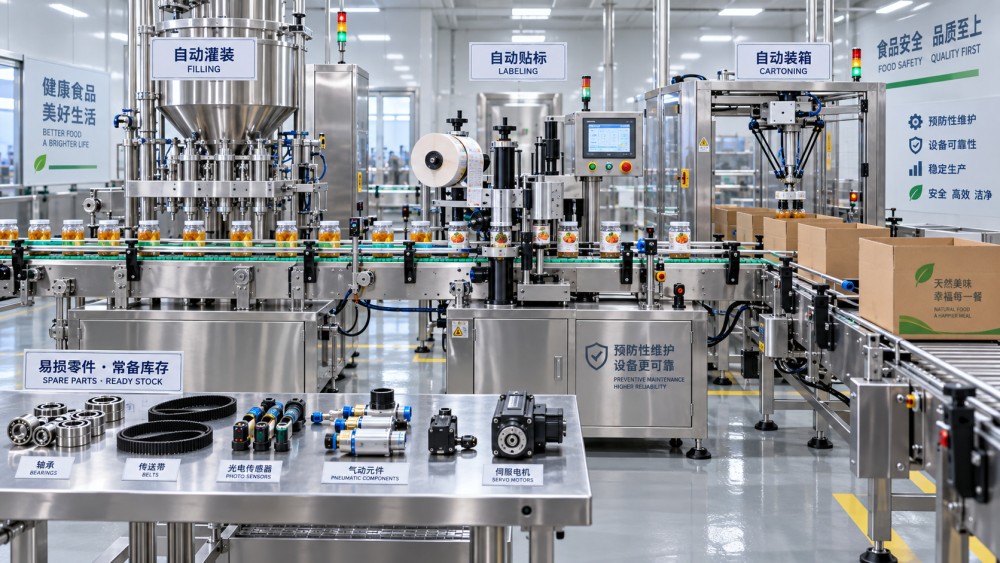
Why two machines with a similar purchase price can have very different maintenance costs
Purchase price is an incomplete predictor. The maintenance profile depends on how the machine performs its packaging task and what happens when production conditions vary.
Motion architecture matters. A mechanically driven machine with chains, cams, gearboxes, and clutches has a different failure pattern from a servo-driven machine. Mechanical systems may require more adjustment, lubrication, alignment checks, and replacement of moving wear components. Servo systems can reduce some mechanical complexity, but faults involving drives, encoders, cables, PLC communication, or motion programming can require higher-cost technical support.
Packaging material quality has a direct maintenance effect. Inconsistent film thickness, poor roll winding, irregular cartons, adhesive contamination, warped trays, or low-quality caps can cause tracking problems, jams, sealing defects, cutter wear, and repeated adjustment. These are often recorded as “machine faults” even when the underlying issue is material variation. Maintenance budgets that ignore packaging-material quality can appear artificially low until line stoppages become frequent.
Operating environment changes component life. Dust, humidity, washdown exposure, abrasive product, elevated temperature, and poor compressed-air quality all accelerate wear. In food, chemical, adhesive, powder, and liquid applications, cleaning requirements and product residue can significantly affect sensors, seals, bearings, pneumatic valves, filling nozzles, and electrical enclosures.
Format complexity raises both planned and unplanned cost. A machine handling one stable SKU is easier to maintain than one repeatedly changed between pack sizes, film widths, bottle shapes, or carton formats. Frequent changeovers increase the chance of incorrect settings, worn adjustment points, damaged format parts, and rushed troubleshooting. The maintenance burden is not only the price of change parts; it is also the time required to restore consistent machine settings.
Routine maintenance, preventive maintenance, and reactive repair are not interchangeable
The lowest visible maintenance expense is not always the lowest operating cost. A line that receives only emergency repair may show limited spending for a period, but it carries a larger exposure to lost output, delayed shipments, overtime, scrap, and urgent freight for parts.
For many packaging operations, the sensible comparison is between a modest, planned cost for maintenance windows and a potentially much larger cost of interruption. A failed photoelectric sensor may be inexpensive, but if it stops a packaging line awaiting export dispatch, its business impact is not measured by the sensor price alone.
Labor is often the least visible variable
Maintenance labor costs vary sharply by country, shift pattern, machine brand, and fault type. Internal technicians may handle cleaning, lubrication, alignment, basic pneumatic repairs, and replacement of common mechanical parts. More complex faults may require an OEM technician, an authorized integrator, a controls specialist, or remote diagnostic support.
Service invoices can include travel time, travel expenses, minimum call-out charges, hourly labor, weekend or holiday premiums, and software or remote-access fees. For imported equipment, the location of the service team is particularly important. A machine with a lower initial price can become expensive to maintain if technical support is distant, documentation is incomplete, or the local distributor cannot provide trained personnel.
Remote support can reduce diagnostic time for PLC, HMI, drive, and parameter issues, but it does not eliminate the need for competent site personnel. A remote technician can identify an alarm sequence or confirm a parameter problem; they cannot physically replace a damaged cable, adjust a worn sealing jaw, or clear a mechanical obstruction.
Spare parts: the difference between inventory cost and interruption cost
Spare-parts policy is where maintenance budgets frequently become distorted. Holding every possible part ties up capital and risks obsolete inventory. Holding no critical parts shifts the cost into emergency freight, extended downtime, and uncertain delivery dates.
Parts should be classified by operational consequence rather than by unit price alone. A low-cost proximity sensor with a long lead time may be more critical than a higher-priced component available locally within a day. Similarly, a proprietary servo drive, controller module, custom sealing jaw, gearbox, vacuum pump, or machine-specific belt may deserve a different stocking decision from standard fasteners, pneumatic fittings, or bearings.
Critical spare parts generally have one or more of these characteristics:
- Failure would stop the machine or prevent safe operation.
- The part is proprietary, programmed, custom-machined, or supplied by a limited number of sources.
- Lead time is long relative to the acceptable production interruption.
- The component is exposed to known wear, contamination, heat, repeated impact, or washdown conditions.
- Replacement requires setup, calibration, or software parameters that must be available at the site.
A complete spare-parts budget should include not only purchase price but also storage conditions, shelf life, firmware compatibility, and the risk that an unused electronic part becomes obsolete before it is needed. This is particularly relevant for PLCs, HMIs, drives, and older control platforms.
OEM service versus independent maintenance support
OEM maintenance support is usually strongest when the machine uses proprietary controls, specialized motion systems, software-protected parameters, custom tooling, or complex safety logic. The OEM may also be the only practical source for updated manuals, approved parts, revised software, and technical bulletins.
Independent service providers can be a cost-effective option for standard mechanical work, electrical troubleshooting, conveyor systems, pneumatics, motors, pumps, generic automation hardware, and routine line maintenance. Their value depends on actual familiarity with the equipment rather than the general ability to repair machinery.
The cost comparison should include more than the hourly rate. Before selecting either route, it is worth checking whether the service provider can access electrical drawings, parts lists, backup programs, alarm histories, parameter records, and safety documentation. A lower labor rate has limited value if diagnosis takes several visits because the machine documentation is unavailable.
Maintenance contracts can improve predictability, but not eliminate risk
Annual service agreements can bundle inspection visits, labor discounts, remote support, response-time commitments, training, and selected consumable parts. They can be useful where a line has limited internal technical coverage or where downtime has a high commercial consequence.
However, a contract should be examined for exclusions. Emergency attendance, travel, software upgrades, obsolete control hardware, wear parts, format components, and failures caused by improper operation may not be included. A contract that looks inexpensive can still leave the most costly risk categories outside its scope.
The practical value of an agreement lies in clarity: defined service intervals, named machine models, response conditions, covered labor hours, parts pricing, and responsibilities for backups and preventive tasks. It should support a maintenance system, not replace one.
Budgeting for the costs that are easy to overlook
Direct repair bills are only part of the financial picture. A realistic maintenance budget also considers production losses associated with planned shutdowns, startup waste after maintenance, rejected packs during adjustment, sanitation time, and the time needed to validate sealing, coding, weight, label placement, or pack integrity after intervention.
Where packaging is linked to filling, inspection, palletizing, or warehouse dispatch, the system constraint may not be the failed machine itself. A short stoppage at a cartoner can create accumulation upstream, starve downstream equipment, and complicate product traceability. The cost of maintenance should therefore be assessed at line level when equipment is interdependent.
For export-oriented operations, an additional exposure is service and parts logistics. Imported replacement components may face freight delays, customs procedures, currency fluctuations, and limited local inventory. Machines intended for international deployment benefit from a maintenance plan that identifies locally sourceable standard parts and separates them from brand-specific or programmed components.
A practical way to set a maintenance allowance
Begin with the machine list rather than a single plant-wide percentage. Record each asset’s age, operating hours, production criticality, machine type, current condition, support arrangement, known obsolete components, and required format changes. Then divide expected spending into planned labor, routine parts, critical-spare replenishment, external service, and a controlled contingency for unplanned failures.
A newer machine under stable operation may need a relatively small contingency but a disciplined inspection schedule. An older line with discontinued electronics, recurring jams, or unsupported software should not be assigned the same allowance merely because its original purchase value was similar. Its risk is different, and so is its maintenance economics.
The most reliable maintenance budget is not the one with the lowest annual number. It is the one that makes expected costs visible, protects the components that can halt production, and distinguishes normal wear from avoidable failure. For packaging machinery, that distinction is often what separates manageable operating expense from an expensive disruption to output and delivery reliability.
Related News
- 00
0000-00
How to verify whether industrial bolts meet the ISO standard - 00
0000-00
When do water-based adhesive technologies for packaging make sense? - 00
0000-00
What to compare in a solution comparison tool before choosing a vendor - 00
0000-00
When does lifestyle product sourcing make sense for home stores? - 00
0000-00
When high strength bonding technology outperforms mechanical fasteners
Weekly Insights
Stay ahead with our curated technology reports delivered every Monday.