





A furniture vendor’s support is only useful if it leads to a workable repair, replacement, or credit when something fails. A long warranty offers limited protection when claims move slowly, freight costs fall on the buyer, or a replacement mechanism is no longer available. Evaluating furniture vendor support quality therefore starts with three connected questions: what does the vendor cover, how quickly does it act, and can it supply the right parts?
When evaluating vendor support quality and reliability standards in the home furnishings market, compare written commitments with evidence of how support operates. The strongest choice is a supplier whose warranty, service process, and parts arrangements match the product’s expected use and the consequences of failure.
Read the warranty as a repair agreement
Warranty length is easy to compare, but coverage determines its practical value. A furniture range may have different terms for frames, upholstery, finishes, drawer slides, hinges, recliner mechanisms, and electrical components. A headline warranty can obscure shorter coverage for the components most likely to require service.
Request the warranty that applies to the exact products and sales territory under consideration. Establish who can claim: the original purchaser, an authorized reseller, or the end customer. If furniture passes through a distributor or retailer, the claim route should remain clear throughout that chain.
Check whether the intended use is covered
Residential furniture may carry exclusions for commercial use, rental accommodation, unusually intensive use, or exposure to unsuitable conditions. A product intended for a private living room may therefore have different support implications when placed in a furnished rental or shared lounge. Coverage should match the actual installation, not merely the product category.
Exclusions also need enough detail to distinguish a manufacturing defect from wear, misuse, or installation damage. “Normal wear and tear” can reasonably exclude gradual fabric abrasion, but it does not explain how the vendor assesses a prematurely failed hinge or collapsing cushion. Ask what evidence determines those decisions and who reviews disputed claims.
Find out what the remedy includes
A warranty may provide a replacement component while leaving diagnosis, installation, packaging, freight, and disposal to the buyer. For bulky furniture, those responsibilities can outweigh the cost of the failed part. Clarify whether labor is covered, whether an authorized technician is required, and whether approval must be obtained before arranging a repair.
The vendor should explain when it offers repair, replacement, or credit. A credit may be practical for a discontinued item, but less useful when a customer needs a matching dining chair. Similarly, replacing one upholstered panel may restore function without matching the appearance of aged fabric. The agreement should address acceptable alternatives and who approves them.
Also establish when coverage starts, whether replacement parts receive their own coverage, and whether any reimbursement decreases as the product ages. These details affect value more directly than the warranty headline.
Separate a quick reply from a completed solution
A vendor can acknowledge a claim promptly while taking much longer to resolve it. “Fast customer service” is therefore too vague to support a purchasing decision. Divide the process into milestones that describe actual progress.
Negotiate service targets around the consequences of failure. A cosmetic defect on a usable cabinet can follow a different route from a damaged support member or unstable chair. A suspected safety issue needs prompt handling instructions and escalation; affected furniture should be removed from use while it is assessed.
Define whether targets use business or calendar days, which time zone applies, and how holidays affect coverage. For international sourcing, an overseas service desk may acknowledge a claim quickly while a local repair remains difficult to arrange. Identify who coordinates technicians, shipping, and communication in the destination market.
Ask what happens when a deadline is missed. A named escalation contact, revised delivery commitment, and agreed interim remedy make the promise actionable. An acknowledgment email alone does little to limit disruption.
Parts access determines whether furniture remains repairable
Spare-parts availability is more than a statement that “parts can be ordered.” The component must be identifiable, compatible, obtainable in a useful quantity, and deliverable within an acceptable period. These conditions matter for furniture hardware and powered products, where a small failed component can disable the entire item.
Request a parts list linked to each model and product revision. Useful documentation includes part numbers, exploded diagrams, installation instructions, and a way to identify the correct version from a label or production code. Product names alone can be insufficient when a supplier changes fittings during production without changing the collection name.
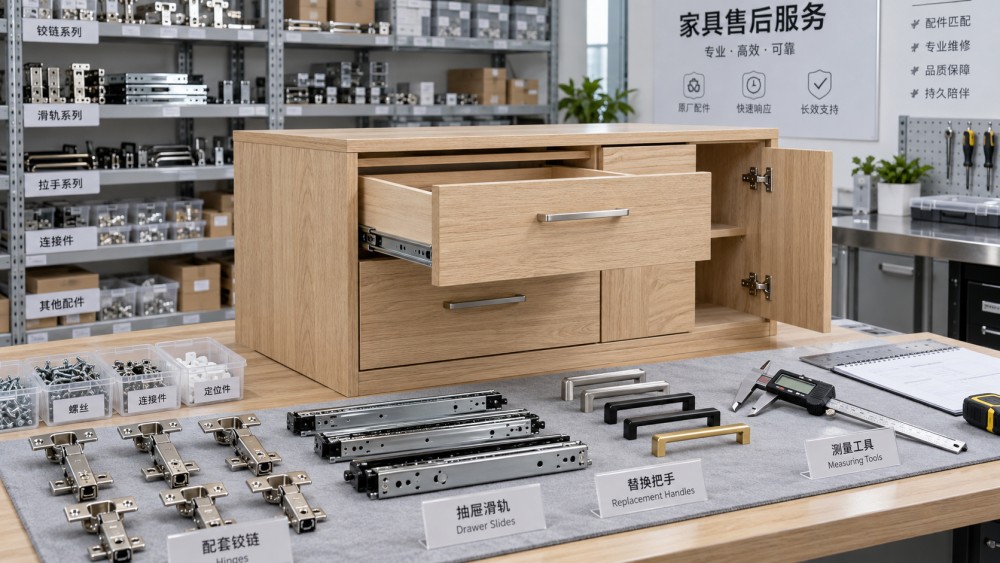
For hinges and drawer slides, dimensions and mounting patterns affect compatibility. For powered recliners or adjustable furniture, connectors, electrical ratings, controls, and mounting geometry also matter. A part that looks similar may still be unsuitable. Substitutions should have documented compatibility and any necessary installation guidance.
Distinguish locally stocked parts from components held at an overseas factory or produced only after an order arrives. Ask about minimum order quantities, freight arrangements, and availability after the furniture model is discontinued. A vendor that supports current production but stops supplying parts at discontinuation creates a predictable repair gap.
A practical spare-parts package should prioritize components that are likely to need replacement, prevent normal use when they fail, or are inexpensive to hold. Depending on the range, these might include feet, glides, handles, hinges, slides, or selected control components. Keeping every possible spare is rarely sensible; the selection should reflect failure consequences and replenishment difficulty.
Common hardware can improve repair options, but it still needs a defined specification. Proprietary mechanisms may offer useful features, yet they make the vendor’s future parts commitment more consequential. Where switching suppliers would be difficult, seek a written support period, notice before discontinuation, and a final-order opportunity for essential spares.
Ask for evidence that shows how support works
Policies explain what a vendor promises. Records and a practical demonstration show whether the process can deliver it. Before placing a substantial order, ask the supplier to walk through a sample claim involving one of the shortlisted products.
Use a realistic fault, such as a drawer that no longer closes correctly or a recliner control that stops responding. Provide the information normally available after delivery and ask the vendor to identify the required evidence, responsible contact, likely remedy, and replacement part. This exercise can reveal unclear ownership or weak documentation before a customer depends on the process.
Useful supporting evidence includes:
- An anonymized completed claim showing the fault, decision, remedy, and closure.
- A current parts catalog with model and revision references.
- A sample repair instruction showing tools, skill requirements, and precautions.
- A description of local service arrangements and their geographic coverage.
- A process for escalating repeated faults or suspected defects affecting a batch.
Review performance figures carefully. An average response time may refer only to the first email, and a high closure rate may include rejected claims. Ask what each measure counts and whether it covers comparable products, regions, and claim types. A few traceable examples can be more informative than an attractive figure with no clear definition.
References can add context when they involve similar products and support needs. Ask how the vendor handled delayed parts, disputed coverage, or repeated failures. General praise for a helpful sales representative says little about repair capability.
Compare vendors against the failures you need to manage
A support scorecard works best when its priorities reflect the order. For straightforward, replaceable items, delivery damage procedures and convenient replacement may matter most. For upholstered collections, matching materials and component-level repair deserve more attention. Powered furniture places greater weight on diagnosis, mechanism availability, and qualified service.
Start with minimum requirements that every shortlisted vendor must meet. These might include coverage for the intended use, a clear claim owner, access to critical parts, and an acceptable remedy for products that cannot be repaired. Do not let a strong score elsewhere compensate for a missing requirement that would make the product impractical to support.
Then compare the remaining tradeoffs. A supplier with a shorter warranty may provide broader cost coverage and locally stocked parts. Another may offer longer coverage but require overseas returns or leave labor unpaid. The better choice depends on the likely burden of each arrangement.
Estimate that burden using the same repair scenario for every vendor. Include the part, technician visit, freight, administration, replacement handling, and any temporary solution needed. Use quoted costs and stated responsibilities rather than invented failure rates. This exposes differences that the purchase price alone cannot show.
Put the support commitments into the order documents
Verbal assurances are difficult to apply when the sales contact changes or a claim becomes contentious. Attach the relevant warranty, service commitments, and parts provisions to the purchasing agreement, with clear product references and document versions.
The documents should identify the party responsible for support, the claim channel, required evidence, decision and dispatch targets, cost allocation, and escalation contacts. For cross-border orders, specify who handles replacement freight, customs arrangements, and damaged returns. Avoid assuming that the original shipment terms automatically settle warranty shipments.
Include an agreed process for recurring defects. Replacing individual parts may be appropriate for isolated faults; repeated failures of the same component may require batch identification, technical investigation, and a corrective remedy. The vendor should be able to connect a claim to the relevant product revision or production batch.
Before awarding the order, trace one plausible failure from report to closure. Establish who receives the claim, how coverage is decided, where the correct part comes from, who installs it, and who pays. Any unclear handoff is a support risk worth resolving before the furniture enters service.
Related News
- 00
0000-00
How to prevent delamination in laminated flexible packaging films - 00
0000-00
Fujifilm and ePac Partner Globally on Jet Press FP790 Deployment - 00
0000-00
Choosing technical ceramics for wear resistance under impact loads - 00
0000-00
Which compliance standards apply to children's stationery in the US? - 00
0000-00
How to assess a furniture components supplier’s production capacity
Weekly Insights
Stay ahead with our curated technology reports delivered every Monday.