





Keep a retrofit in-house when the scope is well understood, your engineers have the required skills, and they can protect enough time for design, installation, and commissioning. Bring in an electromechanical engineering integrator when the upgrade creates dependencies across mechanical equipment, electrical systems, controls, and safety—or when your team cannot absorb the work without compromising plant support.
A hybrid approach often fits projects between those extremes: internal staff define operating requirements and support installation, while an external specialist takes responsibility for integration and testing. The decision should follow the project’s technical risks and delivery constraints. Comparing an outside quotation with internal labor alone will miss much of what determines the outcome.
Start with what the retrofit changes
A replacement motor can look like a straightforward maintenance task. It becomes a different project if the new motor changes starting behavior, requires a variable frequency drive, affects gearbox loading, or needs revised protection and control logic. The component being purchased may be familiar while the system behavior changes substantially.
Before choosing who delivers the work, separate the desired outcome from the proposed hardware. “Replace the drive” describes an activity. “Restore reliable operation across the required speed range without damaging the transmission” defines an engineering requirement. That distinction helps expose work that an initial estimate might overlook.
Map the affected interfaces: mounting dimensions, shaft connections, power supply, control signals, network communications, guarding, operator interaction, and upstream or downstream equipment. Include pneumatic or hydraulic systems where relevant. Each interface needs a defined condition that the completed retrofit must satisfy.
Existing documentation also influences the choice. Accurate drawings, accessible controller programs, and known machine behavior make an internal project easier to manage. Missing source files, undocumented modifications, and obsolete components create investigation work before anyone can confidently commit to a design or shutdown plan.
An integrator can provide resources for that investigation, but hiring one does not remove uncertainty automatically. If equipment condition or program access is unclear, commission a discovery phase before requesting a tightly defined implementation price.
When an in-house team is the stronger choice
Internal delivery works well for a bounded retrofit on equipment your team already understands. Examples include replacing a supported drive with a compatible model, modifying a familiar control panel, or updating a conveyor assembly without changing its operating sequence or safety functions.
Plant knowledge has practical value. Internal engineers and technicians may understand which product variations cause problems, which sensors need frequent adjustment, and how operators recover from a stoppage. That knowledge can prevent a technically acceptable upgrade from creating difficulties during everyday production.
The deciding condition is available capability across the whole scope. A team that maintains controllers may still lack experience with motion tuning, mechanical load assessment, or safety validation. Troubleshooting an existing system and designing a changed one require overlapping but different skills.
Capacity deserves the same scrutiny as competence. Assign named people, reserve their engineering time, and provide cover for urgent maintenance. If the retrofit depends on work being completed between breakdown calls, the schedule is vulnerable even when every person involved is technically capable.
Internal delivery becomes less attractive when success depends on one individual whose knowledge is undocumented. In that situation, the project should include shared access to software, updated drawings, and training for additional staff. Otherwise, the upgrade preserves the same support dependency in newer equipment.
What an electromechanical engineering integrator should add
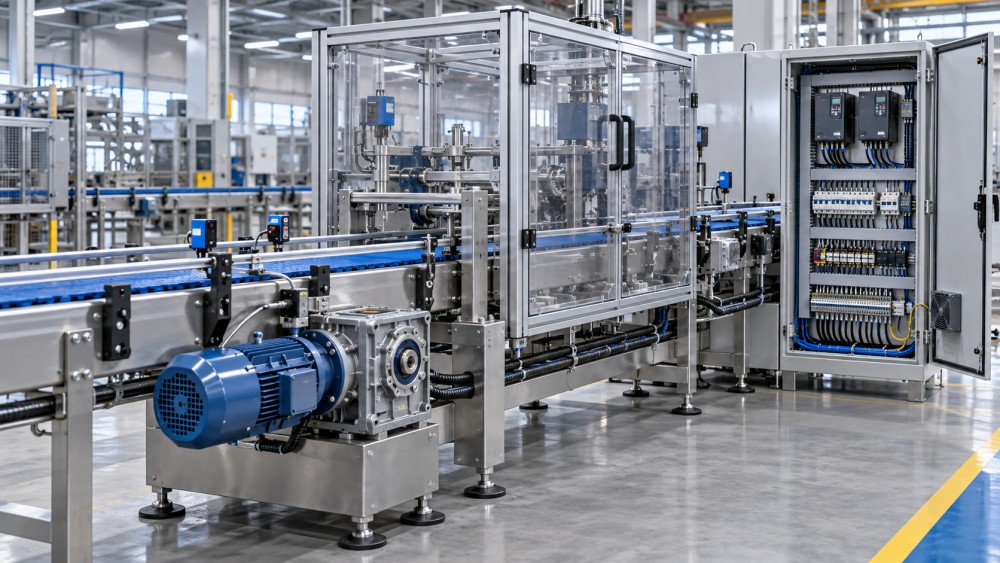
An integrator is most useful when several disciplines must converge on one operating result. A packaging machine conversion, for example, might combine new servo axes, changed tooling, revised sensors, and controller software. Mechanical tolerances affect motion performance; motion behavior affects product handling; both influence fault recovery and operator safety.
The external partner’s value comes from managing those relationships. That may include mechanical design, electrical engineering, controller programming, panel work, installation planning, and commissioning. Some firms perform these activities directly; others coordinate subcontractors. Establish which capabilities are actually included.
A controls contractor can be appropriate when the mechanical design is settled and the remaining work is software and electrical integration. A broader engineering integrator is more suitable when mounting arrangements, loads, motion, utilities, and controls must be developed together. The supplier’s job title alone does not establish its scope.
Ask a potential partner to explain how it would investigate the existing machine, handle incomplete drawings, and demonstrate the finished system. Relevant project examples help, but the proposed working method matters more than a broad list of industries served.
External delivery still needs plant involvement. The integrator needs access to operating limits, representative materials, maintenance knowledge, and people authorized to resolve scope questions. Delayed decisions and incomplete requirements can disrupt an outsourced project just as readily as an internal one.
Compare the full delivery cost
An internal estimate often includes components and installation hours but leaves engineering time, software access, test equipment, and production support implicit. An integrator’s quotation may make these costs visible, which can make external delivery appear disproportionately expensive.
Build both estimates around the same scope. Include surveys, design, procurement, fabrication, programming, installation, testing, documentation, and startup support. Add the cost of temporary arrangements and any work required to return the machine to service if commissioning cannot finish within the shutdown.
Account for internal opportunity cost as well. Assigning a controls engineer to the retrofit may delay another upgrade or reduce support elsewhere. That does not mean internal hours should be priced at an arbitrary premium; it means the scheduling consequence should be visible in the decision.
Downtime exposure needs separate consideration. A lower delivery price can lose its advantage if the approach leaves substantial debugging until installation. Compare which functions can be tested beforehand and what problems are likely to remain for the shutdown.
Check quotation assumptions carefully. A fixed price based on inaccurate drawings may still generate change orders. A phased proposal with a defined survey and design stage can produce a more credible implementation budget. Pay particular attention to exclusions for mechanical repairs, obsolete hardware, safety work, utilities, and production trials.
Let the shutdown plan test the proposal
A delivery model is only credible if it supports the available outage. Ask each team to describe what will be completed before the machine stops, what must happen during installation, and what evidence will justify restarting production.
Advance work can include panel assembly, software review, simulated input and output checks, trial fitting, and verification of cables and connectors. These activities reduce uncertainty, although they cannot reproduce every interaction with the installed machine or real product.
Separate installation completion from production readiness. Equipment can power up and execute a sequence while still struggling with product variation, sustained running, fault recovery, or coordination with adjacent machines. Commissioning must include the operating conditions that matter to production.
Define acceptance criteria before design is finalized. They should address required operating modes, product quality, permitted changeovers, alarm behavior, restart sequences, and agreed performance under representative conditions. Establish how results will be recorded and who can approve deviations.
Where practical, define a rollback plan. This may involve preserving the original program, retaining removed hardware, and identifying the last point at which restoration remains feasible. Some mechanical changes make rollback difficult, so the recovery strategy must be established before dismantling begins.
Give one party ownership of system performance
A hybrid retrofit can combine useful strengths, but it needs explicit boundaries. If internal staff modify the mechanics while an external contractor changes the controls, both must work from agreed loads, positions, tolerances, and operating sequences. Otherwise, a commissioning problem can fall between their scopes.
Assign an overall technical owner with authority to resolve interface decisions. That person or organization should maintain the design assumptions, coordinate changes, and make sure acceptance testing covers the complete machine. Individual contractors remain responsible for their work, but someone must connect it.
Safety responsibilities also need a defined place in the scope. Changes to speed, force, stopping behavior, access, guarding, or control architecture can alter existing risks. Identify who assesses the affected functions, designs any required changes, and validates them before release. Responsibility for safe operation should not be inferred from who supplied the controller.
Record responsibilities in a short project matrix. Design approval, installation supervision, software control, testing, production release, and post-startup support should each have a named owner. This is especially useful when panel builders, equipment manufacturers, and specialist subcontractors are involved.
Choose support you can use after handover
A successful retrofit should leave the plant able to operate and maintain the equipment. Agree on the handover package before placing orders: updated mechanical and electrical drawings, controller and operator-interface source files, configuration backups, component lists, licenses where needed, and recovery instructions.
Clarify access rights and software ownership. Receiving a backup is of limited value if plant staff cannot open it, restore it, or modify the program when required. Password arrangements, remote access, and any dependence on proprietary tools should be understood during supplier selection.
Support should match the machine’s operating pattern. Establish how faults are reported, who provides initial diagnosis, when onsite attendance is available, and which issues fall outside the agreed support scope. Include training that covers routine operation and realistic fault recovery.
Component selection affects that support burden. A familiar drive or controller platform can reduce training and spare-parts complexity, provided it meets the application requirements. Introducing another platform may be justified by functionality, but its maintenance consequences belong in the evaluation.
Make the choice with a short project brief
Before requesting proposals or committing internal resources, prepare a brief covering the operating problem, equipment condition, affected interfaces, available documentation, shutdown window, acceptance criteria, and handover requirements. List unresolved questions explicitly so they become investigation tasks.
Use that brief to test internal readiness and compare external offers on equal terms. Ask who will do the engineering, what they need before design begins, what they can test before shutdown, and who owns the integrated result. These answers reveal more than a general statement of capability.
Choose in-house delivery when scope, skills, and protected capacity align. Choose an integrator when coordinated expertise and dedicated execution address risks your team cannot comfortably carry. Use a hybrid model when responsibilities can be divided clearly under one technical owner. The strongest choice is the one that can explain how the equipment will reach accepted operation—and how the plant will support it afterward.
Related News
- 00
0000-00
How to prevent delamination in laminated flexible packaging films - 00
0000-00
Fujifilm and ePac Partner Globally on Jet Press FP790 Deployment - 00
0000-00
Choosing technical ceramics for wear resistance under impact loads - 00
0000-00
Which compliance standards apply to children's stationery in the US? - 00
0000-00
How to assess a furniture components supplier’s production capacity
Weekly Insights
Stay ahead with our curated technology reports delivered every Monday.