





Supplier Compliance Starts Before the First Purchase Order
For project leaders, supplier compliance management is most valuable when it prevents an avoidable problem from reaching the site, production line, or customer delivery date. A vendor may be capable of making a part, supplying an adhesive, or shipping packaging materials, yet still be a poor fit if its documents, process controls, traceability, or change-management practices cannot support the project.
The onboarding objective is therefore not to collect the largest possible stack of certificates. It is to establish whether a supplier can repeatedly meet the specific obligations attached to the work: approved materials, required performance, documentation, packaging, delivery timing, regulatory declarations, and controlled changes. The level of review should rise with the consequence of failure. A low-value, non-critical stationery item does not need the same qualification process as a bearing, electric motor component, fastening system, structural furniture fitting, or chemical adhesive used in a finished product.
A practical framework makes that distinction visible early. It gives procurement, engineering, quality, operations, and project management a common basis for approving a supplier, setting conditions for the first order, and deciding what must be monitored after onboarding.
Define Compliance Against the Project, Not a Generic Checklist
Many supplier onboarding processes become inefficient because every vendor receives the same questionnaire and evidence request. The result is often a large administrative workload with little insight into the risks that could stop the project.
Begin by translating the project requirement into a supplier compliance profile. This profile should state what the vendor must prove, what the supplier must control, and what must be delivered with each shipment or batch. It should be created jointly by the project owner, engineering or technical team, purchasing, and quality personnel where those functions are involved.
For industrial materials and components, the profile commonly covers five areas:
- Product conformity: dimensions, drawings, approved specifications, functional requirements, finish, color, performance criteria, and tolerances.
- Material and chemical controls: material grade, composition declarations, restricted-substance requirements, safety information, and batch identification where relevant.
- Process capability: manufacturing controls, inspection stages, calibration practices, subcontracting arrangements, and capacity constraints.
- Documentation and traceability: certificates, test reports, declarations, lot records, labeling, revision control, and record retention expectations.
- Commercial and delivery controls: lead time, packaging standards, labeling, shipment documentation, notification rules, and escalation contacts.
Not every category needs all five areas at the same depth. For example, an office supply distributor may be assessed mainly for product consistency, labeling, packaging, and supply continuity. A supplier of industrial sealants may require a deeper review of formulation control, shelf life, storage conditions, safety documentation, and batch traceability. A supplier of fasteners or furniture hardware may need clear evidence that production remains aligned with the approved drawing and finish specification.
The compliance profile should also identify what would make a supplier unacceptable. These are not broad preferences such as “good quality” or “reliable service.” They are disqualifying conditions: inability to provide material declarations, refusal to disclose subcontracted production, lack of batch control for a safety-sensitive material, no process for approving production changes, or inability to meet mandatory labeling requirements for the destination market.
Use a Risk Tier Before Requesting Evidence
Supplier compliance management works better when suppliers are placed into risk tiers before they are asked to submit documents. Risk is shaped by the item being supplied, the project application, and the difficulty of replacing the source. Price alone is a weak indicator.
A useful assessment asks three questions. What happens if the supplied item fails? How easily can a defect be detected before use? How difficult is it to replace the supplier without affecting schedule, validation, or customer commitments?
This tiering keeps the process proportionate. Requiring a small supplier of generic supplies to complete the same compliance package as a supplier of a critical molded component can slow sourcing without improving control. The opposite error is more damaging: treating a high-impact component as a routine purchase because its unit cost is low or because the supplier has worked in an adjacent market.
Project leaders should also distinguish product risk from supplier risk. A manufacturer may have a mature quality system but limited experience with the required material, export documentation, coating specification, or customer-specific packaging. Conversely, a newer supplier may be suitable for a controlled pilot if the item is low-risk and incoming verification is straightforward.
Validate Documents Against the Actual Supply Chain
Certificates, declarations, and quality manuals are useful only when they can be connected to the goods being delivered. A common onboarding failure occurs when a supplier provides polished documentation that describes a general management system but does not show how the specified product, material, manufacturing location, and subcontractors will be controlled.
Review evidence in relation to the proposed supply path. Confirm the legal entity accepting the order, the site that will manufacture or assemble the product, the site that will package and ship it, and any external processors involved in plating, coating, printing, machining, heat treatment, or testing. These details matter because product control can weaken when work is moved outside the supplier’s direct operation.
For a supplied component, ask whether the drawing revision is identified in the supplier’s records and inspection plan. For adhesives, sealants, coatings, or other chemical products, check whether the supplied technical and safety documents match the product grade, application, storage requirement, and shelf-life expectations. For packaging films and printed materials, connect approved artwork, substrate specification, print controls, and lot identification to the intended production process.
The goal is not to assume documentation proves performance. It is to identify whether the supplier has a controlled route from requirement to shipment. A document package with no product identifiers, no revision references, and no link to lot or batch records may be adequate for an initial conversation, but it is not strong evidence for a critical purchase decision.
Watch for the gaps that routine questionnaires miss
Several conditions regularly create trouble after vendor approval:
- The quoted item is made at a different facility than the one represented during qualification.
- A supplier relies on an external processor but has no defined method for approving or monitoring that processor.
- Test reports relate to a similar product rather than the exact material, finish, grade, or revision being purchased.
- The supplier can provide a compliance declaration but cannot trace a shipped lot back to incoming material and production records.
- Sales personnel accept specification changes informally, while production continues to use an earlier drawing or sample.
- Lead times appear workable until inspection, rework, export handling, or mandatory documents are added to the schedule.
These issues are best addressed during onboarding because they are harder to correct after a project schedule depends on the supplier. The project team does not need to demand perfect process maturity from every vendor. It does need to know which gaps can be controlled through inspection, phased approval, dual sourcing, inventory buffers, or tighter contract conditions.
Make the First Order a Controlled Qualification Event
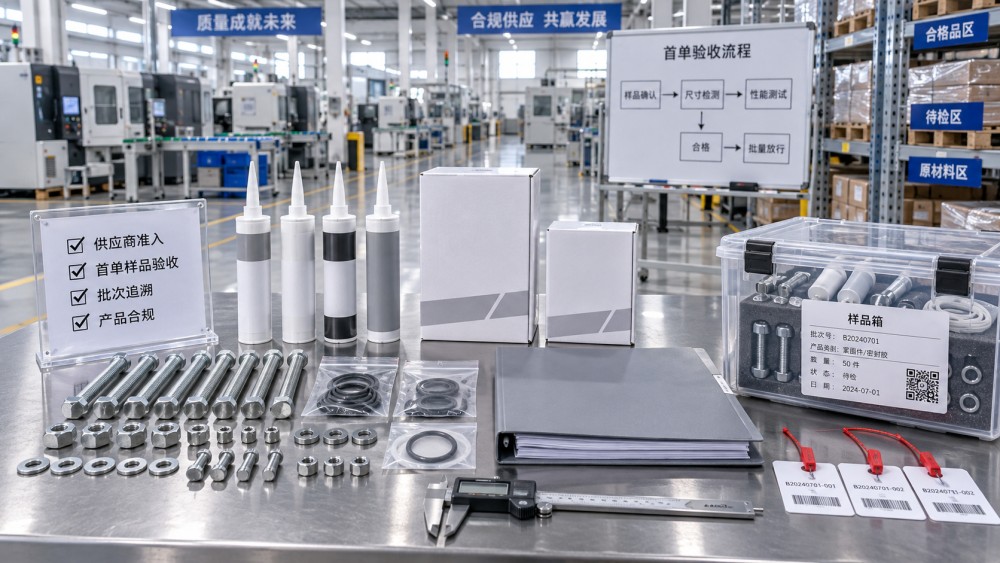
Approval should not always mean unrestricted release for production volume. For moderate- and higher-risk vendors, the first order can function as a structured qualification step. This approach is especially useful for custom hardware, printed packaging, electromechanical parts, specialty adhesives, and products with customer-visible finishes.
The first order should define what is being approved: a sample, a pilot batch, an initial production run, or the supplier’s ongoing capability. Those are different decisions. A sample can demonstrate appearance or fit, while a production run reveals whether the supplier can maintain consistency, protect goods in transit, issue accurate documents, and meet the agreed dispatch date.
Set acceptance criteria before goods arrive. The criteria may include incoming inspection points, required certificates, packaging condition, label format, dimensional checks, functional testing, shelf-life verification, and approval of any deviations. Assign one owner for consolidating the result. Without that role, quality may approve the product, logistics may accept the delivery, and the project team may discover later that required compliance records were never received.
Where a deviation is accepted, record the scope and expiration of that acceptance. A temporary approval for a pilot batch should not quietly become a permanent substitution. This is particularly important when a material source, surface treatment, formulation, or manufacturing location changes after an initial sample has been approved.
Put Change Control in the Supplier Relationship From Day One
Many supplier issues do not arise because the first supplied item was unacceptable. They arise when a supplier changes something thought to be operationally minor: a raw material source, coating provider, tool, production site, packaging method, inspection method, or component design detail. The change may affect function, appearance, regulatory status, assembly performance, or traceability.
Supplier compliance requirements should state which changes require prior notice and, where necessary, written approval. The list should be specific enough to be usable. For a cabinet hinge or fastener, a change in base material, plating process, dimensions, or production location may matter. For an adhesive, changes to formulation, labeling, shelf-life, container format, or manufacturing site may require review. For printed packaging, changes to substrate, ink system, print site, artwork, or food-contact status may be relevant depending on its application.
The supplier also needs a practical route for raising deviations before shipment. Project teams should avoid creating a culture in which vendors conceal problems because formal reporting seems punitive or slow. A documented deviation received early can often be evaluated against the schedule. An undocumented substitute discovered after installation or assembly can trigger rework, delay, and disputes over responsibility.
Measure Compliance Through Operating Signals
Once a vendor is onboarded, annual document collection alone provides a limited view of performance. Ongoing supplier compliance should be observed through signals connected to the project’s real exposure.
For a recurring supplier, track the issues that indicate control is weakening: missing or inconsistent certificates, shipment labels that do not match purchase-order requirements, repeated late change notifications, increasing concessions, recurring packaging damage, unexplained lot changes, and corrective actions that remain open without evidence of effectiveness. Delivery performance matters, but on-time delivery should not conceal incomplete documentation or repeated specification deviations.
A small scorecard can be more useful than an elaborate supplier rating system if it leads to action. The scorecard should reflect the risk tier and include only measures the team can verify. For a high-risk source, documentation accuracy and traceability may deserve equal attention with delivery. For a readily replaceable standard item, order accuracy and responsiveness may provide a more proportionate view.
When problems occur, separate containment from root-cause correction. Containment protects the immediate project: hold a lot, inspect stock, arrange replacement material, or isolate affected assemblies. Corrective action addresses the process that allowed the issue to occur. A supplier response that explains the individual error but does not show what will prevent recurrence should not close the issue by itself.
A Practical Approval Decision
The final onboarding decision should be clear enough that the next team member understands the supplier’s status without reopening the entire assessment. Use categories that reflect operational reality: approved for standard purchases, approved for a defined product family, approved for pilot supply only, conditionally approved pending evidence, or not approved for the intended application.
Each approved supplier should have a concise record of the product scope, applicable specification revision, required documents, risk tier, approved sites, known limitations, and change-notification obligations. This becomes particularly valuable when project personnel change, purchasing is decentralized, or a supplier is asked to quote a new item that appears similar but has different compliance exposure.
Supplier compliance is most effective when it is treated as a project control, not a procurement formality. The disciplined work happens early: define what must be true for the supplied item to be usable, verify that the vendor can sustain those conditions, and establish how changes and failures will be handled. That framework gives project leaders a defensible basis for moving forward, limiting exposure without turning vendor onboarding into an administrative bottleneck.
Related News
- 00
0000-00
Which printing materials prevent ink cracking on flexible packaging? - 00
0000-00
Manufacturing trends exporters should watch when planning capacity - 00
0000-00
Office supplies market trends reshaping corporate buying priorities - 00
0000-00
When does industrial design for retail displays improve shopper flow? - 00
0000-00
What drives screw price differences between suppliers?
Weekly Insights
Stay ahead with our curated technology reports delivered every Monday.