





Dual sourcing is worth the cost when a supply interruption would cause losses that a second supplier can meaningfully reduce—and when that reduction exceeds the extra cost of maintaining two usable sources. The strongest case is a production-critical item with limited substitutes, a replacement lead time longer than available inventory coverage, and an alternative supplier that can deliver acceptable material before operations stall.
The case weakens when both suppliers depend on the same upstream producer, the backup lacks available capacity, or splitting orders makes an otherwise economical purchase expensive. For business leaders evaluating global supply chain insights, the useful question is how much continuity the additional spending actually buys. Two approved suppliers can still leave a business exposed to one common failure.
Start with the cost of losing the item, not its purchase value
A component’s annual spend is a poor guide to its supply risk. A low-cost fastener can prevent an assembled product from shipping. A specialized adhesive may represent a small share of manufacturing cost but require substantial validation before substitution. Packaging film can become production-critical when an alternative does not run reliably on existing equipment or meet the finished product’s requirements.
Procurement should therefore assess what happens after the item becomes unavailable. Does production stop completely, continue at a lower rate, or shift to another product? Can customers accept a revised delivery schedule? Can engineering approve an alternative quickly? These distinctions determine whether dual sourcing protects revenue, avoids additional operating costs, or simply adds convenience.
The financial exposure should include lost contribution margin on sales that cannot be recovered, emergency freight, overtime, restart costs, scrap, and contractual consequences where applicable. Delayed revenue should be distinguished from permanently lost sales. Counting the full sales value of every delayed unit can exaggerate the benefit of a second source, particularly when production can catch up without displacing other orders.
Time matters as much as financial severity. Compare usable inventory coverage with the time required to restore supply. Restoration includes more than manufacturing lead time: order acceptance, material availability, production scheduling, shipping, customs clearance, incoming inspection, and any customer approval all affect when material becomes usable.
A supplier with a short quoted lead time may offer little protection if that quotation assumes normal demand and readily available inputs. During a disruption, several buyers may seek the same replacement capacity. Evaluate the alternative under the conditions that would trigger its use.
Dual sourcing becomes more compelling where three conditions overlap:
- The item can interrupt production or prevent shipment, with limited practical substitution.
- Inventory and existing recovery arrangements cannot cover a credible supply interruption.
- A second source can shorten the interruption enough to avoid a material portion of the loss.
An item that meets only the first condition may be better protected through inventory. An item that meets the first two but fails the third may require a redesign, a different supply region, or a change in upstream material dependence.
Price the full arrangement, including the cost of keeping it usable
The purchase-price premium is only one part of the decision. Splitting demand can reduce volume discounts at the primary supplier and push both sources toward less favorable batch sizes. Smaller shipments can raise freight cost per unit, while separate minimum order quantities may increase inventory. Payment terms, duties, inspection requirements, and working capital can also change the economics.
Qualification costs vary by product and application. A standard office consumable may require a straightforward purchasing trial. A motor, bearing, adhesive, or printed packaging material may require engineering review, production trials, performance testing, or customer acceptance. Tooling, fixtures, artwork, and documentation can create further costs before the first commercial order is placed.
Some expenses recur. Quality teams must maintain specifications and control changes across both suppliers. Procurement must manage forecasts, orders, and commercial terms. Operations may need separate material identification or process settings. These activities consume resources even when neither supplier has a delivery problem.
A workable financial comparison separates three categories:
- Initial costs: qualification, tooling, trials, system setup, and any customer approval work.
- Recurring costs: price premiums, lost discounts, additional logistics, inventory carrying costs, supplier management, and ongoing validation.
- Avoidable disruption losses: the portion of an interruption’s financial impact that the second source can realistically prevent.
Spread initial costs over the expected useful life of the sourcing arrangement, while recognizing that design changes or short product lifecycles may reduce that period. Then compare the annual cost of maintaining the second source with the expected annual reduction in disruption losses. Include measurable routine benefits, such as reduced expediting, only where the sourcing plan supports them.
In plain terms, the financial test is whether the annual value of losses avoided and other measurable benefits exceeds the annual additional cost. The difficult inputs are disruption likelihood, interruption duration, and the share of demand the alternative can actually cover.
Use scenarios when those inputs are uncertain. Assess a short delivery delay, a prolonged supplier shutdown, and a disruption affecting both sources. For each, estimate when the alternative could deliver, how much it could supply, and what losses would remain. A plan that looks attractive only when the second supplier provides immediate, complete replacement deserves closer scrutiny.
A useful decision threshold is the disruption probability at which the added sourcing cost becomes justified. If a single defined interruption would create a given avoidable loss, dividing annual additional cost by that loss gives a rough break-even probability. This is a simplified screen: several disruption types, changing demand, and shared exposure require a broader scenario analysis.
Some businesses may still accept a premium above the expected financial benefit because a severe interruption would threaten liquidity or a strategically important customer relationship. That should be an explicit management decision with a spending limit. Otherwise, almost any extra sourcing expense can be defended as protection.
A second supplier must be independent—and able to respond
Supplier count does not measure resilience. Two distributors may purchase from the same manufacturer. Two factories may rely on the same resin producer, casting operation, port, or subcontractor. Separate corporate names offer limited protection when the disruption occurs at a shared dependency.
Map the dependencies relevant to the item’s likely failure modes. For packaging materials, that could include base film, resin, coating inputs, or conversion capacity. For electromechanical components, it could include castings, windings, electronic parts, or specialized production processes. The purpose is to identify whether the second source avoids the exposure that matters most.
Geographical separation can help with a local shutdown, but it does not automatically eliminate common risk. Suppliers in different countries may share an upstream material source or transport route. A nearby source may provide greater recovery value if it holds independent inputs and can deliver usable goods quickly. Distance alone is an incomplete measure.
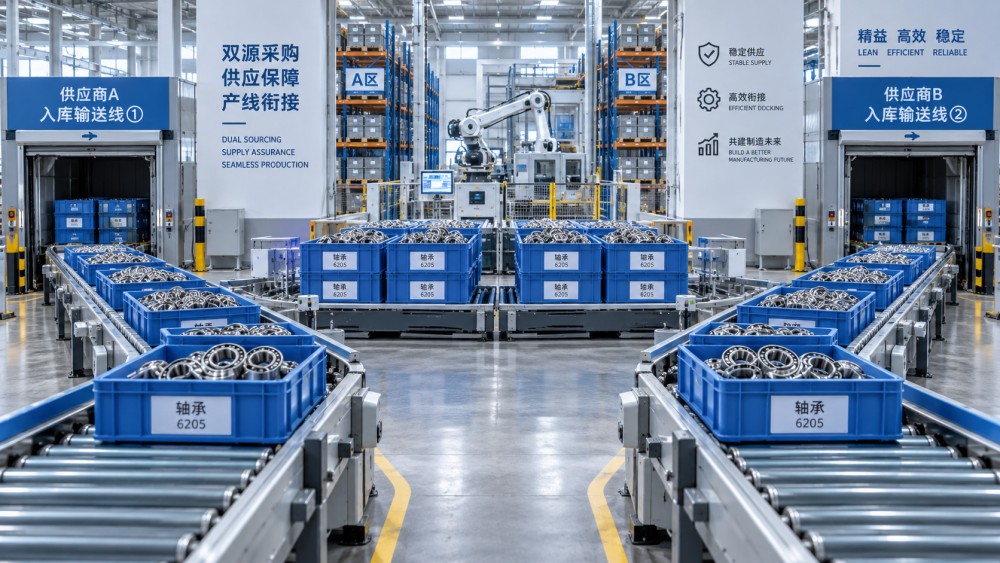
Independence must be paired with readiness. An approved supplier that has received no orders for an extended period may need fresh samples, updated documentation, new pricing, or another production slot before it can ship. Tooling may require maintenance. Specifications may have changed. The people who supported the original qualification may no longer be available.
For that reason, distinguish an approved alternative from an operating second source. Approval establishes that the supplier met requirements at a particular point. An operating source receives enough work to keep the product, process, and commercial relationship usable. The necessary order frequency depends on product stability, process complexity, and how quickly capability can deteriorate.
The volume split should reflect the recovery objective. Giving a supplier a small share of routine demand does not establish that it can absorb the rest. Before assigning a backup role, establish its normal capacity, additional capacity, ramp-up time, raw-material access, and competing commitments. Where reserved capacity matters, define what is being reserved and on what commercial terms.
Quality equivalence also needs a precise meaning. Two components can meet the same drawing yet behave differently during assembly. Adhesives may require different application or curing conditions. Packaging films may need different machine settings. Hardware finishes may vary in appearance across production lots. Acceptable differences should be understood before orders are redirected under pressure.
Approval should therefore cover the intended use, including relevant production conditions and customer requirements. If changing suppliers forces a lengthy line adjustment or additional acceptance process, that delay belongs in the recovery estimate. Dual sourcing earns its premium through usable supply arriving on time.
Choose the least expensive protection that meets the recovery need
Dual sourcing should be compared with other ways to bridge the same interruption. Additional inventory can be economical for stable, standardized items with manageable storage costs and long usable lives. It provides immediate coverage, although prolonged disruptions can exhaust it and demand changes can leave excess stock.
A qualified reserve supplier with periodic orders may suit an item where continuous volume splitting is too expensive but reactivation can happen within available inventory coverage. This arrangement requires a realistic activation plan. Its value falls sharply if the reserve source must begin qualification again when called upon.
Product or specification changes can sometimes offer stronger protection. Removing an unnecessary proprietary requirement, approving a standard size, or allowing a broader material specification may create access to several acceptable sources. Engineering work has a cost, but it can reduce dependence without maintaining duplicate purchasing arrangements indefinitely.
These options can be combined. Inventory may cover the period while a second supplier increases production. A primary supplier may retain most volume while an alternative receives regular orders sufficient to demonstrate capability. Separate sources may serve different regions, with defined arrangements for transferring demand if one is interrupted.
Management should select the arrangement against a clear operating requirement: the business needs a specified amount of usable supply within a specified period after disruption. Procurement can then compare the cost of meeting that requirement through inventory, a reserve source, active dual sourcing, or a combination. This produces a more defensible decision than applying a blanket rule to every critical item.
The sourcing agreement and internal plan should make responsibility visible. Who decides to transfer orders? What triggers that decision? Which specifications and approvals apply? How will transport be arranged? How much additional demand has the second supplier agreed to assess or support? Ambiguity in these areas can consume the recovery time the business paid to protect.
Review the decision when demand, product design, supplier ownership, upstream dependence, or logistics conditions change. A rising minimum order quantity can alter the cost case. A second source’s new upstream supplier can reduce independence. Lower demand can make the original volume split uneconomical.
For the next sourcing review, begin with the few items whose absence would halt production or shipment. Build a recovery timeline and a full cost comparison for each. Fund dual sourcing where a capable, sufficiently independent alternative closes a meaningful supply gap at an acceptable price. If the proposed supplier cannot close that gap, the business still needs protection—and the purchasing budget should go toward an arrangement that can.
Related News
- 00
0000-00
How to prevent delamination in laminated flexible packaging films - 00
0000-00
Fujifilm and ePac Partner Globally on Jet Press FP790 Deployment - 00
0000-00
Choosing technical ceramics for wear resistance under impact loads - 00
0000-00
Which compliance standards apply to children's stationery in the US? - 00
0000-00
How to assess a furniture components supplier’s production capacity
Weekly Insights
Stay ahead with our curated technology reports delivered every Monday.