





Packaging damage in international shipping is rarely caused by one weak carton or one careless handling event. It usually results from a mismatch between the product, the packaging design, the transport route, and the way cargo is loaded. A box that performs well in local delivery may fail after weeks of container vibration, port handling, stacking pressure, humidity, and multiple warehouse transfers.
For exporters asking, “How can I reduce packaging damage in international shipping?”, the practical answer is to build packaging around the actual hazards of the shipment rather than around the lowest material cost. That means protecting the product from movement, selecting the right outer packaging, controlling moisture exposure, and making sure pallet and container loading do not undo the protection built into the box.
The most effective approach is not always the heaviest package. Excess material can increase freight cost, reduce container utilization, and still leave a product vulnerable if the load is poorly supported. The goal is a package that keeps the product stable, separates fragile surfaces, withstands expected compression, and arrives in a condition that matches buyer expectations.
Start With the Damage Mechanism, Not the Packaging Material
Before choosing foam, cartons, pallets, or protective film, identify what is actually being damaged. Cracked ceramic items, scratched furniture hardware, dented metal components, wet paper stationery, and leaking adhesive containers do not require the same packaging solution.
Packaging decisions become more reliable when the product is assessed through four questions:
- Can the product break, bend, deform, leak, or lose surface finish under impact or pressure?
- Does the product have sharp edges, polished surfaces, coatings, threads, glass, moving parts, or protruding components?
- Will the shipment travel by sea, air, road, rail, or a combination of these methods?
- Will cartons be loose-loaded, palletized, floor-stacked in a container, or handled through distribution centers?
A polished cabinet handle may not break during transit, but it can arrive with scratches caused by metal-to-metal contact. An electric motor may survive a drop but suffer bearing damage if it moves repeatedly inside the carton. Paperboard packaging for office supplies may retain its shape in dry storage yet soften and collapse after prolonged moisture exposure. Each failure mode points to a different priority.
Do not assume that a product is durable simply because it is made of metal or rigid plastic. Surface damage, corrosion, misalignment, missing parts, and damaged retail presentation can all create claims even when the main product still functions.
Compare Protection Methods by What They Control
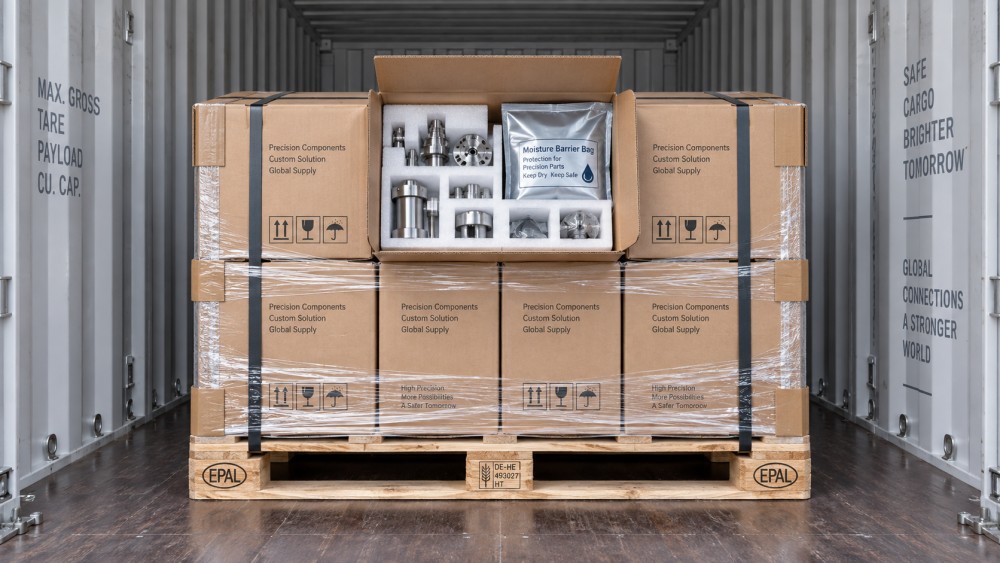
Export packaging is more dependable when each layer has a clear job. Inner protection prevents product-to-product contact. Cushioning absorbs shock and limits movement. The outer carton or crate carries stacking loads. Pallets and container securing protect the shipment at the unit-load level.
The comparison shows why “use stronger cartons” is often an incomplete answer. A stronger outer box may resist compression, but it will not prevent a loose pump, bearing, or ceramic item from striking the inside wall. Likewise, premium foam does little good when cartons are stacked beyond their intended load or allowed to shift across the container floor.
Use the lightest protection system that controls the real damage risk. For a simple metal fastener, moisture protection and a durable carton may matter more than custom cushioning. For a glazed ceramic object, separation, immobilization, and shock absorption deserve more attention than carton appearance. For retail-ready stationery or printed packaging, protection against crushing and dampness may be more important than impact resistance.
Eliminate Internal Movement Before Adding More Material
Internal movement is one of the most common causes of transit damage. It creates repeated impacts during vehicle vibration and makes the product more likely to hit the carton walls when the package is dropped or tilted. Exporters sometimes respond by adding loose fill, but loose fill is not always enough for dense or heavy items because it can migrate within the carton.
A properly packed product should not rattle, slide, or rotate inside its package. This does not mean every empty space must be tightly compressed. Overpacking can transfer impact directly to a brittle item, especially glass, ceramics, coated surfaces, and thin-walled plastic parts. The package needs controlled support, not random pressure.
For products with uneven shapes, support the strongest areas while shielding the weakest ones. A protruding handle, threaded shaft, ceramic edge, or electrical connector should not become the point that takes the impact. Design inserts so that the product rests on stable surfaces and remains centered away from the outer carton walls.
Small components require the same discipline. Furniture fittings, screws, bolts, drawer slides, and cabinet accessories are often shipped in bulk or kits. When metal parts move freely, they can scratch finished components, tear bags, or scatter within the carton. Separate hardware by material or finish where necessary, use properly sealed inner bags, and keep heavy components from resting against decorative parts.
Choose the Outer Pack for Compression, Not Just Appearance
International shipments are frequently stacked, even when cartons carry handling labels. Labels can communicate a preference, but they do not replace structural packaging. The outer package must tolerate the realistic load placed on it during storage, palletization, and transit.
Carton selection should consider product weight, carton dimensions, stacking duration, and moisture exposure. Large cartons with heavy contents are more likely to bulge, split at seams, or lose shape when handled from the sides. A smaller carton with better load distribution can be safer than a larger carton that reduces the number of boxes but creates an unstable unit.
For dense items such as motors, metal fittings, fasteners, pumps, or adhesive containers, reinforce the base and ensure the product weight is supported by the carton structure rather than only by tape. Use closures suited to the carton and load. Tape can secure flaps, but it cannot compensate for weak board, overloaded cartons, or a box that has already lost rigidity.
Packaging dimensions also matter. Excessively tall cartons are prone to instability. Overhanging products or bulging sides make pallet stretch wrap less effective and increase the chance of crush damage. Where product dimensions allow, standardize carton footprints so pallet layers interlock cleanly without unsupported gaps.
Moisture Control Changes the Packaging Decision
Sea freight introduces a moisture risk that is easy to underestimate. Humid air, temperature changes, and condensation inside containers can affect cartons, labels, paper inserts, metal surfaces, adhesives, and coatings. Even products that are not water-sensitive can be damaged when wet corrugated board loses stiffness and no longer supports stacking loads.
Moisture protection should be matched to the product. Metal components may need corrosion-resistant wrapping or sealed inner protection. Printed products, stationery, packaging materials, and paper-based inserts benefit from barriers that reduce direct exposure to moisture. Adhesives, sealants, and liquids may need packaging that also accounts for leakage, cap loosening, and contamination of adjacent cartons.
Do not treat plastic wrap as a universal moisture solution. Wrapping a pallet too tightly without considering the condition of the goods can trap moisture already present in packaging or products. The objective is to keep cargo dry and stable throughout the route, not simply to cover it in film.
Palletization Can Protect the Shipment or Create the Damage
A well-designed carton can still fail because of poor palletization. Pallets distribute weight, reduce direct handling, and make container loading more predictable, but only when cartons are arranged as a stable unit.
Keep cartons within the pallet footprint. Overhang exposes corners to impact from forklifts, racking, container walls, and adjacent cargo. It also concentrates load on carton edges, where crushing often starts. Build even layers, place heavier cartons lower down, and avoid creating a pallet that is tall but narrow or visibly leaning.
Stretch wrap, strapping, corner protection, and top protection should be selected according to the shipment. Stretch wrap stabilizes cartons but should not be relied on to hold together a poorly stacked pallet. Strapping can control movement, yet excessive tension can crush weak cartons. Corner boards are useful when a pallet needs added edge stability, particularly for cartons that must retain a clean retail appearance.
Container loading deserves the same attention. Empty space between pallets or loose cartons allows shifting during braking, turning, vessel movement, and handling. Use appropriate blocking, bracing, dunnage, or load-securing methods to limit movement. At this stage, the question is no longer whether one carton is strong enough; it is whether the entire shipment behaves as one stable load.
Match Packaging to the Route and the Product Category
There is no single export packaging specification that suits every product. The right choice changes with route length, transport mode, shipment value, and product sensitivity.
Air shipments typically involve more handling events but shorter transit time. Products may need strong edge protection and secure internal restraint, while prolonged moisture exposure may be less central than for sea freight. Sea shipments commonly require more attention to compression, humidity, container conditions, and long-duration vibration. Mixed transport routes require packaging that can tolerate both repeated handling and extended storage.
Product category also changes the balance. Ceramic crafts need separation and cushioning around fragile forms. Furniture hardware often needs scratch prevention, compartmentalization, and moisture control for finished metal surfaces. Electromechanical equipment requires stable positioning to protect connectors, shafts, housings, and internal components. Packaging films and printing materials need protection from crushing, edge damage, and environmental exposure. Adhesives and sealants need secure closures, compatible secondary containment where appropriate, and cartons that can remain intact if a primary package is stressed.
GIFE tracks product and material developments across packaging, furniture hardware, electromechanical equipment, ceramics, stationery, industrial adhesives, and fasteners. For exporters working across several of these categories, packaging should be treated as part of product quality control rather than as a final warehouse task. Changes in materials, finishes, product dimensions, and shipping routes can all require the packaging specification to be reviewed.
Test the Actual Pack Configuration, Not a Single Empty Box
Packaging problems are often discovered too late because only the carton is checked, not the fully packed shipment. A meaningful review includes the product, inner packaging, closure method, pallet pattern, and expected stacking arrangement.
Look for practical warning signs before goods leave the facility: cartons that bulge after filling, gaps that allow products to shift, loose hardware bags, tape lifting at dusty or uneven seams, pallet corners that extend beyond the base, or cartons becoming soft in humid storage. These visible issues are more useful than a generic statement that the package is “export grade.”
When damage claims occur, separate the evidence into product damage, inner-pack failure, carton failure, pallet instability, and container movement. This prevents the common mistake of replacing one material without fixing the actual cause. If cartons are crushed from above, adding more inner foam will not solve the issue. If plated hardware is scratched inside intact cartons, a stronger pallet will not address the problem.
Use a Packaging Specification That People Can Follow
The best design fails when different shifts, suppliers, or packing locations interpret it differently. A usable packaging specification should state the product orientation, number of units per inner pack, required separators or inserts, permitted void-fill method, carton type, sealing method, pallet arrangement, and moisture-control requirements where relevant.
Photos or diagrams are especially useful for complex products, but the written instruction must still identify what cannot be changed without approval. This may include carton dimensions, insert position, bag thickness, maximum gross weight, stacking direction, or the separation method for finished surfaces.
Reducing packaging damage in international shipping comes down to controlling movement, compression, moisture, and load stability as one system. Start with the damage mechanism, compare materials by the protection they actually provide, and review the complete shipment rather than one package in isolation. That approach reduces avoidable claims while keeping packaging proportionate to the product and route.
Related News
- 00
0000-00
When does lifestyle product sourcing make sense for home stores? - 00
0000-00
When high strength bonding technology outperforms mechanical fasteners - 00
0000-00
Which printing materials prevent ink cracking on flexible packaging? - 00
0000-00
Manufacturing trends exporters should watch when planning capacity - 00
0000-00
Office supplies market trends reshaping corporate buying priorities
Weekly Insights
Stay ahead with our curated technology reports delivered every Monday.