





What Should Buyers Do When Demand Forecasts Are Wrong?
What should buyers do when demand forecasts are wrong? For sourcing teams managing industrial adhesives, fasteners, packaging materials, or furniture hardware, the immediate answer is not simply to replace the forecast. It is to identify what changed, establish which inventory and supplier commitments are exposed, and adjust purchasing before the mismatch becomes more expensive.
The response also depends on the direction of the error. Buying too much creates a cash and obsolescence problem. Buying too little creates a service and production problem. Treating both with the same blanket instruction—“reduce orders” or “increase safety stock”—usually moves the trouble somewhere else.
Good buyers do not expect perfect forecasts. They distinguish between uncertainty that can still be managed and commitments that have already become difficult to reverse.
Check whether demand changed—or the signal did
Before changing purchase orders, reconcile customer orders, shipments, inventory movements, and the production schedule. These measures answer different questions. Shipments can fall because stock was unavailable, not because demand weakened. Distributor purchases can rise because the distributor is building stock, not because end users are consuming more.
For components used in manufacturing, check the bill of materials and planned output as well. A cabinet redesign may shift consumption from one hinge specification to another while total cabinet production stays unchanged. Buying against the old product mix would produce excess inventory and shortages at the same time.
Ask whether the discrepancy is a timing shift, a genuine volume change, or a specification change. A delayed customer project may still require the original quantity later. A lost contract may not. A revised adhesive application may make the old grade unusable even if overall purchasing volume remains steady.
Keep the original forecast visible during this review. Overwriting it removes the evidence needed to understand when the error appeared and which assumptions failed. Record the revision separately, with its reason and date.
Build an exposure view before making cuts
A warehouse balance is not the full purchasing exposure. Buyers need to see usable stock, allocations, incoming deliveries, and supplier work already authorized. An open order awaiting production is not equivalent to finished, customer-specific goods ready to ship.
Separate quality-held, damaged, expired, or otherwise unavailable inventory from usable stock. Then map expected receipts and demand by period. A total inventory figure can look comfortable while concealing a shortage before the next delivery—or a surplus arriving after the customer project ends.
An exposure review should identify these decision points:
- Which purchase orders remain cancellable or reschedulable under the agreed terms?
- Which materials have already been purchased, converted, printed, coated, or assembled?
- Which stock can serve other products, sites, or customers without modification?
- Which items face shelf-life, revision, storage, or customer-approval constraints?
Prioritize by consequence, not just purchase value. A low-cost, hard-to-replace fastener can hold up an assembly. Excess printed packaging can be expensive to retain because its artwork may become obsolete. Adhesives require attention to remaining shelf life and storage history, not merely the quantity sitting on a shelf.
Also separate forecast demand from confirmed requirements so the same customer order is not counted twice. For each item, agree how confirmed orders consume the forecast before recalculating replenishment.
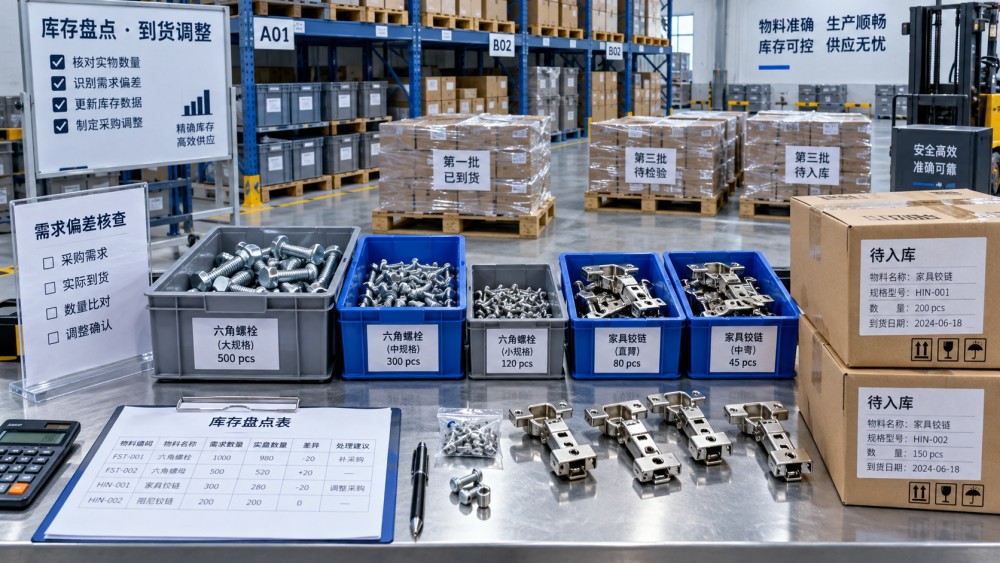
When demand falls: compare cancellation, delay, and redirection
Cancellation is attractive because it appears to remove the problem immediately. But once a supplier has committed to dedicated materials or processing, cancellation may carry charges or require negotiation. Start with the production status and contract, rather than assuming every undelivered order can be stopped.
Deferral is not demand reduction. Moving receipts into the next quarter only helps if consumption is likely to recover or the delay creates time for another disposal route. Otherwise, it hides the surplus and may transfer storage costs to the supplier without resolving the underlying liability.
For customized packaging, consider whether the next batch can be stopped before printing or conversion. For furniture hardware, explore whether common components can remain unfinished until the required finish is confirmed. These options depend on the supplier’s process; they are worth discussing before finished goods accumulate.
When demand rises: expedite the constraint, not everything
A shortage does not automatically justify airfreighting the entire order. Identify the first date on which usable stock will run out and the quantity needed to bridge the gap. A partial expedited shipment may protect production while the balance travels through the normal route.
Compare three options: accelerating the existing supplier, transferring approved stock internally, and buying from an alternative source. The cheapest quoted unit price may not be the cheapest recovery route once inspection, testing, freight, and production disruption are included.
An apparently equivalent bearing, motor, adhesive, or bolt should not bypass technical review because the purchase is urgent. Dimensions alone may not establish interchangeability. Load capacity, material grade, coating, cure behavior, operating conditions, or customer approvals may determine suitability.
Check what is actually limiting delivery. Faster transport will not help if the supplier is waiting for raw material or production capacity. Ask for milestone dates and available partial quantities, not just a revised final delivery promise.
Where supply cannot cover every requirement, agree allocation priorities with operations and sales. Consider contractual obligations, production dependencies, and realistic customer alternatives. Purchasing should not have to make those trade-offs alone.
Choose flexibility that matches the product
Once the immediate exposure is contained, review how orders are placed. Large fixed orders can support pricing and production efficiency when consumption is stable. Smaller releases, blanket agreements, or capacity reservations can reduce exposure when demand varies—but flexibility usually has a cost or a limit.
Compare the total cost rather than treating flexibility as free. Smaller deliveries may increase freight, handling, or setup charges. A blanket order may still commit the buyer to a minimum quantity. Capacity reservations may require payment even if the reserved output is not used.
For broadly reusable fasteners or standard office supplies, holding a modest buffer may be reasonable if consumption is dependable. For printed packaging, decorative ceramic ranges, or customer-specific fittings, limiting finished-goods commitments may matter more. For industrial adhesives, replenishment should account for usable shelf life at receipt and expected consumption before expiry.
Supplier-held inventory also needs clear ownership terms. Establish when title transfers, when invoices become payable, who bears damage or expiry risk, and what happens if demand never returns. Stock held elsewhere is not necessarily risk removed from the buyer.
Improve the next decision, not just the next forecast
Forecast accuracy is useful, but an aggregate score can conceal purchasing problems. Overestimates on one product and underestimates on another may offset each other numerically while leaving both excess stock and shortages. Review error by item or meaningful product family, using the forecast available when the buying decision was made.
Track persistent over- or underforecasting alongside the size of the errors. Percentage measures can be misleading for items with little or no demand, so include unit differences and operational consequences. The relevant question is whether the error caused avoidable inventory, missed delivery, or emergency spending.
Use external intelligence as a cross-check, not a substitute for customer evidence. The Global Industrial Finishing & Essentials (GIFE) covers market trends, price movements, product developments, and supply-chain changes across industrial and commercial categories. That context can help buyers investigate whether a discrepancy reflects a wider market shift, a material change, or an internal planning issue. It cannot establish a particular customer’s future consumption.
Set review triggers around decisions that can still be changed. Reassess exposed orders before supplier production starts, before custom printing is approved, or before a replenishment release becomes binding. A monthly review is too late if the commitment window closes earlier.
Leave the recovery meeting with a short action record: affected items, quantities, supplier commitments, agreed changes, owners, and the next review date. Preserve unresolved assumptions rather than presenting them as confirmed demand. The practical test is simple: if the forecast changes again next week, will the team know which purchases it can still adjust—and which it must now manage?
Related News
- 00
0000-00
How to prevent delamination in laminated flexible packaging films - 00
0000-00
Fujifilm and ePac Partner Globally on Jet Press FP790 Deployment - 00
0000-00
Choosing technical ceramics for wear resistance under impact loads - 00
0000-00
Which compliance standards apply to children's stationery in the US? - 00
0000-00
How to assess a furniture components supplier’s production capacity
Weekly Insights
Stay ahead with our curated technology reports delivered every Monday.