





Choosing a sustainable packaging manufacturer is not just about eco-friendly claims—it is a compliance decision that can affect product safety, market access, and brand trust. For quality control and safety managers, checking regulatory alignment, material traceability, certifications, and supplier risk indicators early helps prevent costly delays and nonconformities. This guide outlines the key compliance issues to review before problems reach production or distribution.
Why early compliance checks are becoming more urgent
Across consumer goods, industrial components, food contact packaging, electronics, furniture, office supplies, and export-oriented manufacturing, the role of the sustainable packaging manufacturer is changing. Buyers are no longer checking only print quality, dimensions, or freight performance. They are now screening for restricted substances, recycled content claims, labeling accuracy, country-specific packaging rules, and the supplier’s ability to document all of it within short approval windows such as 2 to 6 weeks before launch.
This shift is driven by a visible market signal: sustainability claims are moving from branding language into auditable compliance territory. When a package includes statements such as recyclable, compostable, reusable, plastic-reduced, or fiber-based alternative, the burden of proof often expands beyond the package itself. Quality control teams may need evidence from raw material declarations, migration or safety testing, conversion records, and artwork review logs. A sustainable packaging manufacturer that cannot support these requests creates risk long before any shipment is booked.
For safety managers, the practical concern is not theory but exposure. A noncompliant ink, adhesive, coating, or additive may trigger relabeling, market withdrawal, border delay, or internal deviation handling. In fast-moving supply chains, one packaging nonconformity can freeze thousands of units of finished product for 7 to 30 days. That is why early review matters: it is usually cheaper to reject a weak supplier at the qualification stage than to correct a packaging compliance gap after production starts.
Trend signals quality teams should not ignore
Several signals are appearing across industries at the same time. Procurement specifications are becoming more detailed, customer audits are asking for sustainability evidence, and brand owners are tightening approval gates. In many organizations, packaging sign-off now includes quality, regulatory, EHS, and sourcing reviews rather than a single purchasing decision. This broadens the checklist that a sustainable packaging manufacturer must pass.
- More RFQs request declarations for inks, coatings, adhesives, recycled content, and substrate origin.
- More buyers require document refresh cycles every 12 or 24 months rather than one-time submission.
- Export projects increasingly involve parallel checks for market access, waste management rules, and product safety standards.
- Claims on pack are being reviewed with higher scrutiny to reduce greenwashing exposure and consumer complaint risk.
The result is clear: when selecting a sustainable packaging manufacturer, compliance readiness has become part of supplier capability, not an optional extra.
What is changing in supplier evaluation criteria
In the past, supplier qualification often focused on price, lead time, print consistency, transit durability, and defect rate. Those factors still matter, but the threshold has moved. Today, the stronger sustainable packaging manufacturer is usually the one that can connect environmental positioning with technical control. That means documented materials, controlled change management, formal specification approval, and practical evidence for every major claim on the packaging.
From a trend perspective, the biggest change is the move from static documentation to dynamic compliance management. A certificate issued once is no longer enough if resin grades, paper sources, additive systems, or subcontract converters change every 3 to 9 months. Quality and safety managers should therefore evaluate not only whether documents exist, but also how quickly the supplier updates them and whether document control is linked to production batches and artwork versions.
The table below summarizes how evaluation criteria are shifting in practical terms for cross-industry buyers.
This change affects every industry because packaging sits at the intersection of safety, sustainability, product presentation, and logistics. Even when the packaged item is non-food and non-medical, packaging claims and material composition may still create legal or commercial exposure if they are not controlled.
The first questions to ask a sustainable packaging manufacturer
The earliest screening stage should be short but demanding. Instead of requesting a large generic brochure, ask a focused set of questions that reveal whether the supplier operates with discipline. A useful first screen can often be completed within 5 to 10 business days and should reveal whether deeper qualification is worth the effort.
Initial review points
- Can the supplier provide a current specification for each substrate, ink, adhesive, liner, and coating used in the proposed pack?
- Is there a documented process for notifying customers before any formulation, source, or converter change?
- Can the supplier support application-specific requirements such as food contact, heavy metal limits, or sector-specific chemical restrictions where relevant?
- How are recyclability or compostability claims validated, and do the claims match the actual package structure?
- What is the normal lead time for technical documents, compliance declarations, and sample revisions: 48 hours, 1 week, or longer?
These questions help quality teams distinguish a sustainable packaging manufacturer with process maturity from one that relies mainly on sales language.
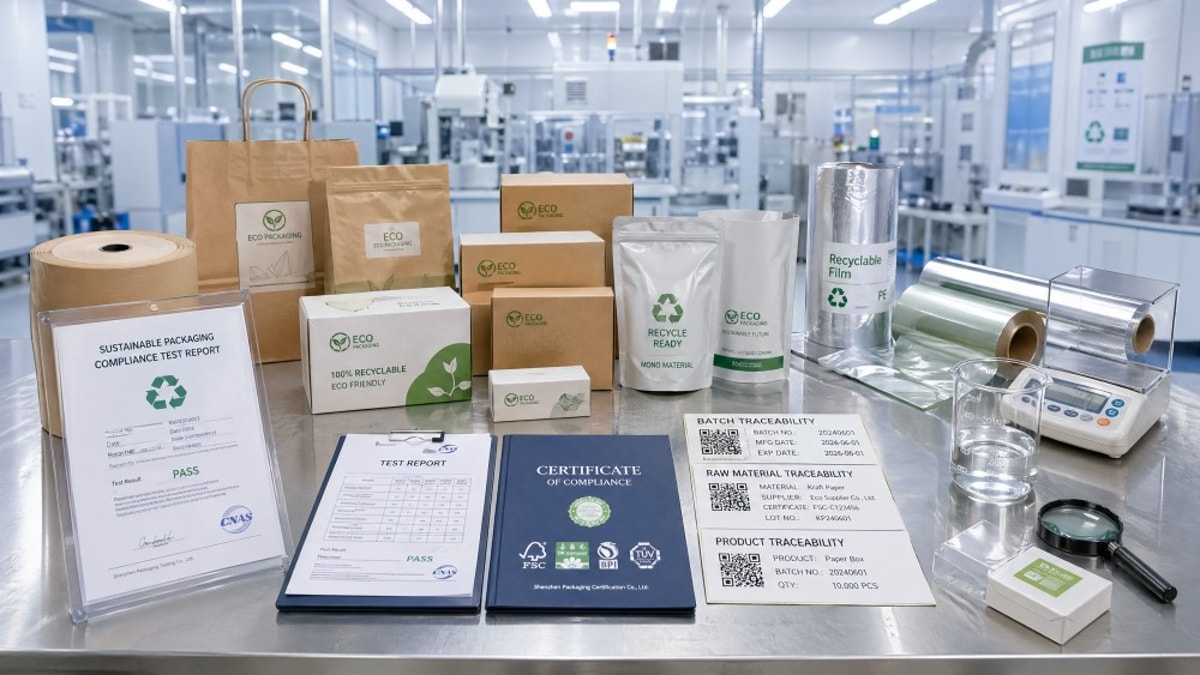
The compliance issues that should be checked before production approval
The most important trend in packaging control is that late-stage checking is no longer enough. By the time first articles arrive, key material and claim decisions have already been made. For that reason, quality control and safety managers should build a pre-production review that covers at least six compliance dimensions: material legality, traceability, testing, claims, change control, and supplier governance.
A sustainable packaging manufacturer should be able to show which raw materials are used, where they come from, and how they connect to the final packaged format. This does not always require disclosure of every commercial detail, but it should provide enough visibility to verify risk. Traceability that stops at the finished carton or pouch is often too shallow for modern compliance review, especially when recycled inputs or multilayer structures are involved.
Another growing issue is claim mismatch. Packaging may be described as recyclable in theory, yet local collection systems, labels, inks, adhesives, or barrier layers may complicate the real disposal route. The safe approach is to treat every environmental statement as a controlled product claim. If evidence cannot be produced within a reasonable period such as 3 to 7 working days, the claim should be reconsidered before artwork release.
Core compliance checklist
The table below can be used as an early-stage checklist when evaluating a sustainable packaging manufacturer across multiple industries.
A checklist like this helps standardize supplier screening across product lines. It also reduces dependency on individual judgment, which is important when multiple plants, regions, or packaging formats are involved.
Documents that should exist before launch
Not every project needs the same file set, but some baseline documents should be available before mass production. If a sustainable packaging manufacturer cannot provide them before launch, quality teams should define whether production can proceed with deviation approval or should remain blocked.
- Approved packaging specification with revision date and clear construction details.
- Material declaration or compliance declaration covering relevant substances and intended use.
- Test summaries for physical performance, and where needed, chemical or migration testing.
- Artwork approval record showing final legal wording and disposal guidance.
- Change notification procedure and contact matrix for technical escalation within 24 to 72 hours.
This document discipline is one of the strongest indicators of whether a sustainable packaging manufacturer can support long-term compliance, not just first-order supply.
How different risk signals affect quality and safety teams
Not all supplier risks look dramatic at first. Some of the most serious packaging issues begin as small inconsistencies: a delayed declaration, a vague recycled content statement, a missing batch code logic, or an artwork file that differs from the approved proof by one claim line. For quality control personnel, these are not minor administrative flaws. They are early indicators that system control may be weak.
A useful trend in supplier management is the use of risk grading rather than pass-or-fail thinking. For example, a low-risk gap might be an outdated template that can be corrected in 48 hours. A medium-risk gap could be incomplete traceability for one component supplier. A high-risk gap might be unsupported food contact suitability, undisclosed material substitution, or no formal change control at all. This grading helps safety managers prioritize attention and decide when containment is necessary.
In cross-border business, response speed matters almost as much as the initial compliance position. A sustainable packaging manufacturer that needs 2 to 3 weeks to answer a basic substance question may create bottlenecks during customer audits, customs review, or deviation closure. Slow response can itself be treated as an operational risk signal.
Warning signs that deserve escalation
- Claims such as biodegradable or recyclable are used broadly, but no application-specific support file is available.
- Supplier documents cover only the main substrate and exclude inks, laminates, varnishes, or adhesives.
- One specification is used for multiple packaging constructions with no revision breakdown.
- Subcontract printing or converting is used, but the downstream control chain is unclear.
- Lot coding or shipment traceability cannot reliably narrow affected stock within 4 hours of investigation.
When two or more of these signs appear together, the safer approach is to pause approval and request corrective evidence. This is especially important for products exported into multiple markets with different waste, labeling, or chemical rules.
Why this matters beyond packaging
Packaging nonconformity can quickly expand into broader business disruption. It may interrupt finished goods release, create customer scorecard penalties, trigger internal CAPA activity, or weaken a company’s sustainability reporting credibility. In sectors with retailer oversight or regulated end users, one packaging issue can affect tenders and renewals for the next 6 to 12 months.
That is why leading teams now evaluate a sustainable packaging manufacturer as part of enterprise risk control, not merely as a source of outer pack materials.
A practical early-review framework for future-ready supplier decisions
The most effective response to these changes is to build a staged review process. A future-ready qualification model does not wait until PO issuance or first article arrival. It starts when a packaging concept is proposed and then deepens through sample validation, launch approval, and periodic re-review. For many companies, a 4-stage model is enough to improve control without slowing procurement excessively.
Stage 1 is concept screening: determine whether the package structure, environmental claims, and target markets are compatible. Stage 2 is supplier evidence review: collect specifications, declarations, and traceability logic. Stage 3 is validation: verify physical performance, label accuracy, and any needed safety tests. Stage 4 is ongoing surveillance: refresh documents every 12 to 24 months or sooner after a material, source, or market change. This approach helps quality teams turn a reactive problem into a managed process.
The framework below can support discussions with procurement, EHS, regulatory teams, and plant operations when selecting a sustainable packaging manufacturer.
This staged method is practical because it aligns with how compliance risk actually appears: gradually, at different decision points, and often through small signals rather than one dramatic event.
What to monitor in the next 12 months
Looking ahead, quality and safety managers should watch four categories of change. First, packaging claims will likely receive closer scrutiny from customers and market authorities. Second, document traceability will matter more as recycled and mixed-material structures expand. Third, supplier transparency around subcontracting and material sourcing will become a stronger differentiator. Fourth, cross-functional approval will continue to grow, meaning packaging decisions may require more alignment across quality, compliance, sourcing, and marketing.
For any sustainable packaging manufacturer under consideration, the question is no longer only whether the pack looks greener. The more important question is whether the supplier can keep the package compliant as requirements evolve over the next product cycle, audit cycle, and market expansion cycle.
Why choose us for compliance-focused packaging intelligence
At GIFE, we understand that selecting a sustainable packaging manufacturer requires more than environmental positioning. Quality control and safety managers need decision support that connects packaging materials, claim credibility, supply risk, and global industrial realities. Our focus on industrial finishing, commercial essentials, and sustainability-linked market intelligence helps teams assess what is changing, where risk is rising, and which supplier signals deserve immediate review.
If your team is comparing suppliers, updating a packaging specification, preparing for export review, or trying to reduce approval delays, we can help you structure the right questions early. You can contact us to discuss compliance checkpoints, supplier screening criteria, packaging material selection, documentation expectations, sample evaluation priorities, lead-time planning, and market-oriented claim review.
Contact us if you need support with parameter confirmation, packaging option comparison, certification-related document planning, customized review frameworks, sample support pathways, or quotation discussions linked to compliance scope. When a sustainable packaging manufacturer is evaluated with the right early controls, your business gains more than greener packaging—it gains fewer surprises, stronger release confidence, and better protection for product quality and brand trust.
Related News
- 00
0000-00
Electromechanical Engineers Consulting for Faster System Integration - 00
0000-00
Sustainable Packaging Solutions: What Works at Scale and What Fails - 00
0000-00
Global Value Chain Management Mistakes That Raise Export Risk - 00
0000-00
Industrial Finishing Technology Trends to Watch in 2026 - 00
0000-00
Industrial Production Efficiency Fixes That Do Not Require New Lines
Weekly Insights
Stay ahead with our curated technology reports delivered every Monday.