





Choosing among sustainable packaging suppliers can look straightforward—until hidden costs surface in tooling, certifications, freight, lead times, and compliance. For procurement teams, a smart comparison goes beyond unit price to evaluate total value, supply risk, and long-term scalability. This guide explains how to assess sustainable packaging options with greater clarity, helping buyers avoid costly surprises while securing both operational efficiency and sustainability goals.
For most procurement teams, the real question is not simply which supplier offers the lowest quote. It is which supplier can deliver sustainable packaging at a predictable total cost, with reliable quality, compliant materials, and enough operational flexibility to support future demand. Hidden costs often appear after supplier selection, when change orders, failed testing, damaged goods, or unstable lead times begin to affect the wider business.
The core search intent behind comparing sustainable packaging suppliers is practical and commercial: buyers want a clear way to evaluate suppliers without overlooking cost drivers that sit outside the headline unit price. They need a framework for comparing sustainability claims, production capabilities, risk exposure, logistics variables, and long-term value. In short, they want to buy smarter and avoid unpleasant surprises.
That is especially true for procurement professionals, who are often measured on cost control, supply continuity, compliance, and supplier performance at the same time. They are less interested in generic sustainability messaging and more interested in issues such as minimum order quantity, tooling ownership, defect rates, freight efficiency, packaging performance, and whether the supplier can support scaling across multiple SKUs or regions.
This article focuses on the parts that matter most in real buying decisions: total cost of ownership, hidden cost categories, supplier due diligence, sustainability verification, and a practical comparison model. Broad environmental theory is less useful here than a disciplined sourcing method. If you are selecting a sustainable packaging partner, these are the areas that deserve the most attention.
Start with total cost of ownership, not the lowest unit price
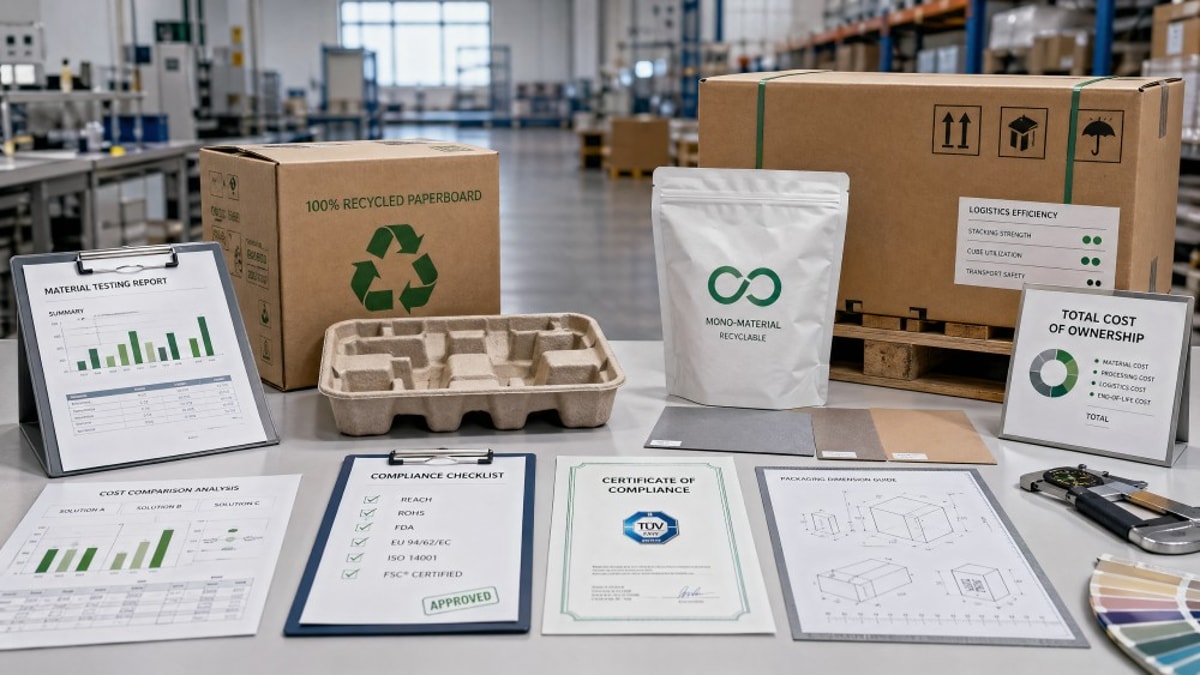
When buyers compare sustainable packaging suppliers, the biggest mistake is treating quoted unit price as the main decision metric. In reality, sustainable packaging should be evaluated through total cost of ownership, or TCO. A supplier with a slightly higher unit price may reduce freight, improve packing density, lower breakage, shorten lead times, or simplify compliance documentation. Those benefits can easily outweigh a cheaper per-piece quote.
This matters because sustainable packaging often involves alternative materials, new production methods, or different performance profiles from conventional plastic-heavy packaging. A molded fiber tray, recycled board carton, mono-material pouch, or compostable format may affect storage, transit protection, machine compatibility, and disposal pathways. If those downstream factors are ignored, procurement may save money on paper and lose more across operations.
A strong TCO model usually includes direct and indirect cost layers: unit price, setup fees, tooling and sampling, inventory holding, warehousing cube efficiency, transportation, customs implications, product damage rates, production downtime, returns, and compliance administration. The goal is not to make comparison more complicated for its own sake. It is to reflect the real economics of packaging across its lifecycle.
Buyers should also look at cost stability over time. Some suppliers quote aggressively to win new business, then recover margin later through material escalators, artwork revision fees, low-volume surcharges, or longer replenishment cycles that force emergency buying. Sustainable packaging sourcing should therefore include both current TCO and future cost predictability.
Identify the hidden costs that most often distort supplier comparisons
Hidden costs in sustainable packaging tend to cluster around a few recurring categories. The first is development cost. This includes structural design, prototyping, testing rounds, artwork adaptation, printing plate changes, and tooling. A supplier may appear economical until these one-time or semi-recurring charges are fully added. Procurement should ask which costs are included in the quote, which are billed separately, and which may reappear if dimensions, materials, or graphics change.
The second category is certification and compliance cost. Buyers frequently assume a supplier’s sustainability claims are ready for market use, but that is not always the case. FSC certification, recycled content verification, food-contact declarations, compostability standards, chemical compliance, or regional packaging regulations may require document collection, testing, audits, and legal review. If the supplier cannot provide these efficiently, internal teams absorb the burden.
A third hidden cost is freight inefficiency. Sustainable packaging formats can vary significantly in weight, nesting efficiency, flat-pack design, and pallet utilization. A lower-cost package that ships poorly may increase landed cost materially. For international buyers, ocean freight, dimensional weight, container fill rate, and port handling all matter. Sustainable does not automatically mean logistics-efficient, and procurement should compare landed cost per delivered usable unit, not ex-works price alone.
Then there is lead-time risk. Some sustainable materials depend on limited regional supply, specialized converting capacity, or seasonal agricultural inputs. If replenishment times are long or variable, buyers may need higher safety stock, dual sourcing, or expedited transport. Those are real costs. They may not appear in the quote, but they affect working capital and service levels directly.
Finally, there are performance-related hidden costs. A package that is environmentally attractive but fails drop testing, moisture resistance, stacking strength, or filling-line compatibility can trigger damage, rework, customer complaints, and packaging line interruptions. In many industries, the most expensive packaging is the package that looks compliant but underperforms in actual operations.
Ask supplier questions that reveal real capability, not just sales language
Supplier comparison improves dramatically when procurement asks questions designed to expose operational truth. Start with manufacturing capability. Does the supplier own production, outsource key processes, or depend on a network of converters? What quality controls exist at each stage? How often are batches tested? What is the standard defect threshold? Can they provide process consistency for multi-location rollouts or product line expansion?
Next, test material transparency. Ask exactly what makes the packaging “sustainable.” Is it recyclable in the buyer’s target market, or merely technically recyclable? Is the fiber virgin, recycled, or mixed? What percentage of post-consumer recycled content is actually verified? If the packaging is compostable, in what environment: industrial, home, or only under specific regional conditions? Vague answers here often signal downstream risk in marketing claims and regulatory compliance.
Procurement should also ask about source resilience. Where do critical raw materials come from? Are there alternative material pathways if one input becomes constrained? Has the supplier experienced shortages in the past two years, and how were customers affected? Sustainable packaging programs can fail not because the concept is wrong, but because the supplier lacks raw material flexibility under market stress.
Commercial questions are equally important. What is the minimum order quantity per SKU? Are blanket orders possible? How are price adjustments handled if resin, pulp, paper, or energy costs change? Who owns tooling? What happens if the buyer changes suppliers later? Hidden lock-in can make an apparently attractive supplier much more expensive over the medium term.
Lastly, evaluate responsiveness. A sustainable packaging supplier should be able to support not only production but also issue resolution, documentation requests, design changes, and collaborative optimization. Slow communication increases the hidden cost of every exception. Strong suppliers reduce friction across procurement, quality, operations, and sustainability teams.
Verify sustainability claims with the same rigor used for quality and cost
One of the most common procurement risks in sustainable packaging is treating environmental claims as a branding matter instead of a sourcing control issue. If claims are overstated, poorly documented, or not aligned with destination-market rules, buyers can face relabeling costs, customer disputes, rejected shipments, or reputational damage. Verification should therefore be part of the supplier scorecard, not an afterthought.
Start by matching claims to business needs. If your goal is improved recyclability, the supplier should prove the package is compatible with local recovery systems where the product is sold. If your goal is reducing virgin plastic, ask for verifiable material composition. If your customers require chain-of-custody documentation, ensure the supplier can provide it consistently and in the required format. The right claim is the one that can be substantiated and used operationally.
It is also wise to distinguish between certificate possession and system maturity. A supplier may hold relevant certifications but still struggle with version control, traceability, audit readiness, or document turnaround. Procurement should test how quickly the supplier can produce declarations, test reports, and renewal schedules. A document that exists in theory but arrives too late is still a hidden cost.
Another point often missed is regional compliance variation. Packaging accepted in one market may require different labels, material disclosures, or waste reporting in another. For companies sourcing globally, the best sustainable packaging supplier is not just the one with green materials, but the one capable of supporting cross-border compliance efficiently. This becomes increasingly important as packaging regulation evolves in Europe, North America, and parts of Asia.
Compare logistics, inventory, and operational fit before making a final decision
Even a well-designed package can become expensive if it does not fit the buyer’s operational system. Procurement should compare how each packaging option performs across warehousing, line feeding, handling, and outbound distribution. Questions such as how many units fit per pallet, whether the packaging arrives assembled or flat, and how easily it integrates with packing processes can significantly affect labor and storage costs.
Inventory implications deserve special scrutiny. Sustainable packaging suppliers may require higher minimum runs because of specialized material sourcing or machine setup economics. That can increase stockholding and obsolescence risk, especially for seasonal products, short promotional cycles, or frequently updated branding. A supplier with higher piece price but lower MOQ and better replenishment rhythm may create stronger total value.
Transit performance is equally critical. Procurement should request test data, pilot shipment feedback, and if possible, trial results under real transport conditions. Moisture sensitivity, compression strength, abrasion resistance, and product immobilization all influence damages and returns. Sustainable packaging that fails in long-haul or mixed-mode distribution can generate costs far beyond packaging spend itself.
In many cases, the best supplier is the one that helps optimize the entire packaging system rather than simply sell a material. For example, redesigning dimensions to improve carton density or pallet stacking may lower freight emissions and freight cost simultaneously. Buyers should actively value suppliers that can contribute this type of cross-functional improvement.
Use a weighted supplier scorecard to make comparisons defensible
To avoid subjective decisions, procurement teams should use a weighted scorecard when comparing sustainable packaging suppliers. This helps align sourcing decisions with broader business priorities and creates a clear audit trail. A useful scorecard typically includes five core categories: commercial cost, sustainability credibility, quality and performance, supply assurance, and service capability.
Commercial cost should include more than unit price. Build in tooling charges, logistics efficiency, MOQ impact, expected defect cost, and the likelihood of future surcharges. Sustainability credibility should assess verified content, recyclability or compostability practicality, documentation quality, and the risk of claim disputes. Quality and performance should be scored using test data, pilot results, and process controls.
Supply assurance should consider capacity, raw material resilience, lead-time consistency, geographic coverage, and contingency planning. Service capability should measure communication speed, technical support, issue resolution, and willingness to collaborate on improvement. Depending on the business, procurement may assign heavier weighting to supply assurance than to marginal price differences, especially if packaging is business-critical or customer-facing.
A practical scoring model might weight cost at 30%, quality and performance at 25%, supply reliability at 20%, sustainability verification at 15%, and service support at 10%. The exact percentages can change, but the principle remains: sustainable packaging sourcing decisions should be evidence-based and balanced. This reduces the chance of selecting a supplier who looks attractive in one dimension but creates problems everywhere else.
Watch for supplier red flags before you commit
Certain warning signs appear repeatedly in weak supplier evaluations. One is incomplete quoting. If a supplier avoids clarifying tooling, freight assumptions, sample charges, testing scope, or document support, there is a good chance hidden costs will emerge later. Another red flag is generic sustainability language with limited evidence. Terms like eco-friendly or green are not decision-grade information.
Unstable lead-time commitments are another concern, especially when paired with optimistic promises and vague sourcing explanations. If a supplier cannot explain capacity planning, raw material backup, or shipment visibility, the buyer may end up financing uncertainty through extra stock or premium transport. That cost usually does not show up during onboarding, but it appears quickly during demand fluctuations.
Procurement should also be cautious when a supplier resists trials, performance testing, or structured review. Strong sustainable packaging suppliers generally welcome pilot projects because they understand that packaging must work commercially as well as environmentally. Avoid suppliers that oversell sustainability benefits while downplaying durability, machinery compatibility, or documentation discipline.
Conclusion: the best sustainable packaging supplier is the one with the clearest total value
Comparing sustainable packaging suppliers effectively means looking beyond attractive pricing and broad sustainability claims. For procurement teams, the right decision comes from understanding total cost of ownership, validating performance, checking compliance readiness, and testing whether the supplier can support reliable operations over time. Hidden costs are rarely random; they usually come from areas that were not examined deeply enough at the selection stage.
The most effective buying approach is structured and evidence-based. Define your packaging priorities, map the hidden cost categories, ask operational questions, verify claims, and score suppliers across commercial, technical, and sustainability criteria. This process may take more effort upfront, but it prevents avoidable cost leakage and reduces sourcing risk later.
In the sustainable packaging market, a good supplier does more than provide materials. The right partner helps procurement achieve cost control, compliance confidence, operational efficiency, and credible sustainability progress at the same time. That is the comparison standard worth using.
Related News
- 00
0000-00
Electromechanical Engineers Consulting for Faster System Integration - 00
0000-00
Sustainable Packaging Solutions: What Works at Scale and What Fails - 00
0000-00
Global Value Chain Management Mistakes That Raise Export Risk - 00
0000-00
Industrial Finishing Technology Trends to Watch in 2026 - 00
0000-00
Industrial Production Efficiency Fixes That Do Not Require New Lines
Weekly Insights
Stay ahead with our curated technology reports delivered every Monday.