





Choosing a sustainable packaging manufacturer takes more than trusting eco-friendly labels or bold carbon claims. For procurement teams, the real challenge is verifying material traceability, production standards, compliance readiness, and long-term supply reliability. This guide explores how to assess suppliers beyond marketing language, helping buyers reduce risk, support sustainability goals, and secure packaging partners that deliver measurable value.
In B2B sourcing, packaging is no longer a peripheral purchase. It affects transit protection, regulatory exposure, waste costs, customer perception, and increasingly, access to retailers and export markets. A weak supplier assessment can create hidden liabilities that surface 3 to 12 months later through failed audits, inconsistent material quality, or delayed compliance documentation.
For procurement professionals across industrial, commercial, and consumer-facing supply chains, the right sustainable packaging manufacturer should offer more than recycled content claims. The supplier should demonstrate process control, stable lead times, verifiable material inputs, and a practical path toward lower-impact packaging without compromising performance or unit economics.
From the perspective of GIFE, where packaging aesthetics, production finishing, and global manufacturing intelligence intersect, supplier evaluation works best when sustainability is treated as an operational capability rather than a branding statement. That means looking closely at documentation, engineering discipline, testing methods, and responsiveness under real purchasing conditions.
What Procurement Teams Should Verify First
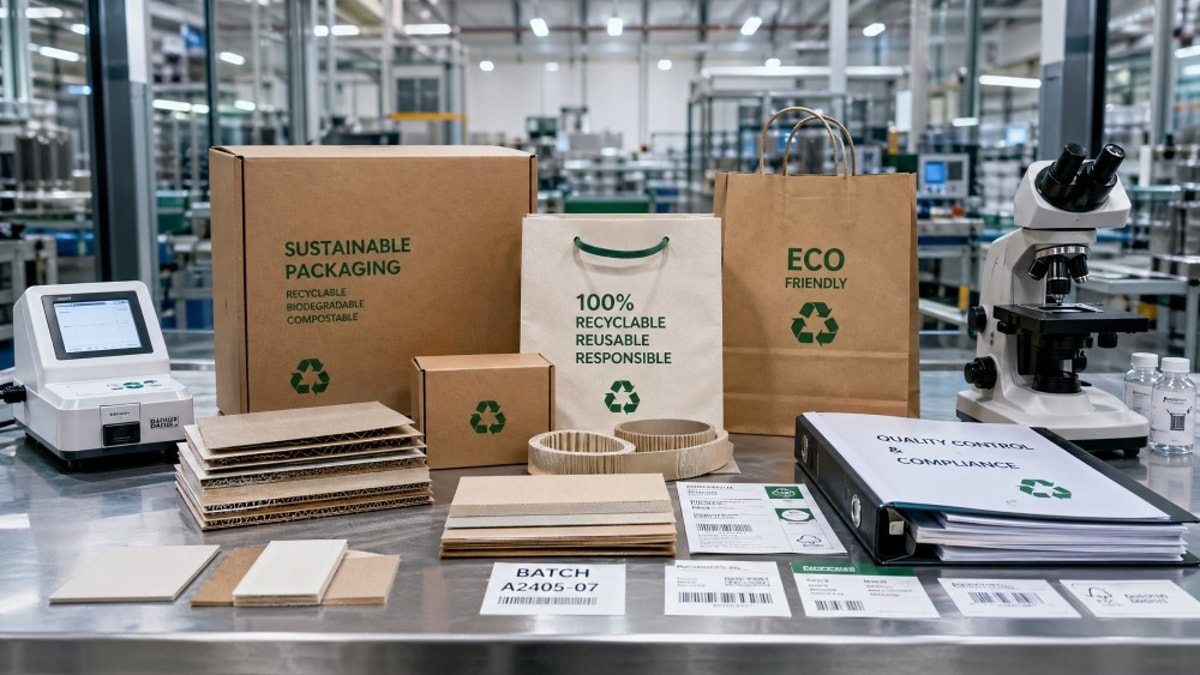
A sustainable packaging manufacturer should first be assessed on evidence, not messaging. Before discussing innovation, buyers should confirm whether the supplier can provide a material declaration, basic process map, and compliance file set within 5 to 10 business days. If these essentials are delayed or incomplete, deeper sustainability claims are harder to trust.
The first review should cover four areas: material origin, converting process, regulatory readiness, and delivery reliability. In many sourcing projects, procurement teams focus heavily on unit price and overlook data quality. Yet inconsistent data often signals inconsistent operations, especially when suppliers outsource printing, lamination, coating, or board conversion to multiple subcontractors.
It is also important to distinguish between a packaging trader and a true manufacturer. A trader may still be useful, but the risk profile differs. If the company does not control at least 2 to 3 core production steps internally, such as extrusion, die-cutting, corrugation, pouch making, or final quality inspection, buyers should expect less visibility and weaker root-cause control.
The minimum supplier evidence pack
At the early RFQ stage, ask for a standardized evidence pack. This should not be a marketing brochure. It should include a bill of materials structure, substrate specifications, recyclability or compostability positioning where relevant, and a list of the production sites involved. Procurement can save 20% to 30% of qualification time by using a fixed intake checklist across all candidate suppliers.
- Material composition by layer, coating, adhesive, ink system, and additive where applicable.
- Country or region of origin for primary substrates and any major outsourced conversion step.
- Typical MOQ, lead time range, sample turnaround, and monthly output capacity.
- Compliance documents used for export, food contact, retailer requirements, or restricted substance review.
A supplier that cannot clearly explain its packaging structure often cannot optimize it either. This matters when buyers are trying to reduce plastic weight by 8% to 15%, improve cube efficiency, or move from mixed-material formats toward mono-material alternatives without causing machine downtime or damage claims.
Red flags in early conversations
Several warning signs appear before a site audit ever happens. Vague answers about recycled content, refusal to disclose subcontracting, or claims that every format is “fully sustainable” should trigger closer review. Sustainable packaging is highly format-specific. A pouch, molded pulp insert, coated paper box, and corrugated shipper each carry different trade-offs in barrier, strength, finish, and recovery pathway.
Another red flag is when the supplier cannot explain test methods. Even a mid-sized sustainable packaging manufacturer should be able to discuss basic metrics such as GSM, burst strength, compression resistance, moisture sensitivity, seal integrity, dimensional tolerance, or transport simulation parameters depending on the format. Buyers do not need perfect technical jargon from sales, but they do need operational fluency.
How to Validate Materials, Claims, and Traceability
Sustainability claims often break down at the material level. A package described as recyclable may still contain incompatible laminates, coatings, labels, or closures that reduce practical recovery. Procurement teams should ask the sustainable packaging manufacturer to identify every functional layer and state whether the claim refers to the whole pack, the main body, or only a portion of total weight.
Traceability is especially important when recycled content is part of the value proposition. Buyers should request batch-level or lot-level traceability for key inputs, plus supplier declarations covering post-consumer or post-industrial content where applicable. For higher-risk categories, it is reasonable to ask how far upstream traceability extends and whether data can be retained for 12 to 24 months.
Claims should also be tied to practical application conditions. Compostable formats, for example, may require industrial composting rather than home composting. Paper-based alternatives may perform well for dry goods but fail in high-humidity or grease-contact applications. Procurement should not only verify the claim but match it to the intended use, storage environment, and transport route.
Questions that reveal real material transparency
The table below can help purchasing teams compare how deeply each supplier supports verification. It is designed for practical sourcing discussions rather than academic sustainability scoring.
When a sustainable packaging manufacturer can answer these questions clearly, procurement gains more than transparency. It gains leverage in product qualification, customer communication, and future redesign discussions. Suppliers with weak traceability often struggle during non-conformance investigations, especially when a packaging defect surfaces after export or retail distribution.
Match the claim to the application
A package that performs well in one channel may fail in another. For example, e-commerce packs may need stronger edge crush and drop performance than shelf-ready display packs. Temperature shifts of 5°C to 35°C, long ocean transit of 4 to 8 weeks, or warehouse humidity above 70% can all change whether a “greener” material is commercially viable.
That is why material validation should include laboratory evidence where appropriate and transport-fit assessment where possible. Procurement teams should ask for sample test reports, trial data, or pilot production feedback instead of relying on generic sustainability narratives.
Manufacturing Capability Matters More Than Green Messaging
Even the most credible material claim loses value if the factory cannot convert the material consistently. A sustainable packaging manufacturer should be evaluated for process capability, quality control discipline, and change management. In practice, many packaging failures come not from the material concept but from unstable bonding, poor print registration, dimensional drift, or weak palletization control.
Procurement should understand which operations are performed in-house and which are subcontracted. The more handoffs in the production chain, the greater the risk of variation in color, thickness, odor, fit, or transit performance. This is especially relevant for multi-component packs that combine cartons, inserts, labels, tapes, sleeves, or molded protective parts.
Ask how the supplier handles new-product introduction. A disciplined manufacturer usually has a 4-step or 5-step launch flow covering technical review, sampling, line trial, approval, and scale-up. If the process is informal, the first three orders may become the real test stage, shifting cost and risk back to the buyer.
Operational checks for procurement audits
During audit preparation, procurement can use the following checkpoints to evaluate whether a supplier’s sustainability position is backed by manufacturing control rather than presentation slides alone.
- Review incoming material inspection frequency, acceptance criteria, and quarantine process for nonconforming lots.
- Check whether tooling, color standards, and specification revisions are version-controlled across production shifts.
- Confirm whether final inspection data is recorded by batch, by shift, or only by shipment summary.
- Assess backup planning for power outages, raw material delays, or subcontractor disruption during peak months.
Capacity planning should not be overlooked. If your annual demand is 500,000 units and the supplier’s practical monthly output is only 40,000 to 50,000 units during normal season, there is little room for forecast error, seasonal spikes, or urgent replenishment. Sustainable sourcing still requires conventional supply assurance discipline.
Sample-to-scale consistency
Many buyers approve an excellent sample, then receive unstable production output 6 to 8 weeks later. To avoid this, ask whether the sample was made on production equipment, pilot tooling, or hand-converted methods. A sustainable packaging manufacturer with mature controls should disclose this difference clearly and explain what may change at scale.
It is also useful to ask for tolerance ranges, not just target specifications. For instance, dimensional tolerances of ±1 mm to ±3 mm, board caliper ranges, or seal strength thresholds provide a more realistic basis for acceptance than nominal values alone.
Compliance, Documentation, and Global Market Readiness
For procurement teams serving multiple markets, compliance readiness often separates a usable supplier from a risky one. A sustainable packaging manufacturer should be able to support the specific documentation needed for the product category, destination market, and customer type. Requirements differ across industrial packaging, food-contact applications, electronics, furniture, office products, and retail channels.
Documentation should be reviewed as a living system rather than a one-time file drop. Buyers should ask how often declarations are updated, who approves them internally, and what happens when a material source changes. A supplier that updates compliance files only once per year may not be responsive enough for fast-moving export or retailer environments.
The next table summarizes practical documentation areas that procurement should review before nomination or contract award. Not every project needs every document, but the supplier’s ability to provide them on request is a strong indicator of maturity.
A supplier with strong compliance habits is often easier to integrate into large procurement systems. This matters when your business needs approved vendor lists, annual sustainability reporting inputs, or customer audit support. Documentation readiness also shortens onboarding and can reduce internal quality review cycles by 1 to 3 weeks.
Contract clauses worth adding
Beyond collecting documents, buyers should embed sustainability and quality expectations into purchasing terms. Useful clauses include change notification windows, lot traceability retention, corrective action response time, and approval requirements for subcontractor changes. These are practical safeguards, not legal formalities.
For many projects, a 48-hour initial response window for critical quality issues and a 10-business-day corrective action plan is reasonable. Where packaging supports regulated or high-visibility product lines, more stringent escalation triggers may be justified.
A Practical Scoring Model for Supplier Selection
Procurement teams often struggle because sustainability is treated as a yes-or-no filter rather than a weighted sourcing decision. A better approach is to score each sustainable packaging manufacturer across several dimensions, combining environmental intent with commercial and operational reality. This creates a decision process that can be defended internally and improved over time.
A useful model contains at least five categories: sustainability credibility, manufacturing capability, compliance readiness, supply stability, and total cost performance. Depending on project complexity, each category can be weighted from 10% to 30%. For strategic packaging, many buyers assign more weight to reliability than to headline sustainability claims, because repeated failures create both waste and cost.
The goal is not to find a perfect supplier. The goal is to compare trade-offs transparently. A manufacturer with slightly higher unit cost may score far better on traceability, documentation speed, and line consistency, leading to lower total risk over a 12-month sourcing cycle.
Example weighted scorecard
The scorecard below gives procurement teams a working framework. It can be adapted for corrugated packaging, paper-based retail packs, flexible packaging, molded fiber, protective inserts, or mixed-format projects.
This type of matrix helps procurement separate “green presentation quality” from actual supplier value. It also supports cross-functional alignment with quality, engineering, operations, and sustainability teams, which is often necessary when a packaging change affects multiple departments.
Common sourcing mistakes to avoid
One common mistake is selecting the supplier with the strongest sustainability story but the weakest delivery infrastructure. Another is demanding recycled or fiber-based alternatives without accounting for shelf life, automation speed, or compression needs. In both cases, the project may look successful at launch and fail during real-world scale-up.
A stronger approach is to run a structured pilot over 2 to 6 weeks, track packaging waste, transit damage, line efficiency, and documentation responsiveness, then score the result against pre-agreed criteria. That gives procurement a fact base instead of a narrative contest.
FAQ for Buyers Evaluating a Sustainable Packaging Manufacturer
How many suppliers should be benchmarked in a serious packaging sourcing project?
For most mid-complexity projects, 3 to 5 suppliers is a practical range. Fewer than 3 may limit market visibility, while more than 5 often creates administrative load without improving decision quality. If the packaging format is highly specialized or export-critical, begin with a broader market scan, then shortlist 3 qualified manufacturers for deeper review.
What is a reasonable lead time for qualification?
A straightforward qualification can take 4 to 8 weeks, including documentation review, sample development, technical feedback, and a commercial comparison. More complex projects involving new materials, line trials, or multi-market compliance may take 8 to 12 weeks. Compressed timelines are possible, but they usually increase the risk of incomplete validation.
Should procurement always prioritize the lowest-impact material?
Not automatically. The most appropriate solution balances environmental intent with protection, processability, cost, and compliance. If a lower-impact pack causes higher damage rates, rework, spoilage, or transport failure, the total sustainability outcome may worsen. Procurement should evaluate whole-system performance, not single-attribute claims.
What documents should be requested before final approval?
At minimum, ask for a current specification sheet, material declaration, production site details, lead time commitment, traceability explanation, and any application-specific test or compliance documentation. For strategic accounts, add change control procedures, corrective action workflow, and a sample retention or batch retention policy where relevant.
Vetting a sustainable packaging manufacturer beyond green claims requires procurement to think like both a risk manager and a value builder. Material transparency, manufacturing control, compliance discipline, and delivery resilience are the factors that determine whether sustainability goals survive real operating conditions.
For buyers navigating packaging, finishing, and commercial essentials across global supply chains, a stronger supplier evaluation framework can reduce hidden costs, improve audit readiness, and support more credible environmental progress. If you are reviewing packaging partners or planning a material transition, GIFE can help you assess supplier capability, compare sourcing options, and identify practical solutions aligned with performance and market demands.
Contact us to discuss your packaging sourcing priorities, request a tailored evaluation framework, or explore more intelligence-led solutions for sustainable industrial and commercial procurement.
Related News
- 00
0000-00
Electromechanical Engineers Consulting for Faster System Integration - 00
0000-00
Sustainable Packaging Solutions: What Works at Scale and What Fails - 00
0000-00
Global Value Chain Management Mistakes That Raise Export Risk - 00
0000-00
Industrial Finishing Technology Trends to Watch in 2026 - 00
0000-00
Industrial Production Efficiency Fixes That Do Not Require New Lines
Weekly Insights
Stay ahead with our curated technology reports delivered every Monday.