





Compliance failures rarely begin at the port. They usually begin much earlier: when a material is substituted without a new review, when a supplier declaration is accepted without checking its scope, when product labeling is treated as artwork rather than a legal requirement, or when a production team assumes that passing one customer’s inspection proves the goods are ready for every export market.
For manufacturers and exporters, manufacturing compliance risks are operational risks. They can stop a production batch, force rework after packaging is complete, delay customs clearance, trigger customer rejection, or make an otherwise saleable product unavailable in a target market. The commercial damage is often larger than the cost of a failed test. A delayed shipment can disrupt a buyer’s launch, consume scarce production capacity, and weaken confidence in future orders.
The practical question for decision-makers is not whether compliance matters. It is where the business is exposed before a nonconformity becomes expensive and difficult to reverse. In many industrial categories, the highest-risk points are material control, product-specific requirements, labeling and documentation, and unmanaged changes across the supply base.
Compliance must be assessed by product, market, and use case
A common mistake is to treat compliance as a company-level status. A factory may hold quality management certifications, maintain internal inspection procedures, and have experience exporting similar goods, yet a particular shipment can still fail to meet the requirements that apply to its destination, intended use, material composition, or buyer specification.
A furniture hinge, electric motor component, packaging film, adhesive, ceramic item, or fastener may look commercially similar across markets while facing different obligations in practice. The relevant questions can include whether the item contacts food, is used near children, forms part of an electrical assembly, contains restricted substances, carries a safety claim, or must display particular origin, traceability, disposal, hazard, or performance information.
Product classification also matters. A supplier may describe an item as a general industrial component, while a regulator, customer, or downstream assembler treats it as part of a regulated finished product. That difference can change the required evidence. An adhesive sold for general bonding, for example, may face a more demanding review when specified for packaging, interior applications, consumer goods, or products with controlled emissions requirements.
Before confirming a production schedule, management should be able to answer four basic questions:
- Which destination market or markets will receive this exact product?
- What is the product’s intended application after sale or assembly?
- Which technical, chemical, safety, labeling, and documentation obligations apply to that combination?
- Who owns the evidence that supports each claim, and is that evidence current for the production configuration?
These questions sound straightforward, but they expose a frequent gap between sales commitments and production readiness. Sales teams may receive a broad request for “compliant” goods without a defined destination, end use, or standard. Production then begins under an incomplete assumption. By the time a buyer asks for declarations, test reports, safety documentation, or marking details, the chosen materials and finished packaging may already be locked in.
A useful internal rule is to treat “compliant” as incomplete language. Compliance with what requirement, for which market, for which version of the product, and supported by what evidence? Until those points are clear, the order carries an unresolved delivery risk.
Material substitutions create some of the most avoidable failures
Manufacturers commonly manage cost, availability, and lead time by approving alternate raw materials or secondary suppliers. That flexibility can protect output, but it also creates a compliance vulnerability when the replacement is reviewed only for price and functional performance.
The risk is especially visible in products with coatings, inks, plasticizers, resins, metal finishes, fillers, solvents, pigments, packaging layers, and chemical formulations. A substituted input can alter restricted-substance content, emissions characteristics, migration behavior, flame performance, corrosion resistance, or the reliability of a declaration already provided to the customer.
The same issue applies to apparently minor components. A screw coating, label adhesive, plastic cap, protective foam, or printed carton can introduce a material issue that is absent from the main product. In export orders, buyers may review the finished unit, its retail packaging, and supporting documents together. A compliant main component does not necessarily rescue a shipment if the supplied configuration includes a nonconforming accessory or packaging material.
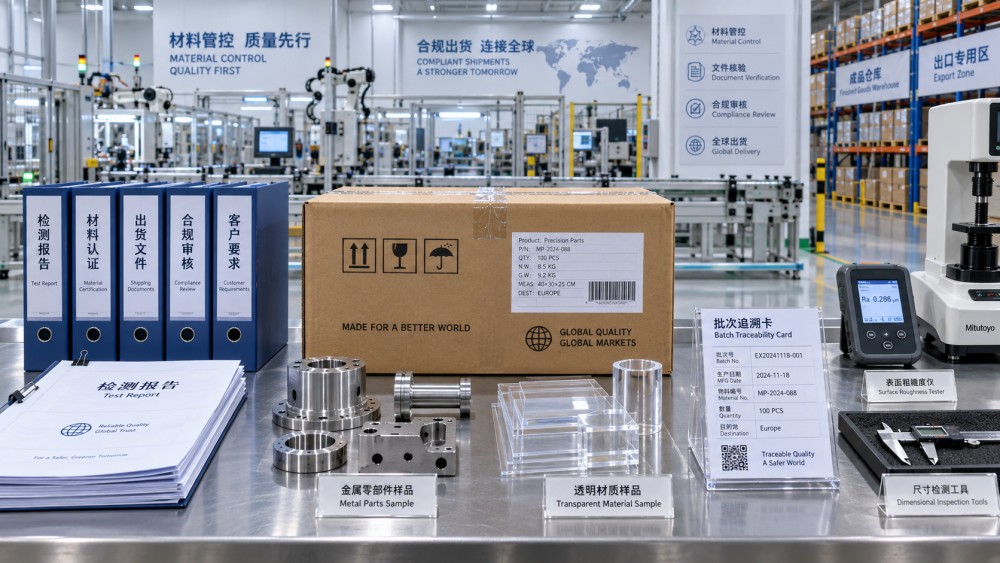
Material control is stronger when it operates as a release gate rather than a document archive. Each approved material should be linked to a defined supplier, specification, intended use, and evidence set. When a purchasing team proposes an alternative, the change should trigger a structured review before the material enters production. The review does not always require full retesting, but it should determine whether the substitution affects any regulated characteristic, customer specification, declaration, label, or previously completed assessment.
Decision-makers should be cautious about relying on a supplier statement that simply says a material is “free from harmful substances” or “meets international standards.” Such statements may be commercially useful but often lack the product scope, substance list, testing basis, validity period, and accountable issuer needed for a defensible compliance file. The stronger document is one that identifies the supplied material clearly and supports a requirement relevant to the intended market.
Change control needs commercial authority
In many organizations, engineering controls design changes while procurement controls supplier changes. Compliance teams may only see the result after goods have been made. This structure is vulnerable because commercial pressure often favors the fastest available substitute.
A workable process gives a named owner authority to pause a change when compliance evidence is missing. It also distinguishes between changes that are genuinely equivalent and changes that only appear equivalent in normal production. A revised coating color, different resin source, new printing ink, altered motor winding material, or replacement packaging film may all deserve review even when dimensions and routine quality checks remain unchanged.
The goal is not to make procurement slow. It is to avoid discovering, after a container booking or customer audit, that the production record no longer matches the documentation supplied with the order.
Documentation failures can delay goods that are physically acceptable
Some export delays arise because the product is defective. Others arise because the evidence is incomplete, inconsistent, expired, or attached to the wrong configuration. In the second case, production may be technically sound, yet the commercial outcome can be the same: the shipment cannot proceed as planned.
Documentation should be treated as part of the deliverable. Depending on the product and market, the file may need to include specifications, material declarations, safety information, test evidence, certificates where applicable, production traceability records, origin information, labeling artwork, packing details, and signed conformity statements. The exact set varies, but consistency across those documents is essential.
Three problems appear repeatedly.
- Scope mismatch: A report covers a similar model, material, color, size, or factory location, but not the exact product supplied.
- Configuration drift: The manufacturing bill of materials or packaging has changed after the evidence was issued, while the documents still describe the earlier version.
- Uncontrolled declarations: A declaration is copied from an old order or provided by a supplier without checking whether it remains accurate for the current batch and destination.
These failures are often detected by customers rather than regulators. Large buyers and distributors may require their own document formats, approved laboratory reports, signed supplier declarations, or traceability data before releasing an order for shipment. A manufacturer that regards those requests as administrative extras may find that production is complete but payment, shipment approval, or final acceptance is held back.
Labeling deserves the same discipline. Product labels, carton marks, warning statements, language requirements, batch codes, importer details, and handling symbols may be reviewed late because they sit between product development, packaging, marketing, and logistics. That organizational gap makes them easy to miss. Reprinting labels or cartons after goods are packed is costly; correcting them after export may be impossible without relabeling, warehousing, or return arrangements.
A pre-shipment compliance review should compare the physical goods, packaging, and order documents against one controlled product record. It should not rely on teams independently confirming that their own part is complete. The point is to identify contradictions before the goods leave the factory.
Supplier compliance is a traceability problem, not a questionnaire exercise
Manufacturers rarely control every material or component internally. Furniture hardware makers depend on plating providers, spring suppliers, plastic molders, and packaging converters. Electromechanical assemblers depend on wire, insulation, bearings, magnets, housings, and electronic components. Packaging producers may depend on films, coatings, inks, paper, and adhesives from several sources. Each tier can affect the final product’s compliance position.
Supplier questionnaires are useful for screening, but they do not establish continuous control. A supplier may answer accurately at onboarding and later change its raw-material source, formulation, process, or subcontractor. The manufacturer may receive a compliant first batch and a poorly documented later batch under the same part number.
For high-risk inputs, supplier management should focus on traceability and change notification. The business needs to know what was supplied, from whom, under which batch or lot, and whether the supplier had an obligation to notify the manufacturer before making relevant changes. This is particularly important for inputs that cannot be visually distinguished after assembly or curing, such as chemical additives, internal coatings, polymer grades, plating chemistry, insulation materials, and embedded electrical parts.
Risk-based supplier controls are more practical than imposing the same burden on every vendor. A standard steel fastener used in a low-regulation application may need ordinary incoming checks and purchase specifications. A coated component, adhesive formulation, food-contact packaging layer, electrical safety part, or child-use accessory may require tighter evidence, supplier approval, batch linkage, and escalation procedures.
Late testing is often a scheduling error
Testing is sometimes treated as the final confirmation after the production run. That approach is workable only when the requirement is already understood, the tested sample accurately represents the finished configuration, and there is enough time to respond to an unexpected result.
For new products, new markets, modified materials, or sensitive applications, a better sequence is to identify the likely compliance path during quotation or product definition, verify materials before large-scale purchasing, and schedule any necessary assessment before final packaging and shipment commitments become fixed. This allows the business to change a material, adjust a label, revise a process, or obtain missing supplier evidence while the cost of correction is still manageable.
Testing also has limits. A passed test result is not a blanket approval for future production. Its value depends on sample identity, method, product configuration, applicable requirement, and continuing control of the materials and process represented by that sample. When those inputs change, management should assume the original evidence needs review rather than assuming it automatically transfers.
That distinction matters for export businesses working across several product lines. Reusing evidence can be efficient when the configuration is genuinely unchanged and the document scope is clear. Reusing it casually creates an audit trail that looks complete until someone compares dates, model codes, bills of materials, supplier identities, or packaging revisions.
Build compliance into order acceptance, not only quality assurance
The most reliable control point is often before the order becomes a production commitment. Commercial teams should capture destination, customer requirements, intended application, required documents, labeling needs, approval milestones, and any prohibited material conditions as part of the order review. Operations can then determine whether the requirement is already covered or whether a new assessment, supplier confirmation, or lead-time adjustment is required.
This does not require a large compliance department for every manufacturer. It requires a clear path for escalation and a controlled product record that connects sales, engineering, purchasing, quality, packaging, and export documentation. The process should make it difficult to release an order based on vague claims, outdated files, or unapproved substitutions.
Management should also distinguish between a recoverable issue and a shipment-stopping issue. A minor document formatting error may be corrected quickly. Missing evidence for a restricted substance, an incorrect mandatory label, an untraceable critical component, or a product classification dispute can affect the entire order. Treating both categories as routine paperwork produces poor prioritization.
The businesses that reduce manufacturing compliance risks most effectively do not attempt to predict every possible regulatory issue. They make product-market requirements visible early, preserve control when materials and suppliers change, and ensure that the physical goods and their documentation tell the same story. That discipline protects more than market access. It protects production capacity, delivery credibility, and the ability to accept export orders with a realistic understanding of what must be delivered.
Related News
- 00
0000-00
When high strength bonding technology outperforms mechanical fasteners - 00
0000-00
Which printing materials prevent ink cracking on flexible packaging? - 00
0000-00
Manufacturing trends exporters should watch when planning capacity - 00
0000-00
Office supplies market trends reshaping corporate buying priorities - 00
0000-00
When does industrial design for retail displays improve shopper flow?
Weekly Insights
Stay ahead with our curated technology reports delivered every Monday.