





Which packaging material best protects products during export? There is no single winner. A five-kilogram electric motor, a carton of ceramic mugs, a pallet of cabinet hinges, and a shipment of water-sensitive adhesive cartridges may all travel in the same container, yet each faces a different failure mode. One needs load restraint, another needs cushioning, another needs moisture control, and another needs packaging that survives repeated warehouse handling.
The most reliable export packaging is usually a system rather than a material: an outer pack that resists compression, internal protection that controls movement, and a barrier or wrap that manages moisture, dust, abrasion, or corrosion. The right choice also depends on whether goods move by parcel courier, LCL consolidation, full-container load, air freight, or a mixed route involving several transfers.
For exporters across furniture hardware, electromechanical equipment, packaging supplies, ceramics, stationery, adhesives, and fasteners, the practical question is not simply “what is strongest?” It is: what protection is justified by the product’s value, fragility, geometry, shipping route, and destination handling conditions?
Start With the Damage You Are Trying to Prevent
Export damage rarely comes from one dramatic event. More often, it is cumulative: cartons are stacked too high, pallet loads shift during a truck transfer, humidity enters a container, metal parts rub against each other, or a fragile item has just enough empty space to crack after repeated vibration. A material can perform well against one risk and poorly against another.
A corrugated carton may be entirely adequate for boxed stationery, but it is not a substitute for a crate when a heavy pump or motor must be handled by forklift. Foam can protect delicate surfaces but may be excessive for robust fasteners. Plastic film can stabilize a pallet but cannot prevent a poorly designed carton from collapsing. These distinctions are where export packaging decisions are won or lost.
Before selecting materials, assess five basic conditions: product weight, product fragility, empty space inside the pack, expected climate exposure, and handling frequency. Also look at the product itself. Sharp hardware edges can cut thin bags; oily components can affect some paper-based cushioning; painted furniture fittings can be damaged by direct contact even when the part remains structurally intact.
Corrugated Cartons: The Default Outer Pack, but Not a Universal Solution
Corrugated board remains the most common export packaging material because it is widely available, printable, relatively light, and adaptable to many product sizes. For office supplies, sealed adhesive products, small furniture fittings, and packaged consumer goods, a properly specified carton often provides a sensible balance of protection and freight cost.
Its limitation is easy to overlook: corrugated board loses practical strength when exposed to moisture and sustained stacking pressure. A carton that looks acceptable at the factory can weaken during a long sea route, especially if container humidity is high or pallets are stored in poor conditions before loading. Carton design, board grade, flute configuration, closure method, and stacking pattern all matter. “Double-wall” is not automatically the right answer if the internal product can still move freely.
For dense products such as screws, bolts, bearings, or metal brackets, carton weight limits need particular attention. A small box filled with fasteners may become difficult to handle safely long before its dimensions suggest a problem. Dividing the shipment into smaller inner boxes, then placing those boxes in a master carton or on a pallet, often reduces breakage and handling mistakes better than merely using thicker board.
Foam, Bubble Wrap, and Air Cushions: Useful for Movement and Impact
Cushioning materials are chosen to manage shock and vibration, but they should match the product’s shape and weight. Loose-fill void fill, bubble wrap, polyethylene foam, expanded polystyrene, and molded foam inserts do not behave the same way under load.
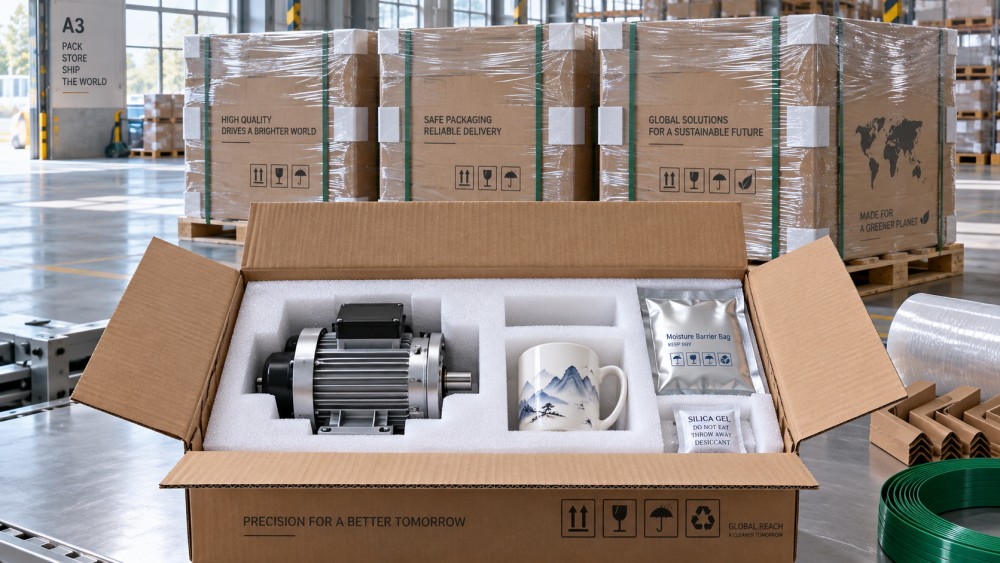
Bubble wrap is practical for lightweight items and surface protection, particularly where a product needs a flexible wrap rather than a precise fit. It is less dependable for heavy, concentrated loads. Heavy components can compress bubbles or migrate through loosely packed layers during transport. For an electric motor, a pump assembly, or a heavy cabinet hardware kit, shaped foam blocks or engineered inserts usually provide more predictable support.
Molded foam is particularly effective for fragile or irregular products because it limits movement in more than one direction. That can be valuable for ceramic crafts, delicate printed materials, coated fittings, and equipment with protruding shafts or control parts. The trade-off is higher tooling or setup cost, greater storage volume, and potential disposal concerns in some markets. It makes more sense for repeat shipments or products with a stable design than for a one-off mixed order.
Air pillows and inflatable packaging can reduce material use and pack weight, but they depend on maintaining inflation and having enough surrounding carton strength. They are best treated as void fill for appropriate goods, not as a universal answer to export impact protection.
Molded Pulp and Paper-Based Inserts: A Practical Middle Ground
Molded pulp has become a credible alternative where products are moderately fragile, shaped consistently, and buyers prefer fiber-based packaging. It is commonly suited to smaller consumer items, stationery sets, certain accessories, and some ceramic products when the product geometry allows a stable nest. Corrugated partitions and die-cut paperboard inserts can serve a similar purpose for glass, ceramics, bottles, and individually packed hardware.
The key limitation is moisture. Paper-based inserts can lose rigidity in humid conditions, and they may not provide enough cushioning for high-value, highly delicate goods without additional protection. A ceramic item can be well separated by partitions and still crack if the carton has excessive void space or if the pallet is exposed to hard impacts.
For exporters trying to reduce plastic content, the sensible approach is not to replace every foam component with paper immediately. Review what the foam is actually doing. If it only fills empty space, paper void fill may work. If it is supporting a heavy part at precise stress points, a different insert design may be needed before material substitution is safe.
Moisture Barriers Matter More Than Many Exporters Expect
Sea freight introduces a risk that domestic packaging often does not: extended moisture exposure. Condensation, changing temperatures, port storage, and high-humidity routes can affect cartons, printed packaging, adhesives, metal surfaces, and untreated wood products. The result may be corrosion, staining, carton softening, label failure, mold concerns, or product adhesion where components were intended to remain separate.
Polyethylene bags, barrier films, shrink bags, desiccants, and vapor corrosion inhibitor materials are used for different problems. A sealed plastic liner can help protect a carton’s contents from humidity, but it may not be suitable where trapped moisture or product off-gassing must be considered. Desiccants can support a moisture-control plan, yet they do not compensate for wet cartons, damaged container seals, or poor packing discipline.
For ferrous fasteners, bearings, machined parts, and certain electromechanical components, corrosion protection deserves its own review. Oil, protective wraps, barrier bags, and VCI materials may be considered depending on storage time, surface finish, destination climate, and buyer requirements. Compatibility matters: a packaging material should not leave residue, alter coatings, or create cleaning work at destination.
Stretch Film, Shrink Film, and Pallet Protection
Once cartons are stacked, pallet stability becomes the next line of defense. Stretch film is widely used to hold a unit load together, reduce dust exposure, and discourage minor carton movement. It is flexible and efficient for many palletized shipments, but it should not be used to hide an unstable stack. If cartons are uneven, overhanging, or too weak for the load above, more film will not solve the root problem.
Shrink film can provide a tighter outer cover in suitable applications, while corner boards, pallet caps, straps, and anti-slip sheets may improve load integrity. These supporting materials are often underestimated. A corner board can protect carton edges under strapping pressure; an anti-slip layer can reduce shifting between carton tiers; a top cap can offer limited protection from dust and overhead abrasion.
For LCL cargo, where pallets may be handled more often and placed near other freight, robust palletization is especially important. For full-container shipments, load planning matters just as much. The strongest pallet wrap cannot prevent damage caused by unblocked gaps inside the container.
Wooden Crates and Plywood Cases for Heavy or High-Risk Goods
Wooden crates, plywood cases, and reinforced export cases are generally the better choice when products are heavy, unusually shaped, high value, or vulnerable to forklift handling. Pumps, motors, machinery components, large furniture hardware assemblies, and ceramic pieces with awkward dimensions may need the rigidity that cartons cannot provide.
A crate should not be selected just because a product is expensive. It adds weight, takes time to build, and can increase freight cost. It may also need to meet phytosanitary requirements when solid wood packaging is used in international trade. Requirements can vary by destination and shipment circumstances, so exporters should verify the applicable rules rather than assume every wood package is acceptable. Plywood and other processed wood materials may be handled differently from solid timber, but this too should be confirmed for the route concerned.
The best crate design supports the item at structurally safe points. Suspending a unit by a weak handle, clamping a painted surface, or allowing a shaft to bear the load can create damage before the goods leave the warehouse.
A Material Comparison for Common Export Situations
Avoid the “Strongest Material” Mistake
Overpackaging can be almost as costly as underpackaging. A heavy crate around a low-risk product can increase freight charges and handling complexity without improving delivery quality. At the other extreme, using a lightweight carton for dense metal goods because it performed acceptably on a short domestic route is a familiar export mistake.
A better method is to build from the product outward. Immobilize the item first. Protect vulnerable corners, finishes, shafts, and edges. Add the correct moisture or corrosion barrier where needed. Then choose an outer pack and pallet format that matches stacking and handling conditions. When the shipment has mixed products, do not allow the strongest items to become loose weight that damages the most fragile ones.
This product-by-product view is especially useful in broad industrial supply chains, where one order may combine cabinet hardware, sealing products, printed cartons, bearings, and office accessories. GIFE’s coverage of materials, components, product applications, and trade conditions reflects a basic reality of global sourcing: packaging decisions are connected to changes in product design, transport methods, buyer expectations, and available materials.
The Best Choice Is Usually a Tested Combination
For most exports, corrugated cartons remain the practical foundation. Add molded pulp or foam where movement and impact are the main threat, moisture-barrier materials where climate exposure matters, and pallet protection where unit-load stability is at risk. Move to a crate or reinforced case when weight, shape, or handling severity clearly justify it.
Before committing to a new packaging format, pack a representative product and examine the weak points: empty spaces, pressure points, carton edges, closure strength, pallet overhang, and the effect of humidity on the full pack. The material that best protects a product during export is the one that addresses those real risks without adding unnecessary weight, cost, or complexity.
- electromechanical components
- furniture hardware
- electromechanical equipment
- fasteners
- cabinet hardware
- furniture fittings
- pumps
- bearings
- ceramic crafts
- screws
- bolts
- cabinet hinges
- office supplies
- office accessories
- product applications
- ceramic products
- industrial supply chains
- Which packaging material best protects products during export?
Related News
- 00
0000-00
Which printing materials prevent ink cracking on flexible packaging? - 00
0000-00
Manufacturing trends exporters should watch when planning capacity - 00
0000-00
Office supplies market trends reshaping corporate buying priorities - 00
0000-00
When does industrial design for retail displays improve shopper flow? - 00
0000-00
What drives screw price differences between suppliers?
Weekly Insights
Stay ahead with our curated technology reports delivered every Monday.