





A design review earns its place in a project budget when its scope targets credible failures whose correction would cost more after purchasing, fabrication, or installation. The consulting fee is visible immediately; the competing exposure is spread across replacement equipment, drawing revisions, site labor, and delayed operation. Comparing those costs requires a defined review scope and a realistic view of what remains changeable.
Electromechanical engineering consulting is most valuable where electrical and mechanical decisions interact: motor selection affects starting behavior, drive settings affect low-speed operation, and equipment geometry affects alignment and maintenance access. A low quotation that excludes these interfaces leaves significant exposure untouched. A broader review also needs justification; repeating settled calculations adds expense without necessarily reducing the remaining risk.
Define the review before comparing fees
“Design review” can describe anything from commenting on drawings to independently verifying calculations and resolving equipment interfaces. Quotations become comparable only when they identify the documents examined, assumptions tested, deliverables produced, and revision cycles included. A drawing markup and a calculation-backed review represent different amounts of work and different levels of assurance.
The scope should state the design stage and the release decision it supports. Before equipment orders, the review can challenge motor ratings, drive architecture, mounting arrangements, and protection assumptions. After fabrication begins, the practical options narrow. The same finding then requires evaluation against cancellation terms, completed work, and installation constraints.
Useful deliverables connect findings to decisions. Each significant issue needs a reference to the affected drawing or calculation, an explanation of the consequence, a proposed disposition, and evidence of closure. A report listing “verify motor suitability” leaves the central question unresolved. A finding that identifies an unsupported duty assumption and requests the corresponding torque-speed calculation creates a reviewable action.
The contract also needs a boundary between identifying a problem and correcting it. Redesign, revised calculations, vendor discussions, site measurements, and repeat reviews are not automatically included in a base fee. An inexpensive initial assessment can become costly if every substantive finding triggers a separately priced task.
What changes the consulting cost
Equipment count alone is a weak measure of review effort. A project with repeated, documented assemblies can require less analysis than a small installation combining unfamiliar equipment, existing infrastructure, and incomplete drawings. Cost follows the number of unresolved engineering relationships and the evidence needed to resolve them.
Fixed fees work best when the input package and review boundaries are stable. Where existing conditions or supplier information remain uncertain, a capped initial investigation followed by a defined verification scope makes the commitment easier to control. Time-based work needs an estimate, reporting intervals, and an approval boundary for additional effort.
A quotation should distinguish engineering time from project coordination and pass-through expenses. Otherwise, two similar totals can conceal very different amounts of technical examination. The useful comparison is the cost of reaching the same documented release decision.
The interfaces that deserve closer scrutiny
A motor nameplate rating does not establish suitability for the driven machine. Required torque across the operating range, acceleration time, starts, ambient conditions, and cooling all affect selection. A motor that satisfies steady running power can still struggle to accelerate a high-inertia load. Increasing its rating without examining the supply and drive can move the problem into another part of the system.
Variable-speed operation introduces a separate interaction. At low speed, a shaft-mounted cooling fan provides less airflow while the application may still demand substantial torque. The review needs to connect the load profile, speed range, motor thermal capability, and ventilation arrangement. Comparing rated power alone misses this relationship.
Electrical protection requires coordination with operating behavior. Settings that allow starting must still address relevant fault and overload conditions. A larger protective device selected to stop nuisance trips can leave a different exposure unresolved. Available fault current, device interrupting capability, conductor suitability, and drive manufacturer requirements belong in the same technical assessment.
Mechanical interfaces are equally capable of creating expensive changes. Matching shaft diameters does not establish coupling suitability: torque, speed, misalignment limits, and transmitted loads also matter. A replacement motor with the correct electrical rating can have a different shaft height, mounting pattern, or terminal-box position. Those differences can require base modifications, cable rerouting, or guard changes.
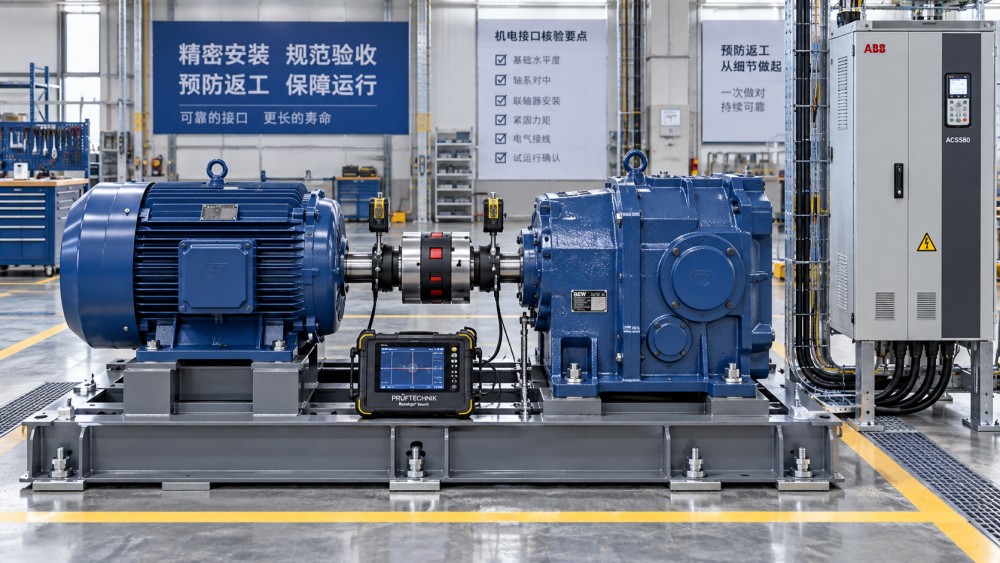
Installation drawings should expose these relationships before release. A combined view showing the motor, drive, coupling, foundation, cable entry, and service clearances is more useful than isolated component drawings for identifying interface conflicts. Maintenance space deserves attention because an assembly that fits during installation can still prevent later bearing access or motor removal.
A deeper review is justified when assumptions cross supplier boundaries or involve unfamiliar operating conditions. A documented repeat installation with unchanged duty and interfaces supports a narrower approach. Its prior design basis still needs to match the new application; similar appearance does not establish equivalent loading.
Build a rework exposure that reflects the project
Start with a specific failure scenario. “Motor replacement” is too broad to price meaningfully. “The selected motor cannot meet acceleration requirements after the base and control panel are complete” connects the technical defect to the work already committed and the corrective actions required.
The exposure includes more than the replacement purchase. Relevant costs include cancellation or return charges, additional engineering, expedited freight, removal and installation labor, cable or mounting changes, repeat commissioning, and disposal of unusable parts. Credit the value of equipment that can be returned or reused. Counting the full original purchase as a loss when it retains recoverable value inflates the comparison.
Delay costs need a separate basis. A delayed installation does not automatically equal lost sales. Available inventory, spare capacity, alternative production routes, and the project’s position on the critical path determine the economic effect. Where output is permanently lost, contribution margin is generally more relevant than gross revenue. Where production is merely deferred, overtime, rescheduling, or contractual costs may better represent the impact.
Keep linked consequences together. An incompatible coupling, altered base, and repeated alignment could all result from one interface error. Treating them as independent events exaggerates the expected loss. Conversely, several defects can be corrected during one shutdown, so adding a full shutdown cost to each also overstates exposure.
Compare the fee with the risk it can actually reduce
A useful financial model separates the cost of an event from the likelihood that the review prevents it. The relevant benefit is the reduction in expected loss attributable to the proposed scope:
Expected avoided rework cost = sum of [(event probability before review − event probability after review) × net financial consequence].
Net expected value = expected avoided rework cost − consulting fee − internal review effort − planned design corrections resulting from the review.
Including early corrections matters. Discovering a design weakness before purchasing avoids late rework, but correcting the design can still require additional calculations, a different component, or revised drawings. Omitting that cost overstates the review’s financial benefit.
Probability estimates are rarely precise. Use project evidence such as unresolved calculations, previous defects in comparable assemblies, conflicting supplier data, and unverified site dimensions. Where numerical probabilities lack support, assess a range and show which assumptions change the decision. Decimal precision cannot compensate for weak evidence.
A break-even calculation offers another perspective. For a single defined event, divide the total incremental review and early-correction cost by the net consequence of late correction. The result is the reduction in event probability required to recover that expenditure. This is a decision threshold, not proof that the review will achieve it.
The model also exposes scope gaps. Reviewing mechanical drawings does little to reduce an electrical-protection risk if the necessary supply data and calculations are excluded. Credit only the risks addressed by the contracted work. High-consequence safety issues and applicable technical requirements also need treatment outside a simple expected-cost calculation; a favorable average does not establish an acceptable design.
Release timing often matters more than review breadth
Review value declines when findings arrive after the relevant commitments. A complete report delivered after motor ordering, panel fabrication, and foundation construction leaves fewer economical options than a focused review completed before those releases. The schedule should therefore identify the decisions that need technical closure.
Purchasing and fabrication do not always need to pause together. Work with settled interfaces can proceed while unresolved selections remain on hold, provided the separation is technically sound. For example, fabrication around a motor mounting arrangement should wait if frame dimensions remain uncertain. Releasing that work based on a provisional footprint turns an open design question into physical rework exposure.
Late supplier substitutions deserve targeted review even when the original design was verified. Equivalent rated power or nominal dimensions do not establish identical starting behavior, thermal limits, shaft loads, or control compatibility. The review should examine the changed characteristics and their connected interfaces, with updated documents reflecting the accepted substitution.
Close the findings before closing the purchase decision
A completed report does not establish that identified risks have been resolved. Findings need a status that distinguishes accepted corrections, justified departures, missing evidence, and unresolved issues. Closure should refer to updated calculations, drawings, settings, or supplier documentation rather than a general statement that the concern has been addressed.
The final cost comparison should show the consulting commitment, expected correction work, remaining uncertainty, and the specific releases supported by the review. Where the fee exceeds plausible avoidable rework and the design evidence is already strong, reducing the scope is defensible. Where an unresolved interface threatens committed equipment or a critical installation window, a focused review has a clearer economic basis.
An approval record becomes useful when it states which assumptions support release and what changes would reopen the review. That record preserves the reasoning when equipment selections, operating duty, or installation conditions change later.
Related News
- 00
0000-00
264 Chaozhou Firms Showcase Quality Home Products at Canton Fair Phase Two - 00
0000-00
What load tests should a mechanical power transmission manufacturer run? - 00
0000-00
How to compare equipment performance under matching test conditions - 00
0000-00
140th Canton Fair Phase One Closes with Record Overseas Buyer Attendance - 00
0000-00
How to prevent delamination in laminated flexible packaging films
Weekly Insights
Stay ahead with our curated technology reports delivered every Monday.