





High-speed equipment exposes weaknesses that may remain hidden in slower machinery. A bearing can carry the calculated load and still fail early because it runs too hot, loses lubricant, develops cage instability, or is installed with too much preload. For spindles, electric motors, pumps, compressors, fans, precision gearboxes, and similar equipment, choosing a rolling bearing is therefore a system decision rather than a simple load-rating exercise.
The starting point is to define what “high speed” means for the bearing position in question. Shaft rpm alone is not enough. Bore diameter matters because the rolling elements travel faster as the bearing gets larger. A practical first screen is the speed factor, commonly expressed as bearing bore diameter multiplied by rotational speed. This does not select a bearing by itself, but it helps reveal when ordinary grease lubrication, standard cages, or conventional radial clearance assumptions may no longer be suitable.
For many high-speed applications, the best bearing is the smallest type that provides adequate stiffness, load capacity, life, and mounting security. Larger bearings can look safer on a load calculation, yet their higher rolling-element speed, frictional heat, and lubricant churning losses may create a less reliable assembly. Selection should begin with the operating duty, then compare bearing arrangements against the thermal and lubrication limits of the complete machine.
Start with the load pattern, not the catalog speed limit
A published limiting speed is useful only when its conditions resemble the machine. It may assume a particular lubricant, heat removal method, bearing tolerance class, cage design, preload, and mounting arrangement. Treating it as a universal operating speed can lead to an overconfident choice.
First establish the radial load, axial load, moment load, shock exposure, speed range, duty cycle, and required service life. The load direction matters as much as its magnitude. A radial fan shaft and a high-speed milling spindle may operate at similar rpm but need very different bearing arrangements. The fan may prioritize low-friction radial support and tolerance of modest shaft deflection. The spindle may require controlled axial location, high running accuracy, and high stiffness under changing cutting forces.
Also separate continuous operating conditions from short peaks. A bearing that briefly reaches a high rotational speed during run-up may be acceptable with a different margin than one that operates at that speed continuously in a hot enclosure. Reversals, frequent starts and stops, vibration, and rapid acceleration can affect cage behavior and lubricant film formation even where average load appears light.
It is useful to review the application in four questions before comparing bearing types:
- Which bearing position locates the shaft axially, and which position is allowed to float for thermal expansion?
- Are radial and axial forces steady, alternating, or combined with an overturning moment?
- Does the machine need rotational accuracy, structural stiffness, low noise, long unattended service, or a balanced combination of these?
- Can the housing remove heat, and can the lubricant be delivered and controlled consistently at operating speed?
These questions often narrow the field faster than comparing headline dynamic load ratings. A high-speed assembly that is axially over-constrained, for example, may build internal load as the shaft warms. No increase in nominal bearing capacity will solve that arrangement problem.
Compare the bearing types by what they manage well
Rolling bearings do not all trade speed, load, stiffness, and friction in the same way. The raceway contact geometry and rolling-element shape determine where each type is strongest and where it needs careful qualification.
Deep-groove ball bearings are frequently selected because they are compact, economical, and tolerant of straightforward mounting arrangements. In truly demanding speed ranges, however, an angular-contact ball bearing pair may offer better axial control and stiffness. That does not make angular-contact bearings automatically superior. They generally introduce more design choices: contact angle, face-to-face or back-to-back arrangement, preload level, pairing accuracy, and lubrication method. Each choice affects friction and heat.
Cylindrical roller bearings deserve consideration where radial load or radial stiffness is substantial, especially when one bearing location needs to accommodate shaft expansion. Their line contact gives useful radial capacity, but it also increases sensitivity to lubricant film quality and heat generation at high surface speeds. Tapered roller bearings can handle demanding combined loads, yet they require particular caution in high-speed work because adjustment errors translate directly into frictional heat and altered running clearance.
Hybrid bearings, usually combining steel rings with ceramic rolling elements, can be appropriate when speed, acceleration, electrical current risk, or lubrication conditions justify them. Their lower rolling-element mass can reduce centrifugal effects, and ceramic balls can interrupt some current paths. But “hybrid” is not a universal upgrade. A poor lubricant choice, excessive preload, contaminated housing, or incorrect shaft fit can still damage a hybrid bearing quickly. The economic case should be tied to the specific failure mode or performance limit being addressed.
Speed capability is largely a heat and lubrication question
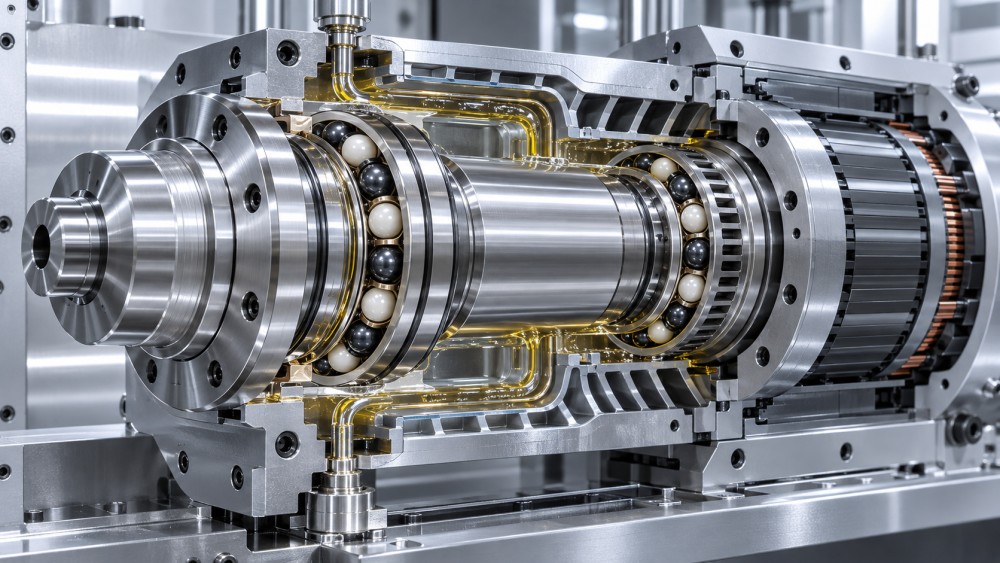
At high speed, bearing performance is often governed by operating temperature rather than static strength. Friction comes from rolling contact, sliding at raceway contacts, cage movement, seals, and lubricant churning. As temperature rises, grease consistency changes and oil viscosity falls. The lubricant film may become too thin, while thermal growth can alter preload or reduce internal clearance. This feedback loop is why a bearing that runs acceptably during a short bench test can become unstable in a fully enclosed machine.
Grease is practical for many motor, fan, and pump applications, but it is not simply a maintenance-free choice. Grease type, base-oil viscosity, thickener system, fill quantity, and free space inside the housing all influence high-speed temperature. Excess grease is a common source of churning heat. A bearing may need a carefully controlled grease quantity rather than a fully packed cavity. Relubrication intervals and purge paths also matter; adding grease without allowing old grease to exit can create the same problem over time.
Oil lubrication becomes more attractive as speed, heat load, or required precision increases. Oil-air, oil-mist, circulating oil, jet lubrication, and oil bath systems are not interchangeable. An oil bath may be adequate at lower speeds but can produce substantial churning losses at higher speeds. Circulating oil can remove heat and contaminants, though it adds pumps, filtration, piping, and control requirements. Jet lubrication can deliver oil effectively to demanding contacts, but flow direction and quantity must match the bearing design.
Seals deserve the same scrutiny. Contact seals improve contamination control but add friction and heat. In a clean, protected, high-speed spindle environment, a non-contact shield or open bearing with an engineered lubrication system may be more appropriate. In dusty packaging, woodworking, or process equipment, the contamination risk may justify the friction of a seal. There is no sensible universal rule: sealing must be evaluated against the actual particle, moisture, washdown, and lubricant-retention conditions.
Precision, clearance, and preload change the result
High-speed equipment magnifies geometric errors. Bearing runout, shaft shoulder squareness, housing bore form, imbalance, and misalignment can introduce vibration that becomes significant at speed. Where rotational accuracy matters, the bearing precision class must be selected alongside the shaft and housing tolerances. Installing a high-precision bearing in an inaccurate housing does not deliver a high-precision assembly.
Internal clearance is another frequent source of selection errors. The clearance stated before mounting is not the clearance available in operation. Interference fits can reduce it; shaft and housing temperatures can alter it further. For a deep-groove ball bearing, the correct clearance class depends on fit, temperature difference, load, and speed. Selecting larger clearance merely as a precaution can permit excess movement, noise, and skidding under light load. Selecting too little can lead to preload-like conditions, heat, and rapid damage.
Angular-contact bearings are often mounted with a defined preload to improve stiffness, axial position control, and running accuracy. The preload must suit the speed and thermal behavior of the assembly. More preload raises stiffness, but it also raises friction and temperature. In high-speed spindle arrangements, preload may be selected specifically for the intended operating range, with the bearing arrangement designed to manage thermal expansion. A preload that works in a cool stationary condition may be inappropriate after the inner ring and shaft heat more rapidly than the housing.
Cage design also becomes relevant as speed rises. The cage must guide the rolling elements reliably without excessive sliding, instability, or lubricant starvation. Material and guidance method are design-specific; the right choice depends on speed, lubrication, temperature, acceleration, and load. It should be specified as part of the bearing variant, not treated as an incidental catalog detail.
Do not separate the bearing from its mounting arrangement
A high-speed bearing can only perform as well as its seats and surrounding components allow. Shaft and housing fits should prevent ring creep while avoiding unintended clearance loss or ring distortion. A tight fit may be necessary on a rotating loaded inner ring, but the interference must be consistent with the bearing clearance and temperature calculation. Thin-walled housings, out-of-round bores, burrs, damaged shoulders, and excessive clamping force can distort raceways and create localized loading.
Shoulders must support the rings without interfering with cages, seals, or fillets. Retaining nuts, spacers, and lock systems need adequate concentricity and face runout control. For matched angular-contact pairs, spacer geometry and arrangement direction are part of the bearing system. Mixing unmatched bearings or changing a spacer without checking axial settings can defeat the purpose of a precision bearing selection.
Balance and alignment should be reviewed at the same time. Bearing replacement is sometimes used to address vibration that originates in an unbalanced rotor, bent shaft, soft housing, coupling misalignment, or resonance near operating speed. In those cases, a bearing with a higher accuracy class may reduce a symptom temporarily without addressing the forcing source.
A practical selection sequence for buyers and designers
Rather than starting with a familiar part number, build a short comparison around the machine’s limiting condition. Record the bore and outside-diameter constraints, actual speed range, load cases, axial-location requirement, ambient and operating temperatures, contamination level, lubrication method, service interval, and acceptable vibration or runout. Then assess candidate bearings as installed assemblies.
- Confirm dynamic life under the relevant load spectrum, not only a single nominal load.
- Check the manufacturer’s speed guidance against the planned lubricant, cage, preload or clearance, and cooling conditions.
- Calculate or evaluate mounted clearance and thermal expansion for the selected fits.
- Compare bearing arrangements for stiffness, axial location, and accommodation of shaft growth.
- Specify the required precision class, cage, seals or shields, lubricant, and matching requirements on the purchase documentation.
- Validate the final design through controlled temperature, vibration, and run-in checks at the intended operating condition.
The purchase specification should describe more than dimensions and a basic bearing designation. At high speed, a part number may have multiple variants with different clearance, preload, cage, precision, sealing, and lubrication provisions. Ambiguous substitution can change the operating result materially. Buyers should also verify that bearings in a matched set remain traceable as a set, rather than being supplied as unrelated single units.
A sound high-speed bearing choice usually emerges from a clear hierarchy of requirements. For a compact motor, low heat, electrical protection, grease life, and noise may lead the decision. For a precision spindle, runout, stiffness, preload stability, and oil delivery may carry more weight than nominal load rating. For a pump or compressor, axial thrust variation, process temperature, sealing, and maintenance access may dominate. Once that hierarchy is explicit, the comparison between bearing types becomes more defensible, and the risk of selecting a bearing solely because it has the highest quoted speed or capacity falls sharply.
Related News
- 00
0000-00
What drives screw price differences between suppliers? - 00
0000-00
When does international sourcing support reduce supplier risk? - 00
0000-00
How surface preparation affects industrial adhesive bond strength - 00
0000-00
How to choose workspace organization racks for high-traffic areas - 00
0000-00
How Do You Choose Rolling Bearings for High-Speed Equipment?
Weekly Insights
Stay ahead with our curated technology reports delivered every Monday.