





Rolling bearings overheat when the heat generated by friction exceeds the heat that the housing, shaft, lubricant, and surrounding air can remove. A brief temperature rise after start-up is often normal while grease distributes or components settle. Persistent heating, a rapid upward trend, discolored lubricant, smoke, noise, or a hot bearing housing points to a fault that needs attention.
The most common causes are lubrication problems, excessive preload or insufficient internal clearance, mounting errors, shaft or housing misalignment, overload, contamination, poor sealing, and abnormal operating conditions. These causes can produce similar surface symptoms, so temperature alone should not be treated as a diagnosis. The pattern of heat, noise, vibration, lubricant condition, and recent mechanical changes usually separates one cause from another.
Lubrication problems create heat in different ways
Too little lubricant leaves rolling contacts insufficiently separated. Under load, the rolling elements and raceways then experience more metal-to-metal interaction, raising friction and accelerating surface damage. In grease-lubricated units, starvation does not always mean that no grease is visible. Grease may have hardened, been pushed away from the rolling path, separated into oil and thickener, or become blocked by a damaged relubrication passage.
Too much grease can also overheat a bearing. When the bearing cavity is heavily packed, rolling elements must churn through excess grease. This creates viscous drag, especially at higher speeds. The housing may become hot soon after relubrication even though the bearing itself was previously operating normally. If the temperature later declines as surplus grease escapes or redistributes, overgreasing is a likely explanation. A continuing rise suggests that the grease volume is not the only issue.
Grease consistency, base-oil viscosity, thickener type, and operating temperature must suit the application. A lubricant that is too viscous increases churning loss at speed and can resist flow in cold conditions. One that is too light may not sustain an adequate lubricating film at load and temperature. Mixing incompatible greases may alter consistency or cause oil separation, so a relubrication event can create trouble even when both products appear suitable on their own.
Oil-lubricated bearings introduce additional failure paths. An oil level that is too high can cause churning, while a low level, blocked feed, leaking seal, clogged filter, or foaming condition can interrupt supply. Oil rings need proper immersion and rotation; a ring that slips, wears, or fails to carry oil will starve the bearing despite an apparently acceptable reservoir level.
Clearance, fit, and preload are often confused
A rolling bearing needs working internal clearance after mounting and after the shaft, inner ring, outer ring, and housing reach operating temperature. The clearance selected on a drawing is not necessarily the clearance available in service. An interference fit expands the ring being mounted and reduces internal clearance. Thermal growth can reduce it further.
If the inner ring runs hotter than the outer ring, it expands more and tightens the bearing internally. This is particularly relevant in electric motors, pumps, gearboxes, and belt-driven equipment where the shaft receives heat from a rotor, coupling, or adjacent component. A bearing with an initially tight clearance can become preloaded once temperatures stabilize. Friction then rises, creating more heat and further reducing clearance.
Excessive preload is a frequent cause in angular contact ball bearings and tapered roller bearings. These arrangements may require preload for stiffness, axial positioning, or accurate running, but the setting must account for speed, load, thermal gradient, and mounting geometry. A preload that feels acceptable during slow manual rotation can become excessive at operating speed. Heat concentrated near the bearing rather than across the complete housing is often consistent with this condition.
Excessive clearance causes a different problem. It permits poorer load distribution, impact between rolling elements and raceways, skidding, and vibration. Those mechanisms also generate heat, but they are more often accompanied by looseness, rumble, or unstable vibration than a uniformly tight bearing. The apparent contradiction matters: both too little and too much clearance can overheat a bearing, but they require opposite corrections.
Mounting damage can be present before the machine starts
Installation force must pass through the ring being fitted. Pressing a bearing onto a shaft by loading the outer ring transmits force through balls or rollers and raceways. The resulting dents, often called brinell marks in workshop language, create rough running and local stress concentrations. The bearing may rotate after assembly, yet later produce noise, vibration, and elevated temperature under load.
Hammer blows, tilted pressing, burrs on the shaft shoulder, damaged threads, and poor seating against a locating shoulder can produce similar results. A ring that is not fully seated may run out of square. A chipped chamfer or fillet that interferes with the bearing corner radius can prevent correct location while making the assembly appear tight.
Heating an inner ring for mounting is common where interference is substantial, but uncontrolled heating presents risks. Uneven heating can distort the ring temporarily, while excessive temperature can affect material properties or seals and grease in pre-lubricated units. The relevant issue is controlled, uniform expansion followed by correct seating, rather than simply applying more heat.
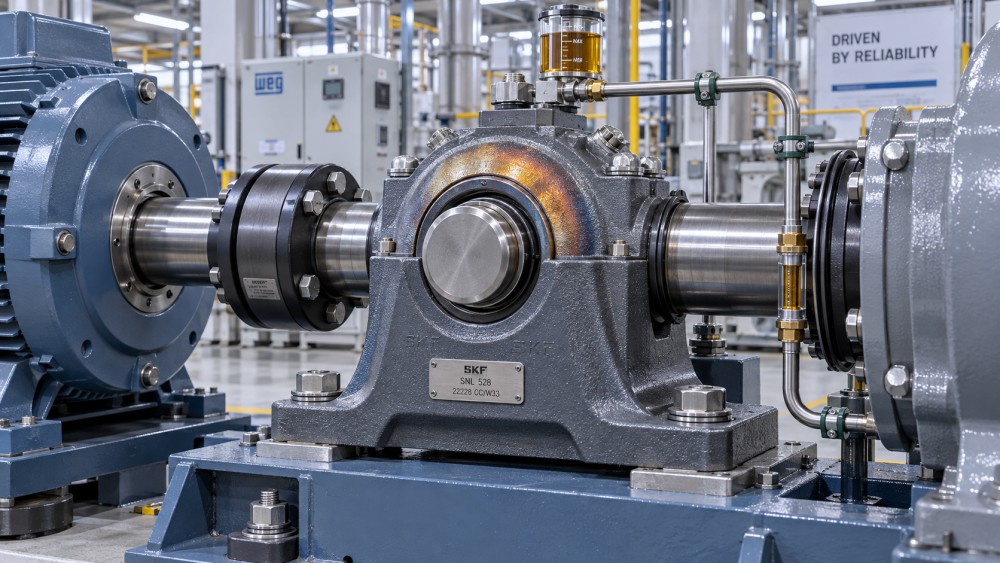
Misalignment changes where the bearing carries load
Rolling bearings are designed to distribute load across a defined contact zone. When the shaft and housing axes are not aligned, the load shifts toward one side of the raceway. The result is edge loading, higher contact stress, friction, and heat. Self-aligning bearing designs tolerate angular misalignment better than rigid deep-groove ball bearings, cylindrical roller bearings, or paired angular contact arrangements, but their capacity is still limited by the specific design and application.
Misalignment may originate outside the bearing housing. A flexible coupling can be misaligned, a belt can be over-tensioned, a pulley can be out of plane, or a machine base can twist after bolts are tightened. Thermal movement can also alter alignment after start-up. For this reason, an alignment reading taken on a cold, stationary machine does not always represent its running condition.
Housing distortion deserves equal attention. Thin or poorly supported housings can become oval when mounted to an uneven frame. Excessive bolt tightening, an out-of-round bore, weld distortion, or an uneven mounting face can compress the outer ring. This reduces clearance locally and produces an overheating pattern that may be mistaken for a lubrication defect.
Load and speed must be considered together
A bearing can run acceptably at a given load and fail thermally when speed increases, because rolling friction, cage drag, lubricant churning, and seal friction all rise. Conversely, a bearing operating at low speed under a heavy radial or axial load may overheat through high contact stress even when lubricant drag is modest.
Unexpected axial load is a recurring issue. Helical gears, pump thrust, thermal expansion of a shaft, and incorrectly located bearing arrangements can force a bearing to carry thrust it was not intended to absorb. A floating bearing position that has become seized by corrosion, a tight housing fit, or trapped components may prevent axial expansion. The locating bearing then receives the resulting thrust load and heats rapidly.
Load direction matters as much as load magnitude. A radial ball bearing subjected to substantial combined loading may operate with an unfavorable contact angle and poor load distribution. Tapered roller and angular contact bearings can carry combined loads effectively when arranged and adjusted correctly, but their axial setting directly affects temperature. Substituting a bearing based only on bore, outside diameter, and width can therefore create a thermal problem even where the replacement physically fits.
Contamination and sealing failures raise friction gradually
Hard particles from machining debris, worn gears, abrasive dust, corrosion products, or degraded grease can enter the rolling contact. Each particle can indent raceways or disrupt the lubricant film. The early sign is often a modest temperature increase combined with rising vibration or a rougher sound, rather than an immediate severe overheat.
Water contamination is especially damaging because it reduces lubricant performance, promotes corrosion, and can change grease structure. Washdown areas, humid storage, damaged labyrinth seals, and pressure cleaning near bearing housings all create entry paths. A bearing assembly may be correctly lubricated at installation but still fail because its seal arrangement does not suit the surrounding environment.
Seal friction itself can be a heat source. Contact seals running at high speed add drag, particularly when installed dry, damaged, compressed incorrectly, or exposed to shaft runout. When a new sealed bearing becomes hot but vibration remains low and the temperature is concentrated near the seal, inspect the sealing arrangement before changing bearing clearance or lubricant type.
Reading the temperature trend prevents misdiagnosis
A single infrared reading is useful only when the measurement point, surface condition, load, speed, and ambient conditions are comparable. Shiny metal surfaces can give misleading readings. Measuring a consistent painted or prepared area on the housing is more reliable than aiming at a reflective ring or rotating shaft. Compare equivalent points across similar bearings where possible, but do not assume matching machines must have identical temperatures; duty cycle, mounting, lubricant fill, and airflow may differ.
The timing of the rise offers practical evidence. Heat immediately after assembly points toward fit, preload, installation damage, seal drag, or excess grease. Temperature that follows a production load change points toward overload, belt tension, thrust, or misalignment. A gradual increase over weeks more often aligns with grease deterioration, contamination, developing wear, or loss of lubricant supply.
Before disassembly, record running speed, load state, housing temperatures, vibration trend, lubrication history, grease type, and any recent work on couplings, belts, seals, or adjacent components. Once the bearing is removed, preserve the lubricant and note the orientation of rings, spacers, and locknuts. A replaced bearing without this evidence can conceal the original fault, allowing the replacement to overheat for the same reason.
Corrective action should match the mechanism found: restore the specified lubricant condition, remove surplus grease where appropriate, verify fits and working clearance, correct alignment and load paths, repair sealing, and replace damaged components. Cooling the housing or shortening a lubrication interval may lower the visible temperature temporarily, but neither resolves a bearing that is being overloaded, squeezed by an incorrect fit, or contaminated at every operating cycle.
Related News
- 00
0000-00
Office supplies market trends reshaping corporate buying priorities - 00
0000-00
When does industrial design for retail displays improve shopper flow? - 00
0000-00
What drives screw price differences between suppliers? - 00
0000-00
When does international sourcing support reduce supplier risk? - 00
0000-00
How surface preparation affects industrial adhesive bond strength
Weekly Insights
Stay ahead with our curated technology reports delivered every Monday.