





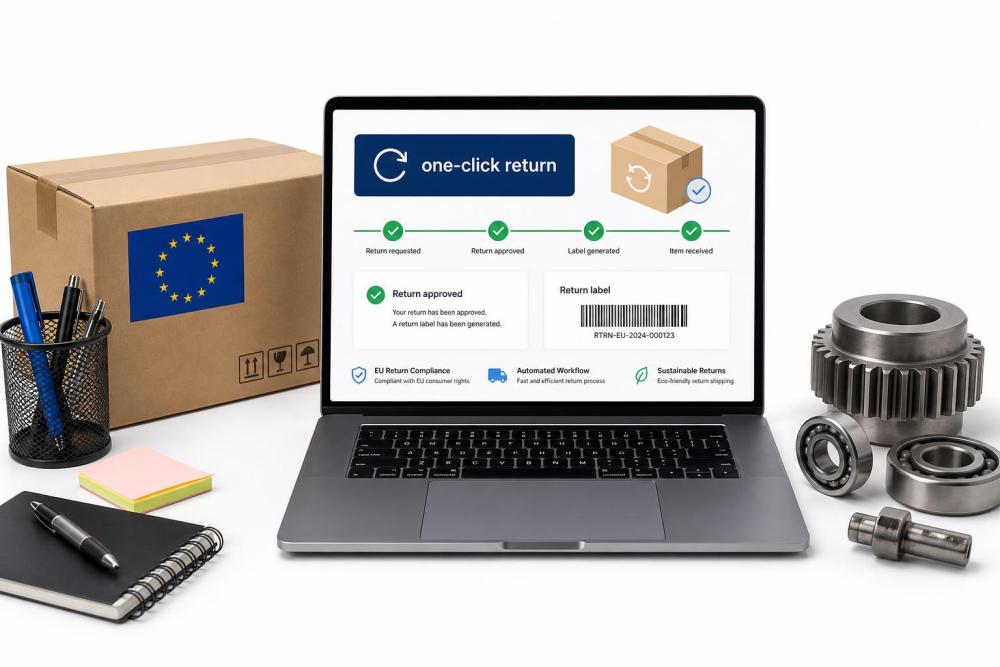
On 2026-08-19, the EU's new Consumer Protection Enhancement Regulation is set to take effect, requiring cross-border e-commerce platforms serving EU consumers to place a standardized one-click return button prominently on the checkout page and to support an automated return flow aligned with GDPR and CE compliance requirements. For sellers operating independent sites or marketplace stores, this is more than a front-end update: it reaches return handling, compliance documentation, and post-sale workflow design across furniture hardware, packaging and printing, office supplies, electromechanical equipment, and other B2B/B2C export lines.
What the new return rule explicitly requires
The information provided indicates that the regulation will become effective on 2026-08-19. It applies to all cross-border e-commerce platforms targeting EU consumers, including independent sites and third-party storefronts operated by Chinese sellers. The checkout page must visibly embed a standardized one-click return function, and the return process must be automated in a way that meets GDPR and CE compliance requirements. The scope covers all product categories mentioned in the input, including furniture hardware, packaging and printing, office supplies, and electromechanical equipment. Platforms that do not comply may face fines of up to 500,000 euros per case and traffic downranking.
Where the pressure will land first in the export chain
Front-end platform operators and independent stores
Analysis suggests the most immediate impact will fall on checkout design, return-trigger logic, and customer-service routing. For independent sites and third-party stores, the return button is no longer a peripheral after-sale feature; it becomes part of the mandatory purchase flow. This means product pages, checkout architecture, and return-policy display may all need to be reviewed together, especially where multiple markets or languages are involved.
Exporters and product suppliers
For exporters, the practical issue is not only whether a return function exists, but whether the underlying return process can be documented and executed in a way that satisfies the stated GDPR and CE-related requirements. That may affect order records, customer-data handling, return authorization steps, and the division of responsibility between sellers, platform operators, and after-sales providers. In categories with higher return handling complexity, the operational burden is likely to be more visible.
Logistics and after-sales service providers
Logistics partners, repair channels, and return-processing vendors may see changes in workflow integration requirements. If return initiation must happen directly at checkout and then flow into an automated process, service providers may need to align status updates, labels, routing, and data exchange more tightly with platform systems. The same applies to any service chain that touches customer data or product recovery records.
Compliance and certification-related teams
Because the rule references GDPR and CE compliance requirements, teams handling legal review, documentation, and product conformity checks will likely need to verify how return workflows intersect with existing records, technical files, and customer-data controls. The important point here is not a new technical certification model, but the linkage between sales-flow design and compliance evidence.
What companies should verify before the effective date
Check whether the checkout flow meets the visibility requirement
Companies should first verify whether the one-click return function is actually prominent at checkout, rather than buried in policy pages or post-purchase emails. The input makes clear that visibility at the checkout page is part of the requirement, so UI placement and user journey design deserve immediate review.
Map the return workflow to GDPR and CE-related controls
At this stage, it is more appropriate to treat the GDPR and CE references as compliance checkpoints that need validation, not as a finished implementation recipe. Businesses should review whether their return data handling, customer consent logic, product conformity files, and internal handoff steps can support the automated process described in the rule.
Review category-level exposure across B2B and B2C exports
The scope in the input is broad and explicitly includes B2B/B2C export business across multiple product lines. That means companies should not assume the rule only concerns consumer-facing brands. Any cross-border seller with EU-facing checkout flows should assess whether its current setup, supplier agreements, and after-sales terms are ready for the same standard.
Prepare for enforcement risk and commercial impact
The stated penalty exposure and traffic downranking make this a commercial issue as much as a legal one. Even where the exact enforcement cadence still needs to be observed, companies should treat non-compliance as a platform-performance risk, not just a back-office compliance gap.
How to read this development now
From an industry perspective, this is best understood as a rule that is intended to shape execution, not a vague policy signal. The fact pattern in the input already sets a clear effective date, a mandatory checkout requirement, and an enforcement consequence. What still deserves closer attention is how platforms interpret the “standardized” button format, how automated return handling will be assessed in practice, and how strictly GDPR and CE-linked process expectations are enforced across different product categories.
That makes the current stage one of readiness and verification. For affected businesses, the key task is not speculation about the policy direction, but confirming whether current storefront, return, and data-handling workflows can survive the rule as written.
What this means for the market
The immediate reading is straightforward: EU-facing e-commerce operations will need to bring returns into the core purchasing flow. For sellers, logistics providers, and compliance teams, the question is now operational alignment rather than policy interpretation. It is more appropriate to treat this as an upcoming execution requirement with clear commercial consequences, while continuing to watch for the exact implementation details and enforcement practice.
Source and verification
This article was generated from the user-provided title, event date, and event summary. No specific official source link was included in the input. For a complete compliance reading, the relevant items to continue monitoring are official announcements, regulator guidance, customs or trade authority notices, industry association updates, and any later clarification on policy details, certification execution, trade handling, and business feedback.
Related News
- 00
0000-00
What drives screw price differences between suppliers? - 00
0000-00
When does international sourcing support reduce supplier risk? - 00
0000-00
How surface preparation affects industrial adhesive bond strength - 00
0000-00
How to choose workspace organization racks for high-traffic areas - 00
0000-00
How Do You Choose Rolling Bearings for High-Speed Equipment?
Weekly Insights
Stay ahead with our curated technology reports delivered every Monday.