





Evaluating Six-Sided Drilling for Custom Cabinet Panel Production
Custom cabinet projects often fail or recover on a small set of machining decisions: hole position, drilling direction, edge reference, hardware compatibility, and the ability to keep panels identifiable after they leave the machine. A panel can look correct at the cutting stage yet become unusable when drawer-slide holes are mirrored, shelf-pin rows drift from the reference edge, or concealed-hinge cups do not align with the door boring pattern.
For project managers responsible for cabinet packages, six-sided drilling deserves attention because it changes where those risks are controlled. Instead of treating horizontal and vertical drilling as separate operations that may require multiple machines, manual repositioning, or intermediate handling, a six-sided process is intended to access faces and edges within one coordinated machining cycle. The practical question is not whether the technology sounds advanced. It is whether its process logic fits the project mix, engineering discipline, batch sizes, and delivery commitments of a cabinet operation.
Its strongest applications are usually found where panel variety is high, hardware patterns change frequently, and assembly crews depend on accurately labeled, ready-to-build parts. In more standardized production, the decision can be less straightforward. A project team needs to distinguish between a machine’s nominal capability and the measurable reduction in handling, rework exposure, and schedule uncertainty it can bring to a specific production flow.
Why drilling becomes a project-control issue
Cabinet drilling is often described as a secondary operation after cutting and edge banding. In reality, it links design intent to final installation. Each hole pattern carries information: which side is the cabinet interior, where a back panel locates, whether a side panel is left- or right-handed, which drawer system is specified, and where adjustment range must remain available.
In a custom environment, that information changes with each room, unit type, or revision. A kitchen run may include standard base cabinets alongside a tall appliance housing, a sink unit with service cutouts, and shallow drawers using different hardware. Commercial fit-out work can add fire-rated enclosure details, access panels, lock preparation, or project-specific fixture requirements. The drilling process must preserve those distinctions without relying on an operator to interpret ambiguous part labels at every station.
Traditional routing can be effective for many of these tasks, particularly when parts require complex profiles, grooves, or unusual cutouts. Yet a workflow that sends each panel through multiple setups introduces transfer points. At each transfer point, the panel can be rotated incorrectly, queued too long, mixed with a similar component, or damaged at an unfinished edge. Those events do not always create immediate scrap; some appear later as installation delays, missing hardware, or field modification.
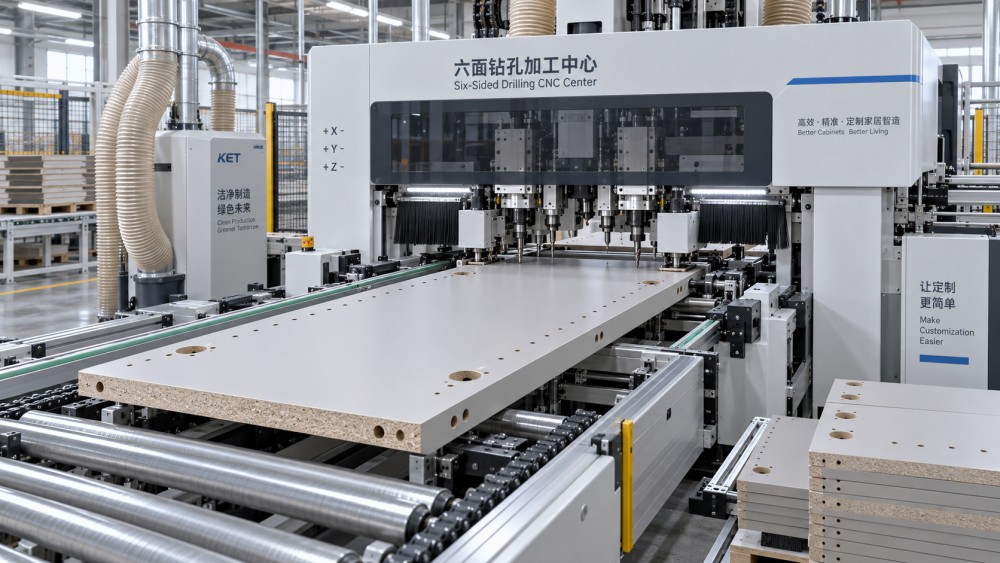
Six-sided drilling addresses a defined portion of this problem by coordinating machining on the panel’s broad faces and four edges. For an engineering team, the value lies in reducing the number of times the hole pattern must be re-established against a different fixture or manual orientation. It does not eliminate the need for accurate machining data, material control, or sensible nesting. It shifts the critical control point toward data preparation and in-process verification.
What “six-sided” should mean in an evaluation
The term can create unrealistic assumptions if it is treated as a guarantee that every machining requirement can be completed on every panel. A proper evaluation should begin with the panel operations actually required by the project portfolio. These commonly include:
- concealed-hinge cup holes and hinge plate locations;
- construction holes for dowels, connectors, cams, and screws;
- horizontal edge drilling for shelf supports, rail connections, and drawer hardware;
- vertical drilling for line boring and cabinet-system patterns;
- back-panel grooves, dadoes, or channel features where routing is required;
- through holes, blind holes, and hardware-specific patterns with different depths and diameters.
A six-sided drilling machine may cover a substantial share of hole-making and some routing-related requirements, but its practical coverage depends on spindle configuration, tool arrangement, panel support, clamping method, and software rules. Complex shaped parts, very small components, unusually narrow panels, deep routing operations, or components with fragile surface finishes may still need separate handling. Project planning should define these exceptions before calculating capacity or labor savings.
It is also useful to separate machining access from production readiness. A panel may be reachable from six directions, yet the process can still be weak if the program does not manage mirrored parts, reference edges, drilling sequence, or barcode identity. The equipment is one part of a controlled cell; part data, labels, material flow, and inspection instructions determine whether the cell delivers assembly-ready output.
Translate hardware plans into machine checks
The most productive way to assess this technology is to start with hardware plans rather than with a machine brochure. Hardware plans contain the logic that makes cabinet parts functional: setback dimensions, mounting plates, shelf spacing, runner clearances, drawer-front adjustment, connector placement, and drilling depth limits. Those requirements should be turned into a verification matrix that can be reviewed by engineering, production, quality, and installation teams.
For each major cabinet family, the matrix can identify the panel type, material thickness, finished dimensions, edge condition, required drilling faces, tool type, reference datum, and inspection method. It should also identify whether the hole is safety-critical to assembly, merely cosmetic, or capable of being corrected without remaking the panel. For example, a hidden shelf-pin hole may permit limited recovery, while an incorrect hinge cup location can make a finished door unusable.
This exercise often exposes data problems before a machine is selected. A library may contain hardware components with inconsistent origin points. One door rule may reference the finished edge, while another references the core dimension before edge banding. A drawer-box program may assume a nominal panel thickness even though the project includes several board products. None of these are machine failures. They are engineering conditions that a faster, more automated process will expose sooner.
When comparing equipment, project teams can use published cabinet panel drilling machine details as a starting point for a structured inquiry into drilling access, tool layout, panel-handling arrangements, and the relationship between programming and the intended panel workflow. The useful follow-up is to test those capabilities against representative production files rather than against a simplified sample part.
Where six-sided drilling tends to fit best
Six-sided drilling can be particularly relevant when a factory produces many cabinet variants from panel material and needs to release small or mixed batches without building a long queue of work-in-progress. A project-driven manufacturer may process one apartment type in the morning and a different set of wardrobe components later in the day. The machine’s potential value comes from retaining part-level flexibility while reducing the need to create dedicated fixtures for routine hole patterns.
It can also support batch-one or order-specific workflows where every panel has a barcode and a defined manufacturing route. In this setting, the goal is not simply faster drilling. The goal is to move a panel through cutting, edge treatment, drilling, sorting, and packaging with enough identity control that installation kits remain complete.
There are limits. A company producing a narrow range of repetitive cabinet carcasses may already have an efficient dedicated-boring or transfer-line arrangement. If the product mix rarely changes, the cost of programming flexibility may not produce a meaningful return. Likewise, an operation that lacks stable design libraries, consistent panel labels, or reliable upstream cutting accuracy may see the new machine amplify confusion rather than solve it.
Accuracy is a system property, not a brochure figure
Project managers often ask for a single accuracy value, but repeatable cabinet assembly depends on more than machine positioning. Panel thickness variation, bowed stock, poor edge quality, drill wear, insufficient hold-down, and incorrect datum selection can all affect the final relationship between holes and finished edges. A machine may be capable of precise movement while a weak material or data process still produces poor fit.
Material preparation deserves special attention. Melamine-faced particleboard, MDF, plywood, and laminated panels behave differently when drilled. Face chipping, breakout on the exit side, core voids, and heat buildup can alter visible quality or fastener holding. Tooling choice and replacement discipline should reflect the board type and coating, rather than relying on a single tool-life assumption for all work.
Reference strategy is equally important. If a hinge pattern is measured from a finished front edge, then the drilling process must reliably recognize that edge as the datum. If the machining program assumes a nominal band thickness or uses a pre-banding panel dimension without adjustment, small deviations can accumulate in visible reveals and door alignment. The risk is most apparent on tall doors, paired fronts, and cabinet banks where inconsistent gaps become obvious after installation.
Quality checks should be placed close to the point where errors can still be contained. A practical approach is to inspect the first-off panel for each new program or revision, then verify selected dimensions and orientation features during production. The inspection record should capture the part identifier, revision level, material, operator or shift, measured feature, and disposition. This creates a useful trail when an installation issue must be traced back through engineering and manufacturing.
Build acceptance around representative parts
Factory acceptance should not rely only on a demonstration panel supplied by the equipment provider. A more credible trial uses a controlled sample set drawn from the buyer’s own cabinet work: a hinged door, a left- and right-hand side panel, a drawer component, a shelf panel, a tall cabinet member, and a part with several drilling directions. The set should include both common operations and the awkward features that normally create rework.
Acceptance criteria can cover hole location relative to the selected datum, depth consistency, breakout condition, edge-hole alignment, repeatability across a run, barcode or program traceability, and the condition of finished faces after handling. Where the project uses proprietary hardware, actual fittings should be assembled into the test panels. A dimensional pass alone does not prove that connectors engage, drawers run correctly, or hinges have sufficient adjustment range.
The trial should also examine changeover behavior. Custom cabinet work rarely runs as one uninterrupted order. Teams need to see how the process handles a revised file, an interrupted batch, a replacement part, a mixed-material job, or a panel returned from quality inspection. These are normal conditions in project production, and they reveal whether the operating procedure is resilient or dependent on a particular technician.
Capacity planning must include the work around the machine
Machine cycle time is only one component of output. A six-sided drilling cell can become the fastest stage in a line while panels wait for labeling, edge rework, hardware insertion, sorting, or packaging. If drilling throughput increases without redesigning those surrounding activities, work-in-progress may merely move downstream.
Map the physical route of a panel before approving the project. Consider how parts arrive from cutting or edge banding, where they are staged, how labels are scanned, where rejected parts are isolated, and how completed panels are sorted by cabinet or installation zone. The space requirement includes more than the machine footprint. It includes safe loading and unloading areas, access for maintenance, tool storage, dust extraction connections, electrical provision, and buffer locations that do not compromise part identification.
Preventive maintenance should be incorporated into the production plan rather than treated as unplanned lost time. Drill bits, clamps, sensors, lubrication points, spoil surfaces, and extraction performance affect quality and availability. A maintenance routine is most useful when it connects observable symptoms to actions: rising chip-out may prompt tooling review; repeated part-position faults may require cleaning or adjustment; poor extraction may affect both finish quality and the operating environment.
The decision is strongest when it follows process discipline
Six-sided drilling is not a universal replacement for routing, dedicated boring, or skilled manual intervention. It is a process option that can make custom cabinet production more controlled when a business has varied panels, recurring hardware complexity, and a need to deliver assembly-ready parts with fewer handling stages.
The best evaluations begin with real hardware plans, representative panel files, and clearly defined exceptions. They test orientation logic as carefully as hole coordinates, examine downstream sorting and packaging capacity, and treat acceptance as an assembly test rather than a machine demonstration. Under those conditions, the technology can help turn cabinet drilling from a sequence of individual operations into a more traceable production checkpoint.
Related News
- 00
0000-00
When does international sourcing support reduce supplier risk? - 00
0000-00
How surface preparation affects industrial adhesive bond strength - 00
0000-00
How to choose workspace organization racks for high-traffic areas - 00
0000-00
Material and Coatings Compliance: Tests and Documents Buyers Should Request - 00
0000-00
What Counts as Proof of Product Compliance During Customer Audits?
Weekly Insights
Stay ahead with our curated technology reports delivered every Monday.