





Choose drawer slides for heavy storage by matching the total loaded drawer weight to a documented rating for the exact slide length, mounting position, and extension required. Then check whether the drawer box, cabinet walls, and fixing points can support that load. A high capacity printed on a product listing does not establish that the complete installation will be safe or durable.
For workshop tools, dense parts, or commercial supplies, side-mounted heavy-duty ball-bearing slides are a practical starting point. Undermount slides can suit concealed-hardware designs, but their capacity and installation requirements need closer checking. The right choice depends not only on weight, but also on how far the drawer opens, where the load sits, how frequently it moves, and whether the cabinet remains stable when loaded drawers are extended.
A load rating is meaningful only with its test conditions
Start with the combined weight of the drawer box, stored contents, and anything attached to the moving assembly. Dividers, trays, handles, and internal organizers count. Specify the heaviest intended configuration rather than the average daily load, particularly where users can add tools or stock without changing the cabinet.
For example, a drawer weighing 12 kg and carrying up to 68 kg of contents creates an 80 kg moving load. A slide advertised as “80 kg capacity” is not automatically suitable. Its rating may apply to a particular length, a narrower drawer, a uniformly distributed load, or test conditions that do not represent the intended service.
Confirm whether the published capacity applies to a pair of slides or one individual slide. Also establish whether it is a static holding capacity or a dynamic rating covering repeated opening and closing. A static figure alone does not demonstrate acceptable operation or service life under repeated movement.
The useful comparison is between ratings with equivalent conditions:
- Slide length: Capacity can vary within the same product family. Use the rating for the actual part number and length.
- Mounting orientation: A vertically mounted side slide may have a substantially different rating when installed flat beneath a drawer.
- Drawer width and load distribution: A wide drawer or a load concentrated toward the front can impose stresses not represented by a simple total-weight figure.
- Extension and cycling: Check that the capacity applies at the required travel and identify the operating cycles used in testing.
Allow capacity above the expected working load, but do not treat a generic percentage margin as a substitute for engineering evidence. The necessary allowance depends on uncertainty, handling forces, duty cycle, and consequences of failure. If loading will be irregular or users may slam a heavy drawer, describe those conditions to the supplier rather than relying on an unexplained “heavy-duty” label.
Compare slide types by the constraints they introduce
Different slide designs solve different installation problems. Visibility, side clearance, load capacity, and maintenance access need to be considered together.
Side-mounted ball-bearing slides carry the load through nested metal members and rolling elements. Their suitability still depends on member geometry, bearing arrangement, materials, and manufacturing tolerances. Two slides with similar external dimensions need not deliver the same stiffness or cycle performance.
Undermount hardware should not be dismissed simply because it is concealed, nor selected solely for appearance. It is more closely tied to drawer construction: bottom recesses, rear attachment features, and front locking devices may be part of the specified support arrangement. Substituting a different drawer design can invalidate the intended fit and performance.
Likewise, “industrial” is not a standardized capacity class. A specialized slide is worth its additional space and cost when it solves a defined requirement—not merely because its headline rating is larger.
Full extension improves access, but changes the loading problem
Partial-extension slides leave part of the drawer inside the cabinet. They can be sufficient when stored items remain easy to reach and reduced travel is acceptable. For deep drawers containing tools or small parts, however, inaccessible rear space can make storage less usable and encourage awkward handling.
Full-extension slides are a useful default when the entire storage area must be accessible. Overtravel slides move the drawer beyond its closed length, which can help clear a worktop overhang or expose removable trays. That extra reach should serve a real access requirement.
As the loaded drawer moves outward, the load acts farther from the cabinet support. The increased bending moment affects slide deflection, mounting forces, and cabinet stability. Compare capacity at the specified extension rather than assuming that a longer-reaching version performs like a shorter-travel version.
Length and travel are separate dimensions. Check the available cabinet depth, closed slide length, travel distance, and any space needed behind the slide or around release mechanisms. A nominal drawer depth is not enough to select a part number.
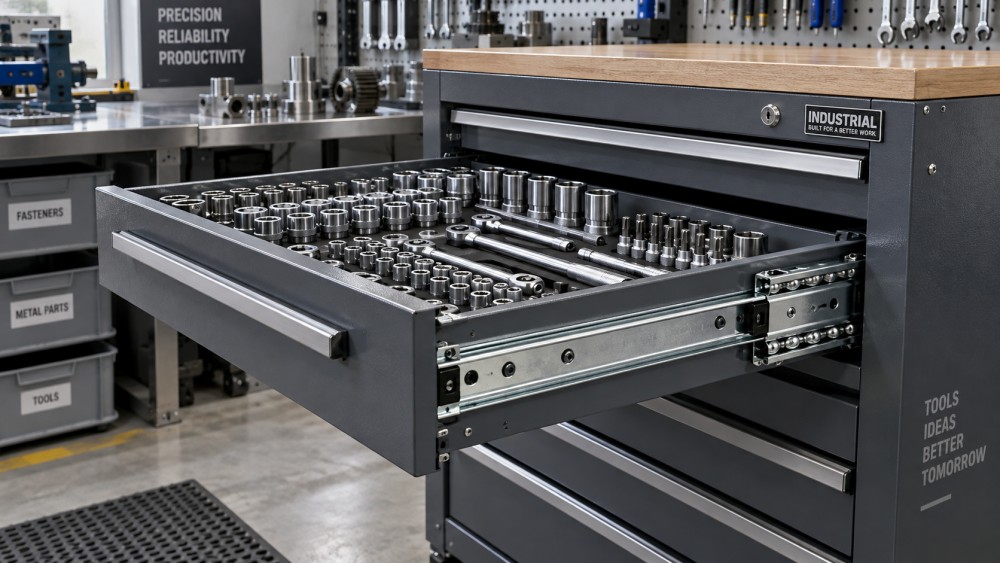
Load position also matters. Heavy items concentrated at the drawer front increase the moment when extended; uneven loading across the width can twist the drawer and load the two slides unequally. A wide drawer containing a dense tool block deserves a different assessment from a narrow drawer with the same total weight spread evenly across its base.
The cabinet and fixing points can be weaker than the slides
A higher-rated slide cannot compensate for a flexible cabinet side, weak drawer joints, or inadequate screw engagement. The load path runs from the contents through the drawer, slides, fasteners, cabinet, and ultimately its supports or anchorage. Each connection must remain secure.
Side-mounted slides require the clearance specified by their manufacturer. Too little clearance can preload the mechanism and increase opening resistance. Too much can distort the assembly or prevent proper engagement. Do not assume that all slides of the same nominal length share the same width or mounting envelope.
Parallel mounting is equally important. Misaligned slides may allow an empty drawer to move while causing binding under load. Cabinet squareness, slide height, and mounting surfaces should therefore be checked before blaming the mechanism for difficult operation.
Fasteners must suit both the slide instructions and the substrate. A fixing suitable for a steel cabinet is not automatically suitable for particleboard. Thin sheet metal may need reinforced mounting points, while wood-based panels require appropriate screw engagement and edge distances. Slotted holes can assist alignment, but the final fixing arrangement should follow the manufacturer's requirements.
Drawer stiffness deserves attention too. A sagging bottom or twisting box can alter slide alignment during use. For wide, heavily loaded drawers, increasing slide capacity alone may leave the underlying structural problem unresolved. Reinforcing the drawer or reducing its width can be more effective than selecting the next capacity class.
Choose operating features for the actual hazard
Soft-close, hold-in, lock-in, and lock-out functions address different problems. Soft-close controls part of the closing movement; it is not evidence of higher load capacity or a substitute for a positive lock. Confirm that the mechanism works with the intended loaded weight and opening force.
A hold-in detent resists unintended opening but is not necessarily equivalent to a positive lock. Lock-in hardware can be relevant where drawers must remain closed during movement. Lock-out hardware keeps an extended drawer in position, which may be important when someone accesses equipment or works from a pull-out platform. Check how the lock releases and whether that action remains practical under load.
Mobile cabinets need particular care. Rolling over uneven floors can introduce shocks, and an unsecured drawer can move unexpectedly. Slides approved for stationary furniture should not be assumed suitable for transport conditions without supporting specifications.
Cabinet tipping is a separate issue from slide strength. A slide pair may support an extended drawer while the cabinet overturns because its center of gravity has shifted. Where several heavy drawers can open together, assess anchorage, base geometry, and the need for a drawer interlock. Position locks on individual slides do not automatically provide anti-tip protection.
Environment and service life can change the preferred option
For dry indoor storage, a specified plated-steel slide may provide an appropriate balance of cost and performance. In damp, washdown, or chemically exposed locations, material and finish selection becomes more demanding. Stainless steel is not universally resistant to every exposure, and some assemblies combine different materials in their bearings, retainers, and locking components.
Compare the complete assembly’s corrosion suitability, not just the visible rail material. A corrosion test result can help evaluate a finish, but it does not directly predict years of service in every operating environment.
Dust and chips create another distinction. Exposed bearing tracks can collect debris that affects movement and wear. Determine whether shielding, cleaning access, or a different slide arrangement is necessary. Use only approved lubrication and cleaning methods; an unsuitable lubricant can attract contamination or interfere with existing components.
Duty cycle matters alongside capacity. A rarely opened stock drawer and a tool drawer opened repeatedly throughout a shift can have the same weight but different durability requirements. Ask for cycle-test conditions at a relevant load, and check what the supplier defines as acceptable performance after testing. Merely completing a number of cycles does not explain allowable play, operating force, or damage.
Make supplier comparisons specific enough to verify
A useful specification identifies the exact slide model and length, maximum loaded drawer weight, drawer dimensions, mounting orientation, required travel, operating environment, and any locking function. It also records the cabinet and drawer materials. Without these details, quotations can appear equivalent while describing substantially different products.
Request a dimensional drawing and technical data for the quoted part number. Supporting information should identify load-rating conditions, installation requirements, cycle-test conditions, and any applicable restrictions. A catalog maximum for a product family is not sufficient evidence for every variant.
For recurring production, approve the slides in a representative cabinet rather than evaluating loose hardware alone. Check movement at the intended load, access at full extension, deflection, mounting security, and operation of locks or closing mechanisms. This assembly check complements—not replaces—documented durability testing.
Replacement compatibility also affects cost. A lower-priced slide may require a different drawer width, fixing pattern, or mounting bracket. Compare the installed arrangement and the availability of the approved part, not just unit price. Record critical dimensions and restrict substitutions that change fit or performance.
The strongest selection is a slide whose documented capability matches the loaded drawer in its actual installation. If two options both meet that requirement, better access, lower deflection, dependable locking, and repeatable fit are more useful distinctions than an unnecessarily large headline load rating.
Related News
- 00
0000-00
How does order volume affect the price of self-adhesive label materials? - 00
0000-00
How backlash affects precision mechanical transmission accuracy - 00
0000-00
How Do You Choose Drawer Slides for Heavy Storage? - 00
0000-00
Choosing a Gearbox for Automation Systems: Torque, Backlash, and Duty Cycle - 00
0000-00
What to verify before choosing a furniture connectors supplier
Weekly Insights
Stay ahead with our curated technology reports delivered every Monday.