





A door handle can match the design brief yet arrive with the wrong spindle, an incompatible latch, or fixings that cannot secure it to the door. On a refurbishment, those mistakes may require additional drilling or replacement parts; on a new project, they can delay installation across multiple openings. Buyers should check physical fit, operating function, safety requirements, durability, and the complete supply package before comparing prices.
The most reliable approach is to approve a door-by-door hardware schedule rather than order from photographs or broad descriptions such as “commercial grade.” Confirm dimensions against the door and frame, compare documented performance for the intended application, and test a complete sample assembly where practical. A low unit price is not a saving if the hardware needs modification, fails inspection, or arrives without essential accessories.
Start with the opening, not the handle design
Two doors with the same appearance may need different hardware. An internal office door, a restroom door, an exterior entrance, and a designated escape door have different operating and safety requirements. Record the location and purpose of each opening before selecting a lock, hinge, closer, or handle set.
A useful hardware schedule identifies the door material, leaf dimensions, thickness, estimated weight, frame construction, opening direction, and required function. For replacement work, include photographs and measurements of existing preparations. Distinguish ordinary swing doors from sliding doors, double doors, and glazed doors: hardware designed for one configuration should not be assumed suitable for another.
Specify whether each door needs passage operation, privacy locking, keyed access, controlled access, or another defined function. Product names vary between suppliers, so describe what the hardware must actually do. For example, state whether users must be able to leave without a key, whether outside entry is restricted, and whether authorized staff need emergency access.
Physical compatibility: the measurements that prevent rework
Check dimensions using the supplier’s drawings, not only nominal size labels. A description such as “standard backset” does not establish compatibility across markets or existing installations. Record measurements in one agreed unit system and ask the supplier to confirm the exact configuration being quoted.
- Door thickness: Verify that the spindle, through-bolts, cylinder, and mounting components suit the finished thickness, including any relevant facing or reinforcement.
- Backset: Measure from the door edge to the relevant lock or handle centerline, following the product drawing. The wrong backset can move the operating hardware away from existing holes.
- Hole pattern and centers: Confirm bore diameters, fixing locations, handle-to-cylinder centers where applicable, and the size of any mortise pocket.
- Faceplate and strike: Compare their dimensions, corner shape, screw positions, and required recess depth. Check the strike against the frame preparation and latch location.
- Spindle and follower: Match the spindle profile, size, length, and engagement to the lock and handles. Similar-looking parts are not necessarily interchangeable.
- Clearances: Check that handles, hinges, and closers will not clash with trim, adjacent walls, glazing beads, or other doors.
Handing deserves separate confirmation. Suppliers may describe left-hand and right-hand doors using different viewing conventions. Send a simple plan showing the hinge side, opening direction, and the side from which the door is viewed. Ask whether the product is reversible on site or must be supplied in a specific hand.
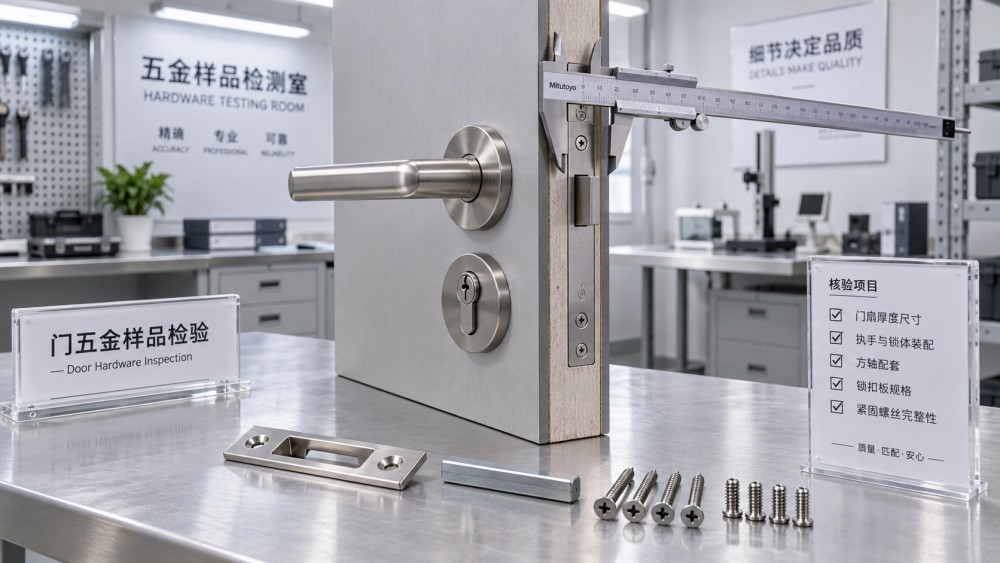
For replacement orders, a larger rose or backplate may cover old fixing marks, but coverage alone does not solve incompatible lock preparations. Request a dimensioned overlay or compare drawings before accepting a proposed substitute.
Compare mechanisms before comparing prices
The choice between lock types should reflect the opening and its existing preparation. Changing mechanisms may involve work to both the door and frame, so the purchasing comparison should include installation consequences.
Do not treat an exit device as simply another locking option. Its selection depends on the opening’s escape requirements and applicable rules. Likewise, adding an electric strike or powered lock changes the coordination needed among the lock, frame, power supply, controls, and emergency-release arrangements.
Request written confirmation of compatibility when sourcing components separately. A handle, lock body, cylinder, and strike can each be satisfactory individually yet fail to work together as a set.
Material and finish are separate purchasing decisions
Base material affects strength, corrosion behavior, weight, and how the component accepts a finish. Stainless steel, brass, zinc alloy, and aluminum are not interchangeable specifications. Their suitability depends on the component design, material grade, environment, and required service conditions—not simply the material name.
For humid, coastal, outdoor, or frequently cleaned locations, ask the supplier to identify the base material and explain the proposed corrosion protection. “Stainless finish” may describe appearance rather than construction. Similarly, a brass-colored handle may be coated alloy rather than solid brass.
Compare appearance samples with performance evidence
A plated finish, powder coating, physical vapor deposition coating, and exposed metal surface can behave differently under handling and cleaning. Ask what finish process is supplied and whether performance information applies to that exact finish on that exact product. A test result for another substrate or coating is not equivalent evidence.
Review corrosion and abrasion reports alongside the test method, acceptance criteria, and product identification. Laboratory exposure results are useful for comparison, but should not be converted directly into a promised outdoor service life.
Approve physical samples for color, gloss, texture, and visible workmanship. Compare handles, hinges, lock trim, and closers together under the intended lighting. Matching finish names across manufacturers do not guarantee a visual match. Record permitted variation and obtain cleaning instructions, especially where disinfectants or strong detergents will be used.
Duty, accessibility, and safety need different evidence
A lightly used residential opening and a busy commercial entrance place different demands on hardware. Ask for declared performance classifications and supporting documentation relevant to the product category. Terms such as “heavy duty” or “premium” are insufficient without a defined basis for comparison.
Cycle testing can help assess mechanical endurance, but it does not answer every question about security, corrosion, or accessibility. Compare suppliers against the same requirements and distinguish what was tested: a handle alone, a lockset, a hinge, or an assembled system.
For hinges, selection depends on door weight and dimensions, frequency of use, mounting arrangement, and loads introduced by closers or other equipment. Confirm the manufacturer’s selection guidance rather than choosing solely by hinge length. For closers, check capacity, mounting position, opening geometry, adjustment features, and interaction with seals and latches.
Accessibility requires checking the complete operating arrangement. Handle shape, operating force, closer adjustment, and maneuvering clearance can all matter. A lever handle alone does not establish that the opening meets applicable accessibility requirements.
Fire-rated and escape-route doors require project-specific verification. Establish which local requirements and approval documents apply, then confirm that the proposed hardware and installation are permitted for the particular door assembly. A component’s fire-related claim does not automatically authorize its use on every fire door. Refer unresolved substitutions to the responsible designer or qualified specialist before releasing the order.
Approve a complete sample, not just a loose component
A loose handle can demonstrate appearance and feel, but it cannot establish fit with the lock, strike, or door preparation. Where practical, assemble the sample on a representative door or test fixture using the intended components and fixings.
- Match the sample’s model, dimensions, material, finish, and included accessories to the quotation and drawing revision.
- Install it without unapproved drilling, improvised packing, or substitute fasteners. Record any mismatch requiring clarification.
- Operate the latch, lock, handles, and closer together. Look for binding, incomplete latch engagement, loose trim, poor handle return, or interference with seals.
- Check operation from both sides, including the intended locking, unlocking, and emergency-access functions.
- Retain the approved sample and record any agreed changes before production or shipment.
Sample testing is a fit-and-function check, not a substitute for required certification or endurance testing. It is particularly valuable when combining suppliers or reproducing an existing hardware arrangement. Ask whether bulk production will use the same construction and components as the approved sample.
Make competing quotations genuinely comparable
Compare the cost of a complete installed set, not isolated headline prices. One quotation may include the cylinder, strike, spindle, screws, and mounting plates; another may include only the visible handles. Request an itemized bill of materials for each door type.
Clarify minimum order quantities, finish-specific quantities, production lead time, dispatch timing, delivery terms, and packaging. Establish when lead time starts: order placement, deposit receipt, drawing approval, or sample approval. Confirm whether mixed finishes or keyed configurations affect availability.
For keyed hardware, define the required keying arrangement, number of keys, identification method, and any master-key requirements before ordering. Keep sensitive keying records controlled rather than placing them in general shipment documents.
Warranty terms should state coverage, exclusions, claim procedures, and responsibility for replacement freight. Ask about spare parts and whether cylinders, springs, seals, or other serviceable components remain available. A replaceable wearing part may reduce maintenance disruption compared with replacing an entire set.
Define what will be accepted on delivery
Put the approved drawing revisions, finish sample reference, models, functions, quantities, and accessory list into the purchase order or attached specification. Require written approval before substitutions to materials, mechanisms, finishes, or included parts.
Agree how deliveries will be labeled and inspected. Cartons should identify the hardware set or door reference where needed, with finishes protected against abrasion during transit. Receiving checks should verify quantities, configurations, visible condition, and completeness; dimension and function checks should follow the agreed sampling approach.
Hold an order when a critical fit dimension, operating function, or required approval remains unresolved. Cosmetic details can sometimes be settled through sample approval, but uncertainty about escape operation, fire-door compatibility, or lock preparation should not be left for installers to resolve after delivery.
Related News
- 00
0000-00
264 Chaozhou Firms Showcase Quality Home Products at Canton Fair Phase Two - 00
0000-00
What load tests should a mechanical power transmission manufacturer run? - 00
0000-00
How to compare equipment performance under matching test conditions - 00
0000-00
140th Canton Fair Phase One Closes with Record Overseas Buyer Attendance - 00
0000-00
How to prevent delamination in laminated flexible packaging films
Weekly Insights
Stay ahead with our curated technology reports delivered every Monday.