





A well-engineered PVD finish over a corrosion-resistant base is one of the strongest choices for exterior door hardware when the priority is keeping a decorative color intact. For coastal exposure, uncoated, properly finished and passivated 316 stainless steel is often the more dependable choice because its corrosion resistance does not rely on a decorative coating remaining undamaged. Neither option is universally best: the complete material-and-finish system matters more than the finish name.
The distinction is between lasting mechanically and looking unchanged. Solid brass can remain serviceable while developing a dark patina. Stainless steel can retain its strength while showing surface staining. A plated handle can look excellent until corrosion begins beneath a scratch. Choosing the longest-lasting option therefore starts with defining what failure means: discoloration, coating loss, visible rust, or loss of function.
Compare the material-and-finish system, not just the color
Descriptions such as “satin nickel,” “polished brass,” and “matte black” describe appearance, not a complete specification. Satin nickel might be nickel plating on brass or on zinc alloy. A brass-colored surface might be lacquered brass, a PVD coating, or another decorative coating. Matte black can be produced by powder coating, liquid paint, or PVD, with very different outdoor performance.
Stainless steel, meanwhile, is a base material rather than a coating. Its natural protective surface film can reform after minor damage when conditions allow. Plating and paint protect differently: if a defect exposes a vulnerable substrate, corrosion can start at that point and spread beneath the surrounding finish.
Where PVD earns its durability advantage
Physical vapor deposition, or PVD, creates a thin coating under vacuum. Door hardware commonly uses hard decorative compounds to produce metallic tones and other colors. These surfaces can resist the repeated rubbing that gradually dulls softer coatings, making PVD particularly relevant to handles and levers touched many times each day.
The strongest case for PVD is therefore not simply “weatherproof hardware.” It is hardware that must preserve both appearance and resistance to everyday surface wear. A properly engineered PVD system can offer a favorable combination of hardness, color stability, and resistance to common handling exposure.
However, PVD is not a substitute for a corrosion-resistant construction. Its performance depends on the base metal, any intermediate plating, surface preparation, coating coverage, and adhesion. Thin coatings can contain microscopic defects, and recesses or complex shapes can be more difficult to coat uniformly. Corrosion at a defect can undermine an otherwise hard surface.
A specification that says only “PVD finish” leaves these variables unresolved. The useful questions are what material lies beneath it, whether the exact coating system is approved for exterior use, and what evidence supports performance in the intended environment. Different PVD colors may use different coating compositions, so results for one finish should not automatically be applied to an entire color range.
Why 316 stainless steel is a strong coastal choice
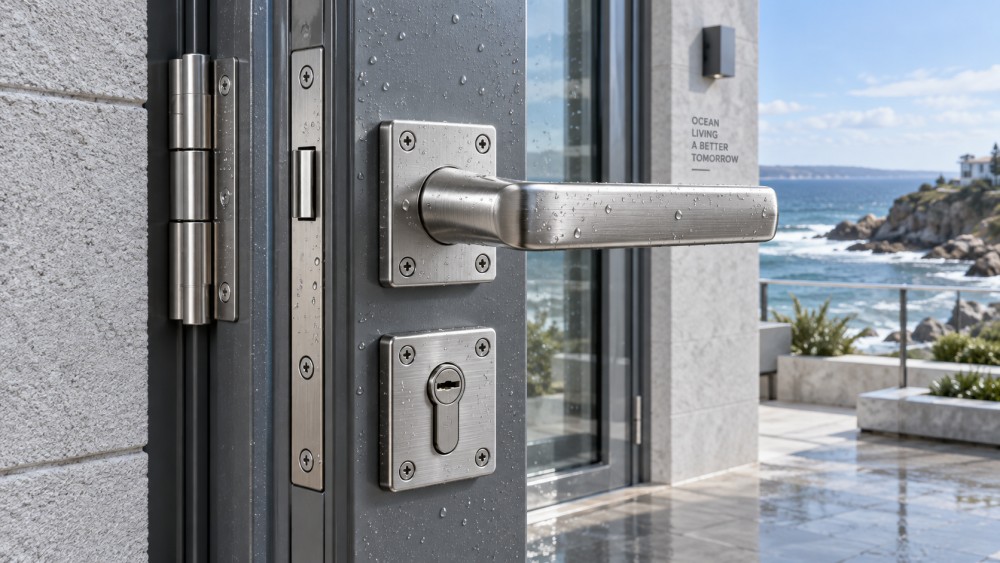
Salt changes the comparison. Chlorides can destabilize stainless steel’s passive film and encourage localized corrosion. The molybdenum in 316 stainless steel gives it greater resistance to chloride-induced pitting than 304, which is why 316 deserves serious consideration for doors exposed to marine air or salt spray.
This does not make 316 immune to corrosion. Salt deposits trapped beneath a rose, around a fastener, or inside a hinge joint can create conditions more severe than those on an open surface. A sheltered coastal doorway may receive little rain washing while still collecting airborne salt. Its hardware can therefore require more cleaning than its protected position suggests.
Fabrication and finishing also matter. Embedded iron contamination from tools or handling can produce rust-colored marks even on stainless components. Appropriate cleaning and passivation help establish a clean, corrosion-resistant surface. A smoother finish can make deposits easier to remove, although surface appearance alone does not establish material quality.
Check whether “stainless steel hardware” means the entire exposed assembly or only its visible cover. A 316 handle attached with unsuitable screws, or paired with a corrosion-prone spring and spindle, does not provide uniform protection. Exterior durability is limited by whichever exposed or moisture-accessible component fails first.
Brass, plating, and powder coating fail in different ways
Solid brass can outlast its original appearance
Uncoated solid brass develops tarnish and patina rather than the red rust associated with ordinary steel. Where changing color is acceptable, this can be a durable outdoor choice: there is no decorative topcoat that must remain intact to preserve a uniform appearance. But “brass finish” does not establish that the component is solid brass.
Lacquered brass serves a different purpose. The clear coating delays tarnishing and preserves the initial polished appearance. Once it wears through, cracks, or loses adhesion, exposed areas can darken while protected areas remain bright. Restoring a consistent appearance may require stripping and refinishing rather than simple cleaning. Severe environments can also attack certain brass alloys, so solid brass should not be treated as universally corrosion-proof.
Plated finishes depend heavily on the layers underneath
Nickel and chrome plating can deliver good performance when the substrate and coating layers are properly specified. The challenge is that a finish label reveals little about layer thickness, porosity, adhesion, or edge coverage. Two visually identical handles can consequently have substantially different resistance to outdoor exposure.
Substrate damage is especially consequential. If a plated steel component is scratched through to the base, rust can develop and lift the surrounding coating. Plated zinc-alloy hardware can also deteriorate where moisture reaches the substrate. Brass substrates avoid iron rust, but the plated system can still discolor or fail. Plating is not inherently unsuitable outdoors; unspecified plating is a weak basis for a durability decision.
Powder coating needs an exterior-grade system
Powder coating can provide a durable colored barrier, but the resin chemistry and pretreatment must suit the exposure. Exterior-grade polyester systems are commonly used where sunlight resistance matters. Epoxy-only powders are generally unsuitable for sustained outdoor UV exposure because they can chalk and lose appearance.
Sharp edges, screw holes, and contact points deserve particular attention. Coverage can be less effective at vulnerable geometry, and installation damage can expose the base metal. Repeated contact with keys, rings, or adjacent parts can also wear the coating locally. On a steel substrate, such damage can initiate underfilm corrosion; on a corrosion-resistant substrate, the consequences may be primarily cosmetic.
Powder coating is therefore a credible option for colored exterior hardware, but it should not be assumed to match a well-made PVD finish for touch-related wear or bare 316 stainless steel for tolerance of coating damage in salty conditions.
Exposure can reverse an otherwise reasonable choice
An inland entrance beneath a deep canopy places different demands on hardware than a seafront door exposed to wind-driven rain. Direct sunlight particularly affects organic coatings and clear lacquers. Frequent operation adds abrasion. Road deicing salts can create chloride exposure far from the coast, while pool chemicals can make nearby installations unexpectedly aggressive.
Water retention is another decisive variable. A finish may perform well on an exposed handle yet fail around a backplate where moisture cannot drain. Corrosion between dissimilar metals can also occur when an electrolyte such as salty water connects them. Compatible fasteners, suitable isolation, and installation details help prevent failures that changing the visible finish alone would not solve.
For an exposed inland entrance where decorative appearance is important, a documented exterior PVD system on a suitable substrate is a strong starting point. For significant salt exposure, 316 stainless construction deserves priority. For a sheltered entrance where an aged appearance is welcome, uncoated solid brass can be more forgiving than lacquered brass. These are application-based choices, not an absolute ranking by finish name.
What evidence makes a durability claim useful?
A credible specification identifies the substrate grade, coating system, intended exposure, and maintenance conditions. It should also distinguish decorative finish coverage from the construction of fasteners, hinges, lock components, and other vulnerable parts. A sample verifies color and feel; it does not establish long-term corrosion performance.
Laboratory corrosion testing can help compare controlled samples. ASTM B117 and ISO 9227 are recognized salt-spray test methods, but a reported number of hours is not a service-life prediction. It cannot reliably be converted into years outdoors. Results are only meaningfully comparable when test conditions, specimen preparation, damage or scribing, and acceptance criteria are understood.
Ask what constituted failure: visible corrosion, blistering, loss of adhesion, or another defined condition. Evidence for a flat test panel is less informative about crevices and assembly details than evidence for representative finished hardware. Where sunlight matters, corrosion testing alone also leaves color retention and chalking unresolved.
Warranty language provides another useful boundary. A long finish warranty may exclude coastal installations, chemical exposure, inadequate cleaning, or installations outside specified conditions. Its value depends on whether those conditions match the actual doorway, not simply on its duration.
Maintenance and replacement cost complete the comparison
No exterior finish should be treated as maintenance-free. Remove salt and dirt using fresh water and manufacturer-approved mild cleaners, then dry accessible surfaces. Avoid abrasive pads, steel wool, and aggressive chemicals unless expressly permitted. Stainless steel needs particular protection from chloride-containing cleaners and iron contamination; coated surfaces need cleaning that does not abrade the protective layer.
Cleaning frequency should follow exposure and deposit buildup rather than a universal calendar. Hinges, fixing points, and the edges of backplates need attention because those locations can retain contamination after the visible handle looks clean.
The financially durable option is not necessarily the lowest-priced or the hardest-coated handle. Replacement includes labor, matching adjacent hardware, disruption, and sometimes refinishing the door around changed fixing positions. Paying more for corrosion-resistant construction can be justified where replacement is difficult or appearance must remain consistent across multiple entrances.
The practical answer is conditional but clear: choose a verified PVD system when long-lasting decorative appearance is the leading requirement, and favor properly finished 316 stainless steel when chloride exposure and tolerance of surface damage dominate. Treat brass, plating, and powder coating according to their actual substrate and protective system. The finish that lasts longest is the one whose construction, exposure limits, and maintenance requirements match the doorway—not the one with the most reassuring color name.
Related News
- 00
0000-00
How to compare equipment performance under matching test conditions - 00
0000-00
140th Canton Fair Phase One Closes with Record Overseas Buyer Attendance - 00
0000-00
How to prevent delamination in laminated flexible packaging films - 00
0000-00
Fujifilm and ePac Partner Globally on Jet Press FP790 Deployment - 00
0000-00
Choosing technical ceramics for wear resistance under impact loads
Weekly Insights
Stay ahead with our curated technology reports delivered every Monday.