





Why Do Drawer Slides Fail to Close Smoothly?
Why do drawer slides fail to close smoothly? A drawer that sticks, stops short, or needs an extra push can signal misaligned runners, loose fasteners, debris buildup, excessive loading, or a faulty soft-close mechanism. For furniture manufacturers, cabinet hardware buyers, and maintenance teams, identifying the cause helps prevent unnecessary replacements and recurring performance issues.
The difficulty is that different faults can feel almost identical at the handle. A drawer that refuses to close may have damaged hardware, but it may also be rubbing against a cabinet opening that has moved out of square. Replacing the runners without checking the surrounding assembly can leave the original problem untouched.
The most useful starting point is not the slide’s brand or price. It is where resistance occurs, whether it changes with the load, and whether the drawer ever worked correctly.
The point of resistance tells you where to look
Move the drawer slowly without forcing it. Resistance throughout the stroke suggests a clearance problem, contamination, or distorted runners. A distinct catch at the same position suggests local interference: a protruding screw head, damaged track, misplaced bracket, or an object behind the drawer.
If movement is smooth until the final closing section, inspect the drawer front, rear clearance, and closing mechanism. Soft-close slides deliberately introduce controlled resistance when the damper engages. That resistance is not itself a fault; the problem is when the drawer stalls, fails to engage, or slams instead of completing a controlled close.
Also separate a failure to close from a failure to stay closed. A drawer that reaches its intended position but drifts open may indicate cabinet tilt, an engagement problem, or an unsuitable slide configuration. It needs a different investigation from a drawer that physically jams before reaching the cabinet face.
Misalignment often starts outside the slide
A pair of drawer slides must follow compatible paths through the full travel. If one runner sits higher, angles inward, or is mounted farther forward than the other, the drawer box forces the two sides to work against each other. Ball-bearing slides may tolerate some installation variation, but they are not designed to compensate for a twisted cabinet.
Check the cabinet opening at the front, middle, and rear. A correct front measurement does not prove that the sides remain parallel. Compare diagonals where accessible, inspect the drawer box for square, and check whether anchoring the cabinet to a wall has pulled the carcass out of shape.
Side clearance deserves particular attention. Too little space can squeeze side-mounted runners; too much can pull them outward or leave the drawer poorly supported. There is no universal clearance that suits every slide. Use the installation drawing for the exact model, including any specified tolerances and mounting orientation.
Undermount slides have different checks. Drawer dimensions, bottom recesses, rear preparation, and locking devices must match the hardware requirements. A drawer that looks correctly positioned at the front can still be incorrectly seated at the rear.
For visual inspection, compare both runner positions, their mounting points, and the gaps around the drawer box—not just the visible alignment of the decorative front.
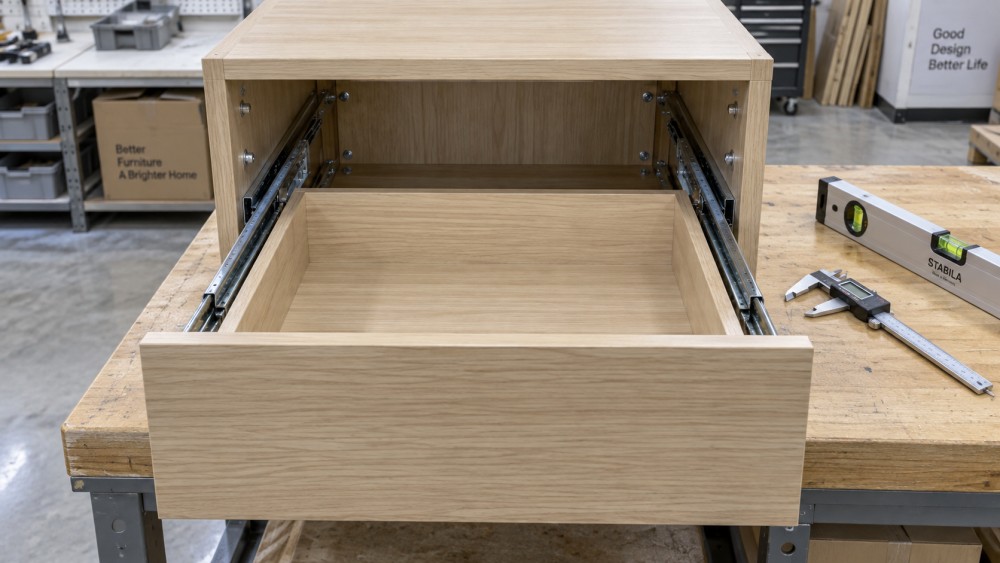
Adjustable mounting slots can help establish alignment before final fixing. Follow the manufacturer’s fastening sequence: leaving essential fixing points unsecured may allow an initially smooth drawer to shift after repeated use.
Fasteners can create interference as well as prevent it
A loose screw allows movement, but the wrong screw can cause binding even when tight. Check head shape, head height, length, and compatibility with the designated mounting holes. A protruding head can contact a moving slide member, while excessive tightening can distort a mounting surface or strip the substrate.
In particleboard or other relatively weak substrates, repeatedly tightening a stripped fixing rarely provides a durable repair. Restore the fixing using an appropriate approved method, or replace the damaged component. Thread-locking compounds are not a general solution for screws that have lost their grip in wood-based panels.
Load, drawer shape, and material movement change the picture
An empty drawer that closes smoothly but binds when filled points toward loading or deflection. Remove the contents and retest, then consider their distribution. Heavy items concentrated at one front corner can twist the drawer and place unequal demands on the runners.
The load rating is not simply the permitted weight of the contents. Check whether the supplier’s stated capacity includes the drawer’s own weight and whether it applies to a pair of slides. Slide length, extension, mounting orientation, drawer width, and test conditions may affect how that rating applies to the finished assembly.
A wider drawer also gives users more opportunity to pull off-center. Higher-capacity slides alone may not resolve racking if the drawer box lacks stiffness or the hardware is unsuitable for that width. Where required, consider a system designed for wide drawers rather than treating capacity as the only selection criterion.
Material movement can explain problems that appear months after installation. Moisture-related swelling, panel sag, or a distorted drawer bottom may consume the available clearance. Look for rubbing marks on the box, front, and cabinet opening. Those marks often reveal contact that is difficult to see while the drawer is moving.
Soft-close failure needs a separate diagnosis
Soft-close operation combines a pull-in action with damping. Depending on the design, a catch engages an actuator near the end of travel, a spring supplies closing force, and a damper controls speed. Failure in one part can produce a different symptom from failure in another.
- If the drawer never enters the controlled closing phase, check actuator alignment, seating, and engagement.
- If it engages but stops short, investigate friction and interference before assuming the spring or damper has failed.
- If it pulls inward but slams, inspect for a disconnected or damaged damping component.
- If one side engages differently from the other, check installation symmetry and whether the design uses one or two closing units.
Some mechanisms can become disengaged and have a manufacturer-defined reset procedure. Others require replacement. Do not improvise by pulling exposed catches with tools or opening a sealed damper. Confirm the model and service instructions first.
Push-to-open hardware adds another variable. Certain systems require a specified activation gap and a compatible closing arrangement. Combining unrelated push-to-open and soft-close components can create conflicting forces or insufficient travel. Verify compatibility rather than assuming that two useful features will work together.
Clean carefully, then inspect for damage
Sawdust, packaging fragments, dried finishing material, and other debris can enter the runners during production or installation. Remove loose contamination with a vacuum and a soft brush. Wipe accessible surfaces using a method compatible with the slide’s finish and plastic parts.
Lubrication is not a universal remedy. Many slides arrive with factory-applied lubricant, and some components should not receive additional oil. An unsuitable spray can wash away grease, attract dirt, or affect plastics. Use only the lubricant and application points recommended by the hardware supplier; keep it away from damping assemblies unless explicitly permitted.
After cleaning, inspect for bent members, corrosion, displaced bearing cages, loose rollers, and damaged stops. Scraping, uneven play, or repeated catching after alignment is corrected may indicate mechanical damage. Do not straighten load-bearing parts casually and return them to service, especially on heavy drawers.
A practical inspection sequence prevents unnecessary replacement
Start with the least invasive checks and change one condition at a time. Otherwise, a drawer may improve without anyone knowing why, leaving the same fault to recur elsewhere.
- Empty the drawer, remove obstructions, and note where resistance begins.
- Inspect surrounding gaps and contact marks; check cabinet stability and drawer squareness.
- Support and remove the drawer according to the release instructions. Use assistance for heavy assemblies, and respect any cabinet anti-tip or drawer-interlock provisions.
- Inspect fixings, runner alignment, debris, and visible damage. Moving a runner without the drawer can reveal local roughness, although it does not prove correct performance under load.
- Reinstall correctly, confirm locking-device engagement, and test empty before testing with a representative distributed load.
Record the original symptoms and the adjustment made. For production troubleshooting, also record the slide model, drawer dimensions, substrate, and fixing method. These details help distinguish an isolated damaged runner from a recurring assembly problem.
When the fault becomes a sourcing decision
Replace slides when confirmed damage or wear prevents reliable operation, or when the installed model cannot meet the application requirements. Replacement should address the cause. A stronger slide fitted into the same distorted opening may still bind.
For purchasing teams, the useful comparison extends beyond length and price. Request installation drawings, load-rating conditions, drawer-width limitations, fastening requirements, and maintenance guidance. Where durability testing is claimed, ask which method was used and whether the tested configuration represents your finished product. A cycle count without its loading and acceptance conditions is difficult to interpret.
Trial assemblies should use the intended drawer construction and representative contents. Check closing behavior after final cabinet installation, not only on a workshop bench. For ongoing supply, confirm whether replacement locking devices, brackets, or closing modules are available and whether specification changes are communicated.
The Global Industrial Finishing & Essentials (GIFE) connects furniture-hardware knowledge with related material, fastener, and supply-chain information. That cross-category perspective is useful here: smooth closing depends on the interaction between the runner, cabinet, fixings, load, and assembly process—not on one component in isolation.
Before ordering replacements, establish whether the problem follows the slide, the drawer, or the cabinet opening. That distinction is usually more valuable than choosing a higher specification without understanding what failed.
Related News
- 00
0000-00
How to verify adhesive product certification for your intended use - 00
0000-00
How does order volume affect the price of self-adhesive label materials? - 00
0000-00
How backlash affects precision mechanical transmission accuracy - 00
0000-00
Why Do Drawer Slides Fail to Close Smoothly? - 00
0000-00
How Do You Choose Drawer Slides for Heavy Storage?
Weekly Insights
Stay ahead with our curated technology reports delivered every Monday.