





Is Custom Industrial Hardware Worth the Higher Cost? A practical sourcing guide for manufacturers, product teams, distributors, and buyers evaluating bespoke components against standard alternatives.
Is custom industrial hardware worth the higher cost? Often, yes, but only when its total operational value exceeds the added tooling, engineering, purchasing, and supply-chain expense.
For a high-volume furniture line, packaging machine, office product, or industrial assembly, a tailored hinge, fastener, bracket, bearing housing, or latch can solve expensive recurring problems.
However, customization is not automatically a quality upgrade. A standard component may provide better availability, lower risk, proven performance, and stronger commercial flexibility for many applications.
The right decision requires teams to compare lifecycle cost, manufacturing impact, product requirements, annual volume, supplier capability, and the financial consequence of component failure.
This article explains where custom industrial hardware creates measurable value, where standard catalog parts remain preferable, and how sourcing teams can assess the investment before committing.
Start With Total Cost, Not the Unit Price
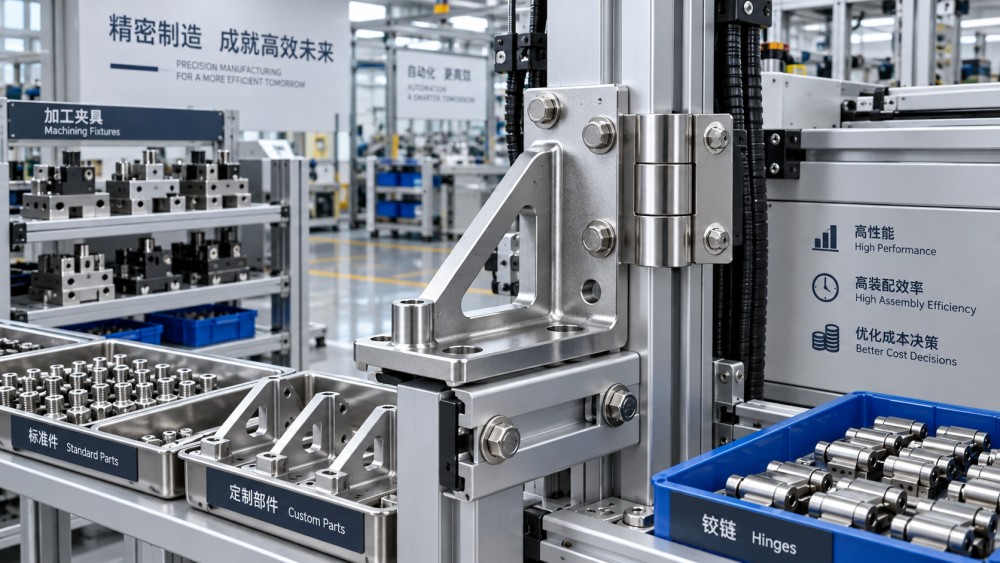
Custom hardware commonly costs more per piece because suppliers must absorb design work, material sourcing, prototypes, tooling, process validation, inspection planning, and smaller initial production runs.
That visible unit-price premium is important, but it is rarely the complete financial picture. Buyers should assess the component's effect on production, warranty exposure, inventory, service, and customer perception.
A standard drawer slide might be cheaper to purchase, for example, yet require additional brackets, manual adjustment, or secondary machining during cabinet assembly.
In that case, a custom slide with integrated mounting features may reduce labor time, eliminate parts, improve installation consistency, and lower the total cost per finished cabinet.
The same logic applies across electromechanical equipment, packaging systems, industrial adhesives, fastening products, and office furniture accessories, where installation errors can become significant hidden costs.
A useful comparison starts by separating purchase price from total landed cost. Landed cost includes freight, duties, packaging, handling, inspection, storage, scrap, and supplier-management effort.
Then calculate the broader cost of ownership. Include assembly labor, machine downtime, field returns, rework, replacement parts, lost production capacity, and the cost of delayed customer deliveries.
Custom industrial hardware is usually justified when it removes a repeatable operational cost or protects revenue at a scale large enough to recover the upfront investment.
When Custom Hardware Delivers the Strongest Return
Customization creates the most value when a component directly affects product function, assembly speed, durability, safety, regulatory compliance, or a feature customers can recognize and value.
Furniture manufacturers often benefit when custom fittings support thinner panels, concealed mounting, soft-close motion, unusual opening angles, higher load ratings, or a distinct visual finish.
For office furniture, a bespoke cable-management fitting or height-adjustment mechanism can simplify installation while helping a product meet ergonomic, stability, and user-experience expectations.
Packaging and printing operations may gain more from custom rollers, guides, clamps, shafts, or fasteners when standard parts cause alignment issues, film damage, inconsistent tension, or frequent changeovers.
In electromechanical applications, tailored housings, mounting plates, connectors, bearings, or sealing hardware can reduce vibration, improve thermal management, and protect equipment in demanding environments.
Custom fasteners are especially valuable where a standard screw, bolt, anchor, or nut creates assembly confusion, requires multiple operations, or fails under vibration, corrosion, or unusual loads.
Industrial adhesive and sealant selection can also become a custom solution question. A formulation or packaging format may reduce curing time, material waste, operator exposure, or application defects.
In each situation, the business case becomes stronger when the customized item solves a documented problem rather than merely making a finished product appear more specialized.
Volume Determines Whether Tooling Can Be Recovered
Annual volume is one of the clearest decision factors because tooling, engineering, and qualification costs must be spread across the expected life of the component.
A custom die-cast handle, stamped bracket, injection-molded fitting, or cold-formed fastener may require meaningful upfront expenditure before the first approved production batch is delivered.
For low-volume products, that expense can overwhelm any unit-level saving. Standard hardware, modified catalog parts, or limited secondary machining may be commercially more sensible.
For stable, repeatable demand, the calculation changes. Once tooling is amortized, a custom part may approach standard pricing while delivering savings elsewhere in the production process.
Teams should use realistic demand estimates instead of optimistic forecasts. Consider expected annual sales, product life, replacement demand, regional variants, and the possibility of design changes.
Break-even analysis should compare all incremental costs with all recurring savings. This includes tooling amortization, engineering hours, supplier qualification, assembly-time reduction, and avoided quality losses.
For example, a component that saves twenty seconds of labor per unit can create substantial annual value in a high-throughput line, even when its purchase price is higher.
Conversely, a low-volume premium product may justify custom hardware for differentiation, but its decision should be based on margin protection and market positioning rather than manufacturing savings.
Product Performance Can Matter More Than Purchase Savings
Hardware should be evaluated as part of a system. Its dimensions, tolerances, coating, material grade, load capacity, surface finish, and installation method influence overall product reliability.
A custom component can be designed around actual stresses and use conditions instead of forcing engineers to compromise around the limitations of available catalog hardware.
That matters where products face moisture, chemicals, repeated impact, heavy loads, outdoor exposure, vibration, heat, or frequent opening and closing cycles.
Material selection is particularly important. Stainless steel, zinc alloy, aluminum, brass, carbon steel, engineering plastics, and coated materials differ substantially in cost, durability, appearance, and manufacturability.
A lower-cost standard component may corrode early or deform under load. The result can be field failures that cost much more than the original hardware price difference.
Custom finishing also has practical value. Powder coating, electroplating, anodizing, passivation, polishing, and specialized surface treatments can improve corrosion resistance, wear behavior, and visual consistency.
Buyers should ask suppliers for relevant test data, including salt spray performance, cycle testing, pull force, torque resistance, load ratings, dimensional inspection, and coating-thickness records.
Performance claims should be tied to the actual application. A part proven for light indoor furniture may be unsuitable for industrial equipment or high-use commercial installations.
Custom Design Can Improve Assembly and Reduce Errors
Manufacturing efficiency is frequently the most underestimated reason to specify custom industrial hardware. Small geometric changes can remove multiple assembly steps across thousands of finished units.
A locating tab, captive fastener, asymmetric shape, pre-applied adhesive, integrated washer, or poka-yoke feature can make correct installation faster and more repeatable.
These features reduce reliance on operator judgment, especially where labor turnover is high or production involves several variants sharing similar-looking components.
Custom parts can also reduce the bill of materials. Combining two brackets, a spacer, and several fasteners into one engineered component can lower picking, handling, and inventory complexity.
Yet part consolidation requires careful review. A highly integrated component may be difficult to replace during service, may increase tooling risk, or may create costly waste when one feature changes.
Production engineers should map the existing assembly sequence before requesting a custom design. The best opportunities are bottlenecks, defect-prone steps, awkward access points, and recurring rework areas.
Measure actual labor time and defect rates rather than relying on anecdotal feedback. A documented baseline makes it possible to quantify the return after the custom part enters production.
Prototype trials should involve line operators, quality teams, maintenance staff, and service personnel. Their feedback often identifies practical issues overlooked during initial engineering reviews.
Customization Also Creates Supply and Change Risks
Custom hardware can increase supplier dependence because the buyer may own a design but still rely on one factory's tooling, processes, material sources, and undocumented production knowledge.
This risk is manageable, but it should be addressed before production approval. The sourcing team needs clear ownership, technical documentation, quality requirements, and contingency plans.
Confirm who owns the drawings, molds, dies, gauges, test fixtures, and intellectual property. Contract language should specify access rights if the supplier relationship changes.
Lead times may also be longer than for standard products. Custom material procurement, tooling maintenance, capacity scheduling, and inspection requirements can affect both initial launch and replenishment orders.
Minimum order quantities deserve equal attention. A supplier may offer an attractive unit price only when buyers commit to inventory levels that create obsolescence or cash-flow risk.
Design changes become more expensive after tooling is released. Before authorizing production tools, teams should verify adjacent components, installation methods, packaging, labels, and regional compliance requirements.
Dual sourcing is not always practical at launch, but buyers can reduce exposure by retaining complete specifications, approving critical raw materials, and identifying potential alternative manufacturing processes.
For strategically important hardware, consider maintaining safety stock of finished parts or critical raw materials. The correct approach depends on lead-time volatility and the cost of production interruption.
When Standard Hardware Is the Better Business Choice
Standard hardware is usually preferable when the component is non-critical, demand is uncertain, the design may change soon, or equivalent catalog parts meet all functional requirements.
Catalog components offer proven specifications, faster sampling, established distribution channels, lower minimum orders, and more opportunities to compare suppliers on price, delivery, and quality.
They are particularly useful during early product development. Using standard hinges, handles, screws, bearings, or brackets can accelerate prototyping before the final product architecture is stable.
Standardization also helps organizations operating across multiple plants or regions. Common parts reduce training needs, simplify maintenance, improve purchasing leverage, and make inventory planning more predictable.
A hybrid approach often provides the best result. Customize only the interfaces that create differentiation or remove major production costs, while retaining standard fasteners and serviceable components elsewhere.
This approach protects the product's unique value without turning every component into a dedicated sourcing project. It also makes later redesigns less disruptive and less expensive.
A Practical Decision Framework for Sourcing Teams
Before requesting quotations, define the problem in business terms. State what the current hardware costs in labor, defects, warranty claims, lost capacity, customer complaints, or missed product requirements.
Next, establish measurable design targets. These may include load capacity, cycle life, corrosion resistance, installation time, torque range, allowable tolerances, appearance, packaging, and regulatory performance.
Request quotations from qualified suppliers using the same technical package. Compare tooling, unit price, minimum order quantity, lead time, material grade, finishing process, quality controls, and payment terms.
Do not select solely on the lowest quotation. A lower initial offer can conceal weaker tooling quality, inconsistent raw materials, insufficient inspection, or assumptions that will later generate engineering changes.
Ask suppliers to explain their manufacturing route. Stamping, forging, die casting, machining, injection molding, cold heading, and assembly each produce different cost structures and performance limitations.
Run prototype and pilot-production evaluations under realistic conditions. Test installation, fit, load, wear, corrosion, packaging durability, and interaction with surrounding materials before approving mass production.
Finally, calculate the expected payback period under conservative volume assumptions. Include a risk allowance for design changes, delayed launches, quality escapes, and supply interruptions.
A custom project is commercially credible when stakeholders can explain exactly which recurring costs or market benefits will repay the investment and when that repayment should occur.
Conclusion: Pay More Only for Measurable Value
Custom industrial hardware is worth the higher cost when it improves product performance, streamlines manufacturing, reduces recurring failures, supports differentiation, or solves a documented supply or compliance requirement.
It is not worth pursuing simply because customization sounds premium. The strongest decisions connect engineering features to measurable commercial outcomes and use realistic assumptions about volume and risk.
For manufacturers and sourcing professionals, the key question is not whether bespoke hardware costs more today. It is whether it produces a lower total cost and stronger product tomorrow.
By comparing lifecycle cost, operational savings, tooling recovery, supplier resilience, and customer value, buyers can choose standard or custom components with greater confidence and clearer financial discipline.