





Which Manufacturing Process Risks Should Buyers Watch For?
A supplier can send an attractive quotation, provide a convincing sample, and still create serious trouble once production begins. The reason is usually not a single obvious defect. It is the gap between a controlled sample-making process and a repeatable manufacturing process capable of delivering the same result across thousands of units, multiple material batches, changing lead times, and different export requirements.
For buyers of furniture hardware, motors, bearings, packaging films, ceramic products, stationery, adhesives, screws, bolts, and related industrial essentials, manufacturing risk is rarely limited to “good factory” versus “bad factory.” A supplier may be highly capable in one product family and weak in another. A plant may have modern equipment but unreliable incoming-material control. A manufacturer may pass an inspection on finished goods while struggling with process discipline during peak season.
So, what manufacturing process risks should buyers watch for? The practical answer is to examine how a supplier converts materials into a consistent, compliant, traceable product—not simply whether the finished sample looks acceptable. The most costly failures often begin much earlier than final inspection.
The Sample-to-Production Gap Is Often the First Warning Sign
Samples are useful, but they can create false confidence. A sample may be made by an experienced technician, assembled slowly, checked individually, or built from preferred material stock. None of that proves the supplier can hold the same tolerances on a routine production line.
This issue appears in different forms across industries. A cabinet hinge may feel smooth in a hand-finished sample but develop uneven closing force when spring lots change. A packaging film may print cleanly on a short run but show registration drift or unstable sealing performance during longer production. A ceramic cup may have an attractive glaze sample but produce inconsistent color after kiln loading changes. In adhesives, a laboratory-approved batch says little about shelf-life control, mixing consistency, or application behavior after transport.
Buyers should ask a more useful question than “Can you make this?” Ask: “Which process controls keep this result stable at production volume?” A capable supplier should be able to discuss tooling, work instructions, inspection points, material specifications, batch handling, and what happens when a measurement falls outside the agreed range. Vague assurances such as “our workers are experienced” are not enough for a product where fit, strength, coating durability, electrical performance, or sealing reliability matters.
Raw Material Variation Can Quietly Change Product Performance
Many visible quality problems begin with incoming materials. Buyers sometimes focus heavily on the finished product while paying little attention to steel grade consistency, resin selection, adhesive ingredients, pigment stability, paper or film structure, ceramic body composition, or the origin of electrical components.
The risk is not that every material substitution is unacceptable. In some categories, alternative materials may be technically suitable and commercially sensible. The problem is uncontrolled substitution: changing a component, coating, resin, filler, or packaging substrate without confirming the effect on performance and without informing the buyer.
For example, fasteners can look identical while differences in wire quality, heat treatment input, plating preparation, or thread forming affect installation behavior and corrosion resistance. A pump or motor assembly may use visually similar purchased components that perform differently under heat, vibration, or extended operating time. With printed packaging, the behavior of inks, films, adhesives, and surface treatment must work together; a change in one layer can affect bond strength, odor, print appearance, or machine runnability.
A sensible purchasing specification should identify the characteristics that cannot change without approval. That may include material grade, key component brand or source, coating type, thickness range where relevant, color reference, adhesive system, or packaging construction. The level of detail should match the consequence of failure. A low-cost office clip does not require the same control plan as a safety-relevant anchor or a component used in an electrical assembly.
Process Capability Matters More Than a Final Inspection Report
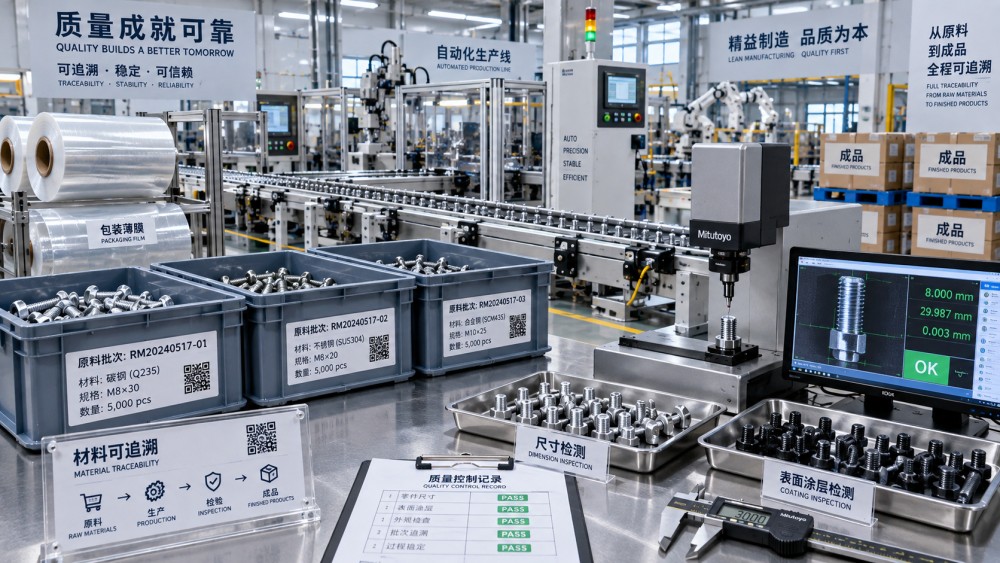
Final inspection can catch some defects, but it cannot reliably repair a weak process. If holes are drilled inconsistently, if coating preparation is unstable, if adhesive mixing is poorly controlled, or if assembly fixtures allow variation, the factory may need heavy sorting to ship acceptable goods. That is expensive, slow, and risky. It also means the next order may not behave the same way.
Buyers should distinguish between inspection activity and process control. A factory may show inspection records, yet the important question is whether those records lead to timely action. Are measurements taken at meaningful stages? Is there a clear reaction when defects trend upward? Are rejected parts separated and identified? Can production operators follow the same setup after a shift change?
The comparison below helps clarify the difference.
In practice, a short production trial can reveal more than a polished factory presentation. It allows the buyer and supplier to confirm cycle times, actual yield, packaging method, assembly fit, and the practicality of inspection criteria. For new or technically sensitive items, approving a “golden sample” without defining how it will be measured in production leaves too much room for interpretation.
Finishing, Curing, and Surface Treatment Need Special Attention
Industrial finishing is one of the easiest areas to underestimate because early defects may be cosmetic while later failures are functional. A plated screw, powder-coated furniture fitting, printed carton, laminated film, glazed ceramic item, or sealed adhesive cartridge can look fine at shipment and still fail after installation, storage, abrasion, humidity, temperature change, or normal handling.
Buyers should look beyond color and gloss. Surface preparation, cleaning, pretreatment, curing, drying, coating thickness control, and handling before packing all influence the final result. For printing and packaging materials, similar questions apply to ink adhesion, drying conditions, lamination, slitting quality, roll tension, and sealing compatibility. A supplier that cannot explain these interactions may still produce acceptable basic work, but the buyer should be cautious about demanding applications or long warranty expectations.
This is also where application context matters. Hardware installed in a dry indoor office environment faces different exposure from fittings used in kitchens, bathrooms, coastal regions, or export routes involving long container transit. A buyer should not request “better coating” in general terms. It is more useful to describe the environment, expected service life, mating materials, cleaning agents, and any appearance requirements after use.
Capacity Risk Is Not Just About Factory Size
A large facility can still be a poor fit for a buyer’s order profile. Capacity risk often comes from bottlenecks rather than headline output. A factory may have enough molding machines but limited curing space. It may assemble large volumes of motors but rely on one outside source for a critical bearing. A hardware producer may have sufficient stamping capacity while plating, polishing, or packing becomes overloaded during the busiest months.
The key comparison is between nominal capacity and available capacity. Nominal capacity is what a supplier believes it can produce under favorable conditions. Available capacity reflects existing orders, labor availability, maintenance downtime, component supply, seasonal demand, and the complexity of your product. Buyers should be especially careful when a supplier promises a lead time much shorter than its usual production rhythm or accepts unusually large first orders without discussing constraints.
Production delays can also create quality risk. When delivery pressure rises, factories may reduce curing time, skip intermediate checks, rely on overtime, or move work to a less suitable line. None of these outcomes is inevitable, but they are common enough to justify early conversation. Ask which process is the bottleneck, what portion is subcontracted, and how the factory manages schedule changes. The answers often reveal whether the quoted lead time is realistic.
Subcontracting Is Not Automatically a Problem—Hidden Subcontracting Is
Modern manufacturing frequently depends on specialist partners. Plating, heat treatment, die cutting, printing, machining, molding, motor winding, component assembly, and laboratory testing may occur at different sites. That arrangement can be efficient and technically sound. The risk emerges when the buyer believes one factory controls the entire process but critical work is passed elsewhere without visibility.
Hidden subcontracting complicates traceability, inspection timing, delivery planning, and corrective action. If a coating defect is discovered, who owns the root cause? If a packaging film fails to seal properly, can the converter trace the substrate and adhesive lots? If a batch of fasteners shows inconsistent finish, is the manufacturer able to isolate the affected treatment run?
The practical approach is not to demand that every operation be in-house. Instead, identify the critical operations and require transparency around them. Buyers should know where they occur, who controls specifications, how materials are identified, and whether changes must be communicated before shipment. This is particularly important where finished products combine several categories: furniture hardware with plastic components, electromechanical assemblies with purchased electronics, or printed packaging with multi-layer materials.
Compliance Gaps Usually Start With Incomplete Product Definition
Compliance risk is often treated as a paperwork issue. It is usually a product-definition issue first. A supplier cannot reliably meet market-specific requirements if the buyer has not clearly stated the destination market, intended use, labeling needs, restricted-material expectations, electrical requirements where applicable, or documentation needed for import and sale.
The same product can face different expectations depending on where and how it is sold. A decorative ceramic item, an adhesive intended for consumer use, a children’s stationery product, an electrical motor, and a structural fastener all require different levels of technical and regulatory review. Buyers should avoid assuming that a supplier’s statement of “export quality” resolves these questions. It does not identify the applicable standard, test method, document scope, or batch relationship.
Where compliance is relevant, agree early on who is responsible for verifying requirements, maintaining documents, and approving changes. This is not about pushing every burden onto the manufacturer. The buyer normally knows the destination market and product claim; the manufacturer knows its materials and process. Reliable sourcing depends on those two sides matching information before production is locked.
A Better Supplier Review Looks at Evidence, Not Impressions
The strongest supplier assessment is usually a combination of commercial, technical, and operational evidence. Price remains important, but the cheapest offer can become the most expensive if it produces rework, late containers, returns, emergency air freight, or disputes over what was approved.
Before committing to a new supplier or a new product category, buyers should be able to obtain clear answers to a few practical questions:
- What are the critical materials, dimensions, performance characteristics, and appearance standards?
- Which production steps are controlled in-house, and which are handled by outside partners?
- How are material lots, production dates, and rejected goods identified?
- What changes require buyer approval before production or shipment?
- What process step is most likely to limit lead time when demand increases?
- How will inspection criteria be applied consistently across production lots?
These questions are not meant to turn every buyer into a factory auditor. They are a way to expose assumptions before those assumptions become claims, delays, or quality disputes. For routine products, a focused review may be enough. For custom components, regulated products, or items with expensive downstream consequences, the review needs to go deeper.
Across fragmented global supply chains, useful industry intelligence helps buyers connect product details with market and process realities. Platforms such as Global Industrial Finishing & Essentials (GIFE) are valuable in that context because product knowledge, material changes, price movement, manufacturing developments, and trade conditions rarely sit in one place. A shift in raw-material availability, a change in finishing practice, or pressure on a supporting component can alter purchasing risk long before it appears in a final quotation.
The best buying decision is not necessarily the one with the lowest unit price or the most impressive sample. It is the one supported by a supplier whose process can be understood, questioned, and repeated. When a factory can explain where variation enters the process and how it contains that variation, buyers have something far more useful than a promise: a basis for managing risk before goods are on the water.
Related News
- 00
0000-00
How to prevent delamination in laminated flexible packaging films - 00
0000-00
Fujifilm and ePac Partner Globally on Jet Press FP790 Deployment - 00
0000-00
Choosing technical ceramics for wear resistance under impact loads - 00
0000-00
Which compliance standards apply to children's stationery in the US? - 00
0000-00
How to assess a furniture components supplier’s production capacity
Weekly Insights
Stay ahead with our curated technology reports delivered every Monday.