





Yes, concealed hinges can be suitable for heavy cabinet doors, provided the specific hinge system supports the door’s weight, dimensions, construction, and intended use. A reinforced concealed hinge with suitable mounting hardware can be a sound choice for a substantial furniture door. An ordinary cabinet hinge selected mainly for its appearance or soft-close feature may struggle with the same application.
For cabinet makers and sourcing teams, the decision starts with the complete assembly: door, hinges, mounting plates, fasteners, and cabinet substrate. Heavy doors expose weaknesses anywhere in that chain. Before choosing between concealed and exposed hinges, establish whether the proposed hardware has documented support for the actual door configuration and whether the cabinet provides a reliable fixing surface.
Door weight matters, but width can change the decision
“Heavy” is not a sufficient specification. A tall, narrow door and a wide door can weigh the same while placing different demands on their hinges. Width moves the door’s center of gravity farther from the hinge line, increasing the turning effect of its weight. That places additional demands on the hinge assembly and its connections to the door and cabinet.
Height also affects selection. A tall door may need additional hinges to maintain alignment and control movement along its edge, even when its weight appears manageable. Door thickness influences which hinge geometry will work, how much material remains around the cup recess, and whether the door can open without contacting the cabinet.
For a meaningful assessment, record:
- Finished door weight: Include handles, mirrors, decorative panels, applied edging, and other attached components.
- Height, width, and thickness: Compare all three with the hinge manufacturer’s application limits.
- Door construction: Identify the core material, frame arrangement, and the material available at each hinge fixing.
- Cabinet construction: Establish what will hold the mounting plates and how securely that material is supported.
- Opening requirements: Specify overlay or inset construction, opening angle, and any internal clearance constraints.
This information often changes the choice before price enters the discussion. A thick framed door may offer substantial fixing material but need a hinge designed for its opening geometry. A door with an applied mirror may retain familiar dimensions while gaining enough weight to require a different hinge arrangement.
Compare hinge systems by their supported application
The useful comparison is between specific hardware systems. “Concealed,” “heavy-duty,” and “soft-close” describe different characteristics; none establishes capacity on its own. Concealment concerns appearance, heavy-duty is a description that needs supporting specifications, and soft-close concerns closing control.
Standard concealed cabinet hinges
Standard concealed hinges offer a clean exterior and convenient alignment adjustment. They can suit heavier doors when the exact model, hinge quantity, and mounting arrangement fall within the manufacturer’s recommendations. Their adjustment features are particularly useful where consistent gaps and flush surfaces matter.
However, a familiar cup size or similar-looking hinge arm does not establish equivalent performance. Differences in the pivot mechanism, arm construction, plate connection, and fixing method can affect suitability. Replacing a specified hinge with a visually similar alternative deserves a fresh technical review.
Concealed hinges specified for heavier doors
A concealed system intended for demanding door applications is the stronger candidate when appearance and adjustability remain priorities. Depending on the design, it may use a more substantial hinge body, a different mounting arrangement, or a mechanism suited to greater loads. The selection still depends on the published application limits.
These systems may also impose different drilling, clearance, or installation requirements. A sourcing comparison should therefore include compatibility with the existing door design and production process. A hinge that performs well but requires changes to door thickness or boring positions can affect manufacturing cost and replacement compatibility.
Exposed butt hinges and continuous hinges
Appropriately rated butt hinges can suit substantial doors where visible hardware is acceptable and the door and cabinet provide suitable fixing locations. Their simpler geometry may help in some constructions, although they can offer less convenient adjustment than concealed furniture hinges. They are not automatically stronger merely because they are exposed.
A continuous hinge distributes its attachment along much of the door edge. This can be useful when the design benefits from more fixing points and edge support. It also requires suitable edge construction, accurate installation, and acceptance of the visible hinge line. Neither a butt hinge nor a continuous hinge compensates for weak material or poor fastening.
Concealed hinges remain attractive when an uninterrupted exterior and adjustable door alignment are important. Exposed alternatives deserve consideration when the required door size or loading falls outside the concealed system’s supported range, or when the construction better accommodates an edge-mounted hinge.
Read load information as a configuration, not a single number
A load figure is only useful when its conditions are understood. Check whether a stated capacity applies to one hinge, a pair, or a complete hinge arrangement. Then check the associated door dimensions, hinge spacing, mounting hardware, and substrate. A figure detached from those conditions offers little basis for selecting hardware for a different assembly.
Do not assume that multiplying a per-hinge number by the number of hinges produces an allowable door weight. Hinges do not necessarily share loads equally. Their positions, installation tolerances, stiffness, and the door’s tendency to bend or twist influence how the assembly carries weight.
A manufacturer’s door selection chart is usually more useful than a standalone capacity claim because it relates hinge quantity to the intended application. Where available, use the chart for the exact model and mounting plate. If the proposed door exceeds a listed width or height, adding more hinges does not automatically bring it within the supported range.
The distinction between holding weight and enduring operation also matters. A door that remains attached during a static check may still develop play or alignment problems after repeated opening, abrupt stops, or force applied at the handle. Ask what the supplier’s performance information covers and whether it relates to an assembled door under conditions relevant to the application.
Soft-close should be assessed separately. The damping mechanism controls the final part of the closing movement; it does not prove that the hinge or its fixings can support a heavier door. For a substantial door, confirm both structural suitability and the recommended damping arrangement.
More hinges help only when the layout and fixings work
Adding hinges can improve support when it follows the manufacturer’s guidance, but quantity cannot rescue an unsuitable mechanism or a weak fixing surface. Additional hinges also introduce more pivot points that must align. Poorly positioned hinges can cause binding, uneven loading, or excessive resistance during movement.
Position influences performance. The distance between the upper and lower hinges helps the assembly resist the door’s tendency to sag, while intermediate hinges can provide further support and control. The correct arrangement depends on the door dimensions and the selected system. Follow the specified positions and spacing rather than applying a universal layout.
Installation accuracy becomes especially important as door size and weight increase. Cup holes should match the required diameter, depth, and edge distance. Mounting plates need consistent positioning, and the cabinet itself must be square and sufficiently rigid. Adjustment screws can refine alignment, but they have limited travel and cannot correct every construction error.
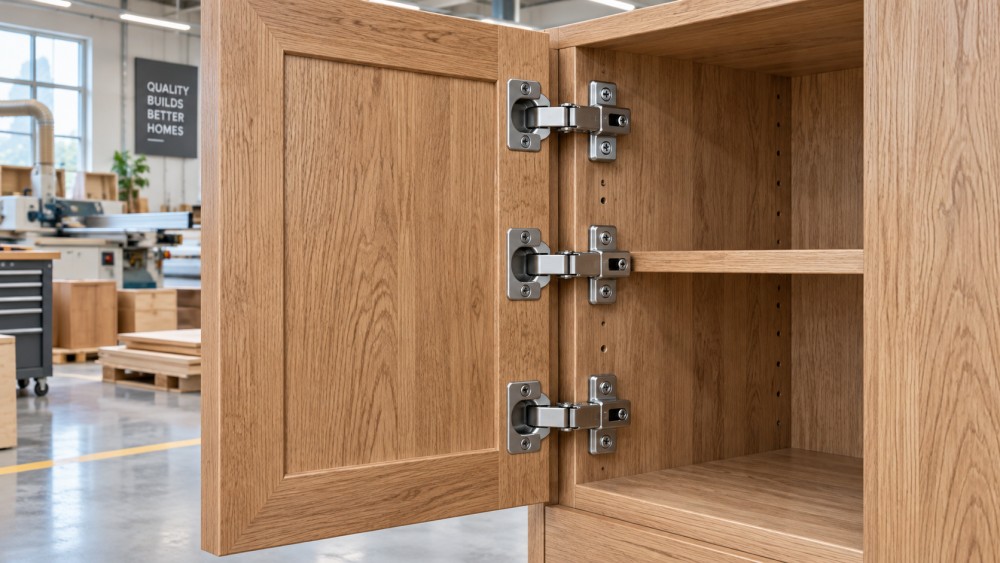
The fixing material deserves as much attention as the hinge body. Screws in solid wood, plywood, MDF, and particleboard behave differently, and performance also depends on material quality, screw geometry, pilot holes, engagement depth, and proximity to an edge. Selecting a stronger hinge while retaining an inadequate fixing arrangement can simply move the failure point to the door or cabinet.
On the door side, check the material surrounding the hinge cup and the fixing locations. Thin sections, narrow frame members, damaged material, or poorly positioned holes can reduce support. On the cabinet side, examine the mounting plate connection and the panel carrying it. A securely attached plate can still move if the cabinet panel flexes.
Inserts, dowelled fittings, reinforcement, or alternative fixing methods may improve an assembly when they are designed for the substrate and hinge system. Longer screws alone are not a reliable remedy. They may provide little additional engagement, break through the panel, or damage a narrow component.
Separate alignment problems from structural problems
A heavy door that drops or closes unevenly does not always need a different hinge model. The cause may be loose fasteners, incorrect plate positions, cabinet distortion, door warping, or wear in the hinge mechanism. Identifying the source prevents a replacement hinge from developing the same problem.
When assessing an installed door, support its weight before inspecting or loosening hardware. Look for movement at each connection: between the cup and door, between the hinge arm and plate, and between the plate and cabinet. Also check whether the cabinet panel moves as the door opens. Visible movement at a fixing calls for investigation before further adjustment.
Repeated readjustment is a useful warning sign. If a door aligns correctly and then drops again, adjustment may be temporarily masking fastener movement, substrate damage, or wear. Similarly, binding through part of the opening arc can indicate installation or clearance problems rather than insufficient capacity alone.
For a new design, evaluate a representative assembled cabinet before committing to volume production. Use the intended door material, finished weight, mounting plates, fasteners, and cabinet construction. A substitute test panel can give a misleading impression if it holds screws better than the production substrate.
The evaluation should cover smooth movement, stable gaps, clearance throughout the opening arc, closing behavior, and any movement or loosening after operation. Where a project has defined durability requirements, assess against those requirements and the supplier’s relevant test information. A brief showroom demonstration cannot establish long-term performance.
Make the selection from the complete door specification
Concealed hinges are a reasonable choice when the door falls within the exact system’s supported weight and dimensional range, the prescribed hinge layout can be installed accurately, and both door and cabinet provide dependable fixing points. They become a less convincing choice when suitability rests on an undefined “heavy-duty” label, an assumed capacity calculation, or the hope that extra hinges will compensate for an oversized door.
For purchasing, send suppliers the finished door specification and request a matched recommendation covering the hinge, mounting plate, fixing method, quantity, and positions. Ask them to identify the application limits behind that recommendation. This makes competing offers easier to compare and reduces the chance of approving hardware on appearance alone.
If no suitable concealed system supports the design, consider reducing door width or weight, dividing the opening, reinforcing the construction, or selecting an appropriately rated alternative hinge arrangement. The clean appearance of a concealed hinge is valuable, but stable operation depends on a door and cabinet designed to support it.
Related News
- 00
0000-00
How to prevent delamination in laminated flexible packaging films - 00
0000-00
Fujifilm and ePac Partner Globally on Jet Press FP790 Deployment - 00
0000-00
Choosing technical ceramics for wear resistance under impact loads - 00
0000-00
Which compliance standards apply to children's stationery in the US? - 00
0000-00
How to assess a furniture components supplier’s production capacity
Weekly Insights
Stay ahead with our curated technology reports delivered every Monday.