





Two products can perform the same function yet carry very different manufacturing costs. A cabinet handle with hidden fixings, a seamless equipment enclosure, or a custom-shaped package may look straightforward on a drawing but require extra tooling, difficult finishing, or slower assembly. Those requirements become visible when production quotations arrive—or when a prototype must be converted into repeatable production.
How does industrial design affect manufacturing cost? It determines much of the work needed to turn materials into a finished product: material grade, geometry, surface appearance, component interfaces, and assembly access. The economical design is not necessarily the simplest-looking one; it is the one that meets functional and visual requirements through a suitable, repeatable production process. Comparing concepts before their details are frozen helps separate valuable features from avoidable manufacturing expense.
Compare production cost, not just material price
Industrial design concerns a product’s form, usability, and appearance, but those decisions overlap with engineering and manufacturing. A curved housing can affect mold construction. A concealed joint can restrict tool access. A premium surface can change handling, inspection, and packaging requirements. Cost control therefore needs collaboration between design, engineering, and production—not a cosmetic review after engineering is complete.
A practical comparison separates recurring costs from one-time costs. Recurring costs include material consumption, machine time, purchased components, finishing, assembly, inspection, and expected scrap or rework. One-time costs include molds, dies, fixtures, programming, and production preparation.
Estimated manufacturing cost per acceptable unit = recurring batch cost ÷ acceptable units produced + allocated tooling and setup cost per unit.
This model exposes a frequent quotation problem: one concept appears cheaper because tooling is excluded, while another includes production preparation. Compare equivalent scope, batch size, quality requirements, and tooling ownership. Development spending and logistics can be assessed separately when the decision concerns total project economics rather than factory conversion cost alone.
Material and geometry must be evaluated together
A lower-priced raw material can produce a more expensive finished part. It may need thicker sections, protective coating, longer processing, or additional reinforcement to meet the same requirements. Conversely, a more expensive material may eliminate a finishing operation or support a simpler construction. The comparison should begin with required strength, stiffness, temperature resistance, chemical exposure, and appearance.
For a furniture fitting, switching between a formed steel part and a cast alloy component changes more than material price. It changes section design, tooling, finishing, and fastening details. Neither route is automatically cheaper. The answer depends on geometry, expected demand, load conditions, and the supplier’s equipment.
Features that look small can add complete operations
A recessed logo, a deep pocket, or a decorative edge may add little material but substantial processing. In machining, deep cavities and thin walls can restrict tool access and require slower cutting or extra setups. In injection molding, undercuts may require side actions or a different parting strategy. Uneven wall thickness can contribute to cooling differences and dimensional instability.
Sheet-metal designs face different constraints. Closely spaced bends, inaccessible fasteners, and features positioned near bend zones can complicate fabrication. A shape optimized for casting should not be assumed suitable for stamping or machining without modification.
During concept comparison, ask the manufacturer to identify features that require an additional setup, special tool, or secondary operation. These explanations are more useful than a single total price: they reveal which changes can reduce cost without changing the product’s purpose.
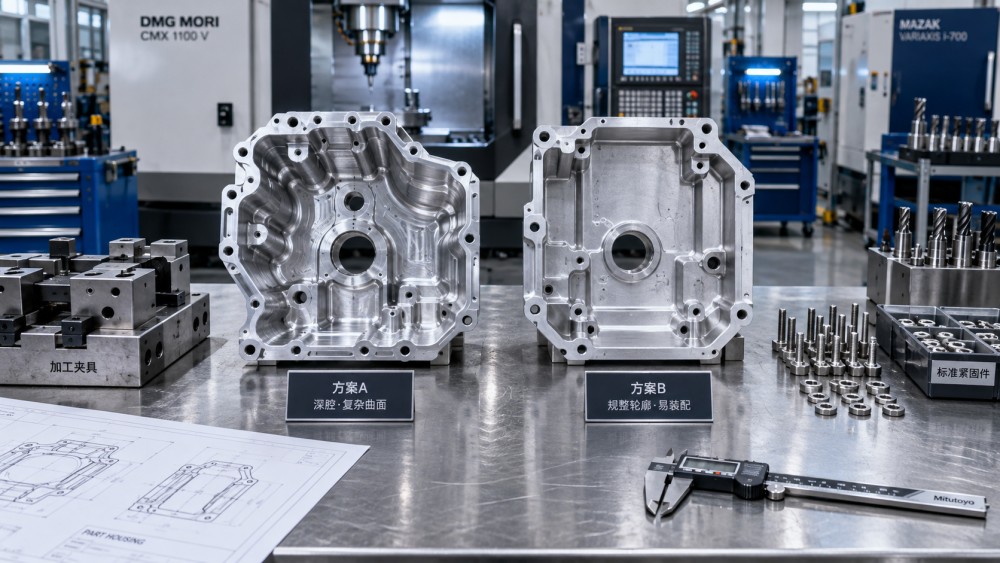
Prototype-friendly versus production-efficient design
A machined enclosure can be attractive for early development because dimensions can be revised without committing to a production mold. Once the design stabilizes, molding or casting may offer a different cost structure. The trade-off is between flexibility, tooling investment, and recurring production effort—not simply between an “expensive” and a “cheap” process.
At low or uncertain demand, flexible processes can avoid investment in tooling that may never be fully used. At sustained demand, dedicated tooling may become economical if it reduces cycle time and delivers acceptable quality. However, projected volume is not enough: cavities, maintenance, production yield, and design-change risk also affect the comparison.
A useful break-even calculation divides the additional fixed cost of a tooling-based route by its expected recurring cost saving per acceptable unit. It only applies if both routes meet the same specification and the assumed saving remains realistic. Obtain supplier-supported inputs rather than applying a generic volume threshold.
Demand uncertainty also has a design implication. Keeping interfaces stable while allowing an exterior panel or decorative insert to change can preserve production assets through product updates. A fully integrated shape may offer efficient assembly but force broader tooling changes whenever its appearance changes.
Tolerances and finishes: pay for what the product needs
Dimensions do not all deserve the same tolerance. A bearing seat, sealing interface, or locating feature may require close control. A non-contact cover surface may not. Applying tight tolerances across an entire drawing can increase machining time, inspection effort, and rejection without improving performance.
Start by identifying functional interfaces, then examine their tolerance stack. Several individually acceptable parts can still fail to assemble if their combined variation exceeds available clearance. Relaxing every dimension independently is therefore no better than tightening every dimension indiscriminately.
For an electromechanical enclosure, the position of mounting points may be more important than an external decorative radius. Datums and measurement methods should reflect how the product locates and functions. Where a tolerance materially affects price, request a comparison between the proposed specification and a justified alternative.
Surface finish requires equally explicit decisions. “Premium appearance” does not tell a supplier which surfaces are visible, which marks are acceptable, or how color and texture should be assessed. Ambiguity can lead to excessive finishing allowances or disputes over acceptable output.
- Identify visible surfaces separately from hidden faces.
- Specify finish requirements by zone rather than applying the strictest requirement everywhere.
- Define inspection conditions and acceptance criteria for cosmetic defects.
- Check whether coatings affect fits, threads, electrical contact, or bonding surfaces.
A polished surface can require preparation and protective handling that a textured finish does not. Texture is not automatically cheaper, though: tooling treatment, cleaning requirements, and appearance consistency still matter. Compare complete finishing routes, including masking, curing, inspection, and protection during assembly.
Fewer parts versus easier assembly and repair
Reducing part count often saves purchasing, handling, and fastening effort. Combining a bracket and cover into one component may remove an assembly step. Yet integration can also create a difficult-to-produce shape, increase tool complexity, or make the entire component unusable when one feature is defective.
The better comparison measures assembly work, not component count alone. A product with fewer parts can take longer to assemble if operators must reach into a narrow cavity, hold several features in alignment, or use a special fixture.
Look for assembly direction, access, and error prevention. Can components be loaded from one side? Are fasteners reachable with ordinary tools? Do locating features hold parts before tightening? Can similar components be installed incorrectly? These details affect labor time and the chance of rework.
Fasteners, snap-fits, and adhesives have different cost boundaries
Standard screws support controlled assembly and disassembly but require access and installation time. Snap-fits can remove separate hardware, yet depend on suitable materials, geometry, and dimensional control. Adhesive bonding can join dissimilar materials or avoid visible fixings, but may add surface preparation, dispensing, cure time, and bond verification.
No joining method is universally cheapest. Compare its complete production sequence and service requirements. A permanent bond may suit a sealed disposable assembly but be unsuitable where maintenance requires access. Likewise, an aggressive snap-fit reduction in assembly effort is not worthwhile if handling damage or inconsistent engagement raises rejection.
Design variation, yield, and packaging can change the result
A quoted cycle time assumes the process produces acceptable parts consistently. Designs with fragile edges, difficult-to-fill sections, distortion-prone surfaces, or challenging cosmetic requirements can lose their apparent cost advantage through scrap and rework.
Yield-sensitive comparisons should use the cost of acceptable units, not merely the cost of running a machine. For molded packaging, wall distribution can affect forming consistency and product protection. For ceramic products, shape and section transitions can influence drying and firing behavior. These effects require process-specific review rather than transferring rules from metal or plastic production.
Product geometry also affects protection and packing labor. Protruding hardware, easily marked finishes, and irregular shapes can require separate wrapping or custom inserts. Stackable or nestable designs may simplify handling, provided they do not introduce surface damage or make separation difficult. Assess these consequences before claiming savings from reduced material or fewer components.
Resolve the expensive decisions before design release
Cost reduction is easier when alternative concepts remain available. Once tools are built and interfaces are approved, changing geometry can require new validation, inventory decisions, and production disruption. A focused design review should use the following sequence:
- Establish non-negotiable requirements. Record loads, operating conditions, critical interfaces, appearance zones, and service access. This prevents cost reductions from quietly removing necessary performance.
- Compare realistic production routes. Ask capable suppliers to assess material, geometry, tooling, and expected demand together. Require them to identify expensive features and proposed alternatives.
- Normalize quotations. Align tolerances, finishes, batch quantities, tooling scope, inspection, and acceptable yield assumptions. Separate one-time spending from recurring cost.
- Review assembly and handling. Use a prototype or representative assembly to check access, locating, joining, finish protection, and packing. Prototype success alone does not establish production capability.
- Validate the selected changes. Confirm critical dimensions and performance using representative materials and processes before releasing production documentation.
Where a design change affects load-bearing parts, pressure containment, electrical protection, or another safety-related function, cost comparison cannot replace engineering verification. Material substitutions and relaxed tolerances must be assessed against the actual operating requirements.
The final choice should make its trade-offs explicit. Retain features whose functional or commercial value justifies their production burden; simplify those that add tooling, inspection, or assembly effort without a defined benefit. When two concepts remain close in estimated cost, give weight to the one with better-supported process capability and fewer unresolved manufacturing assumptions—not merely the lower initial quotation.
Related News
- 00
0000-00
How to prevent delamination in laminated flexible packaging films - 00
0000-00
Fujifilm and ePac Partner Globally on Jet Press FP790 Deployment - 00
0000-00
Choosing technical ceramics for wear resistance under impact loads - 00
0000-00
Which compliance standards apply to children's stationery in the US? - 00
0000-00
How to assess a furniture components supplier’s production capacity
Weekly Insights
Stay ahead with our curated technology reports delivered every Monday.